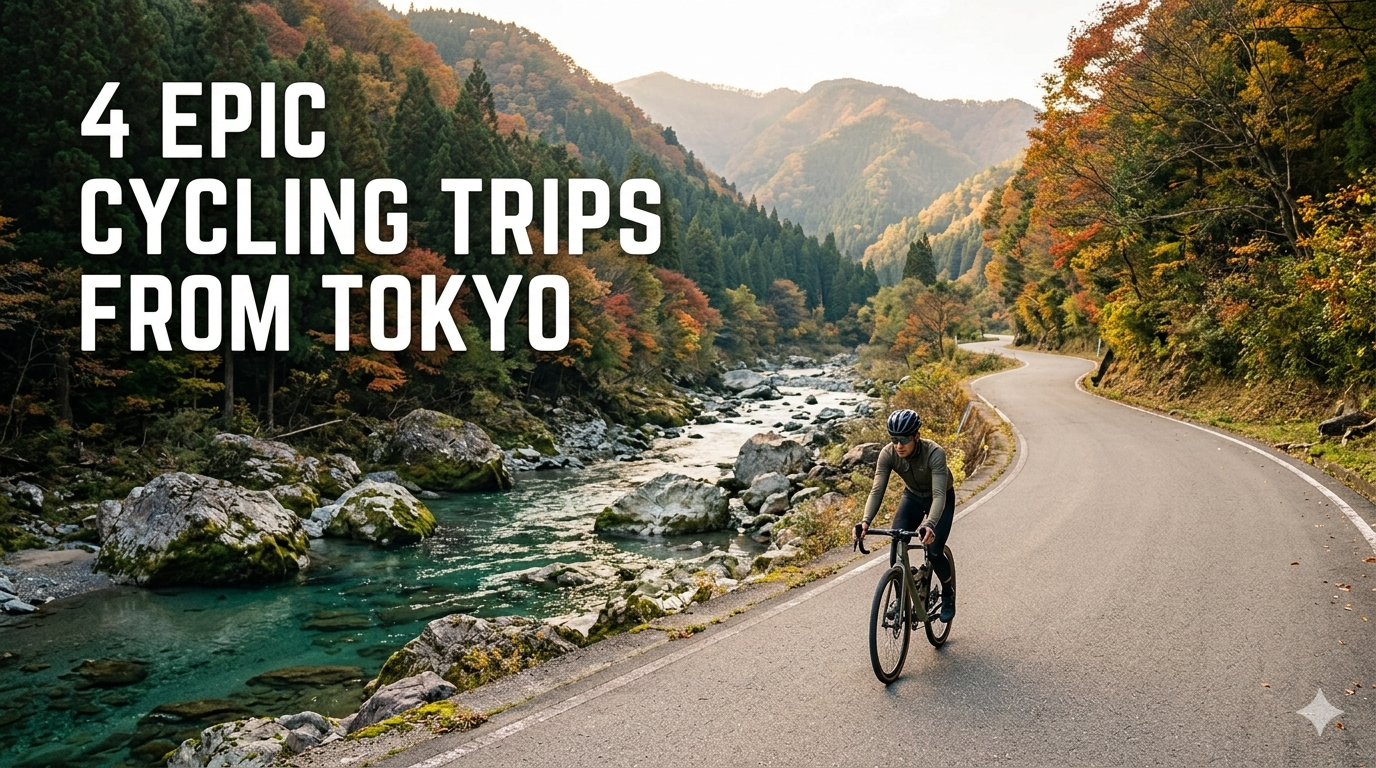
Picture this: You step off a train somewhere in Tokyo’s vast western reaches, take a deep breath of actual fresh air (yes, it exists!), grab a bicycle, and spend the next several hours pedaling through emerald-green river valleys, stopping at roadside stalls for hot croquettes, and wondering why you ever bothered with theme parks. Sound good? Then keep reading, because Japan’s day-trip cycling scene is one of the country’s most underrated pleasures — and you don’t need to be a spandex-wearing ultra-cyclist to enjoy it.
I live near the Itsukaichi / Akigawa Valley area in western Tokyo, and it was there that I truly fell in love with cycling in Japan. Rent a bike steps from the station, ride through the valley, devour a korokke (Japanese potato croquette) from a roadside shop, sip soba noodles at a mountain teahouse, and you’ve got yourself a perfect day. Once I discovered how easy all of this is, I started hunting for more spots — and there are plenty. Below, I’ll walk you through four fantastic cycling destinations, all reachable from central Tokyo in a day.
- 🚴 1. Itsukaichi & Akigawa Valley (Tokyo) — The Perfect Beginner’s Escape
- 🏔️ 2. Okutama (Tokyo) — For Those Who Want the Real Mountains
- 🌾 3. Arakawa Cycling Road — Yoshimi Area (Saitama) — Flat, Fast & Refreshingly Chill
- 🌋 4. Izu Oshima (Tokyo) — An Island Adventure That Will Blow Your Mind
- 🛠️ Essential Practical Tips for Cycling in Japan
- 📊 Quick Comparison: Which Spot Is Right for You?
- Final Pedal Stroke
🚴 1. Itsukaichi & Akigawa Valley (Tokyo) — The Perfect Beginner’s Escape
My home turf, and arguably the easiest cycling day trip from Tokyo. The Akigawa Valley stretches roughly 20 kilometres through Akiruno City and Hinohara Village, following the crystal-clear Akigawa River through forest-covered hills. It’s the kind of scenery that makes you want to double-check you’re still in Tokyo — and yes, you absolutely are.
Getting There
Take the JR Itsukaichi Line to Musashi-Itsukaichi Station, the final stop. From Shinjuku, it’s about 1 hour 15 minutes with a transfer at Haijima or Tachikawa. Straightforward, and your IC card (Suica / Pasmo) works fine on this route.
📌 Official cycling guide: Go Tokyo — Cycling the Akigawa Valley
What to Ride
Right outside the station is the Tokyo Ura-yama Base (TEL: 050-1417-6751), an outdoor centre where you can rent sport-type bikes and head straight into the wilderness. The route follows the Akigawa River upstream, with plenty of flat and gentle stretches perfect for a casual pace. You’re in no rush — the scenery demands frequent stops.
Don’t Miss
- 🍱 Korokke (コロッケ / Japanese Potato Croquette) — golden, crispy, slightly sweet, sold piping hot at small shops along the valley. Think of them as Japan’s answer to fast food, but actually delicious.
- 🍜 Soba (お蕎麦 / Buckwheat Noodles) — earthy, nutty noodles served cold or hot at teahouses tucked into the hillside. Perfect mid-ride fuel.
- 💧 The rivers here are some of the clearest you’ll see in the Kanto region — in summer, locals swim in them.
- ☕ After your ride, finish at do-mo factory blan.co inside the station building for craft beer, ayu (sweetfish) rice balls, and hydrangea tea soft-serve ice cream. Weird? Yes. Wonderful? Also yes.
E-bike available? ✅ Yes, check with Tokyo Ura-yama Base and nearby rental options in Hinohara Village (HINOHARIDE at Hossawa-no-taki Station offers power-assisted bikes for the hillier Hinohara routes).
Payment: Bring cash for roadside food stalls and smaller rental shops. Some larger shops accept IC cards or credit cards — it’s worth calling ahead to confirm.
🏔️ 2. Okutama (Tokyo) — For Those Who Want the Real Mountains
If Itsukaichi is a lovely Sunday stroll, Okutama is that stroll’s more dramatic older sibling who climbs volcanoes for fun. Deeper into western Tokyo’s mountain range, Okutama sits within the Chichibu-Tama-Kai National Park and offers some of the most jaw-dropping nature accessible by train from any major world city.
Getting There
Take the JR Ōme Line to Okutama Station (about 2 hours from Shinjuku). The train ride itself is scenic — as you leave the suburbs behind, the mountains close in around you like a very polite ambush.
Rental: Trekkling
Near Okutama Station, Trekkling is the gold-standard bike rental for this area, and it’s genuinely foreigner-friendly — they have an English-speaking British guide on staff. They offer e-bikes, gravel bikes, mountain bikes, and hybrids, with 73 bikes total. You’ll get a hand-crafted cycling map, a route briefing, and local food tips before you set off. Reviews consistently call it one of the best outdoor experiences near Tokyo.
📌 Official website: trekkling.jp
📌 Rental page: trekkling.jp/en/rental-en/
📌 Course options: trekkling.jp/en/cycling-course-en/
Recommended Routes
Trekkling offers four main courses:
- 🏞️ Course A — Old Road to Lake Okutama: Follow an Edo-era trade route that once carried charcoal and rice over the mountains. The road climbs gently to Lake Okutama, where you’ll find a panoramic reservoir lake set against steep forested ridges. Don’t miss the floating bridge (Mugiyama Hashi) — it’s exactly as surreal as it sounds.
- 🦇 Course B — Nippara Limestone Cave: A challenging uphill ride to one of the largest limestone caves in Kanto. E-bikes strongly recommended. The thousand-year-old cypress tree on the way is worth the climb alone.
- 🌊 Course C — Unazawa Valley Waterfalls: Called “Tokyo’s Yakushima” (that’s a big compliment in Japan), this mossy, cool forest valley is pure magic in summer.
- 🏘️ Course D — Down to Ōme: A one-way downhill ride along the Tama River to historic Ōme city, where you can drop the bike off at a partner shop. Sake breweries, Zen gardens, and antique museums await.
Hours: 9:00–17:00 (last rental at 15:00). Helmets: Free rental. Minimum height: 138 cm. Age: 12–69 (under 16 must be with a guardian).
Food & Drink
Trekkling staff will point you toward their favourite local spots. A few highlights: Vertere craft brewery near the station (perfect post-ride reward), Soba Tanzaburo for buckwheat noodles, and various riverside cafés along the routes. Cash is king up here — bring more than you think you’ll need.
E-bike available? ✅ Yes, and highly recommended for the hillier courses. Okutama is not flat. At all.
Payment: Book online via the Trekkling website. Online payment accepted. Bring cash for food stops en route.
🌾 3. Arakawa Cycling Road — Yoshimi Area (Saitama) — Flat, Fast & Refreshingly Chill
“I just want to pedal somewhere beautiful without dying on a hill.” Heard. This one’s for you. The Arakawa River cycling path in Saitama Prefecture is flat, wide, and largely signal-free — essentially a highway for bicycles where the speed limit is “however fast the wind takes you.”
Getting There
Take the Tobu Tojo Line to Higashi-Matsuyama Station (about 1 hour from Ikebukuro), then take a bus toward the Yoshimi area. Alternatively, the JR Takasaki Line to Kōnosu Station also works, with a short bus ride to the Michinoeki.
Rental Base: Michinoeki Ichigo no Sato Yoshimi
The 道の駅 いちごの里よしみ (Roadside Station Strawberry Village Yoshimi) is your starting point. This charming facility doubles as a cycle base where you can rent bikes, then fuel up on local strawberry sweets, Musashino udon noodles, and strawberry soft-serve before heading out.
📌 Official website: ichigonosato.com
The station specialises in Yoshimi strawberries — Saitama’s finest, and arguably Japan’s finest. Their ichigo nama dorayaki (fresh strawberry pancake sandwich with homemade jam and cream) is the kind of thing you’d eat three of if no one was watching. We’re not judging.
What to See Along the Route
- 🌸 Yoshimi Sakura Tsutsumi Park (吉見さくら堤公園): A riverside embankment with hundreds of cherry trees. In spring, it’s absolutely breathtaking — in summer, it’s all lush greenery and open sky.
- ⛩️ Yoshimi Hyakuana (吉見百穴 / The Hundred Holes of Yoshimi): History fans, prepare to geek out. This national historic site features 219 ancient burial caves carved into a hillside during the Kofun Period (late 6th to 7th century). The nickname “Japan’s Cappadocia” is a touch dramatic, but honestly not entirely wrong. Learn more here.
- 💨 The cycling path itself: Wide river levee roads with almost no traffic lights, a constant river breeze, and nothing between you and the horizon. Sometimes simple is best.
E-bike available? ⚠️ This area is primarily flat, so a regular bike works perfectly. Check with the Michinoeki for current rental options, as they do vary seasonally.
Payment: The Michinoeki accepts credit cards and IC cards for purchases, but check bike rental payment specifics directly with them.
🌋 4. Izu Oshima (Tokyo) — An Island Adventure That Will Blow Your Mind
We have to talk about Izu Oshima. Because when you tell people you spent the day cycling on a volcanic island — in Tokyo — and the confused faces start appearing, it’s one of the most satisfying moments a travel story can produce.
Yes, Izu Oshima is part of Tokyo. Yes, it’s an active volcano. Yes, you can cycle around most of it in a day. No, I’m not making any of this up.

Getting There
From Takeshiba Passenger Terminal (near Hamamatsucho Station), take the high-speed jet ferry (高速ジェット船) to Oshima. The ride takes 1 hour 45 minutes, and you’ll arrive feeling like you’ve already had an adventure before the cycling has even started.
📌 Ferry information: Tokai Kisen (English)
You can also fly from Chofu Airport in just 25 minutes if you’re feeling fancy.
Rental: Gojinka Cycle
Near Motomachi Port, Gojinka Cycle rents stylish SUPER 73 electric-assist bicycles — those gorgeous California-style e-bikes that look like a motorcycle-bicycle crossover. You don’t just ride them; you pose on them. With an e-bike, even the volcanic hills are manageable, and you’ll have energy left over for all the breathtaking views.
📌 Oshima cycling overview (Tokyo Metropolitan Government): Tokyo Metropolitan Natural Parks
📌 JNTO overview: japan.travel — Izu Oshima Island
The Routes
- 🌅 Sunset Palm Line (サンセットパームライン): A coastal road stretching from Motomachi Port northward, with no traffic lights and views in every direction — Mt. Fuji to the north, the Izu Peninsula to the west, and the open Pacific to the south. It’s also the road used for the 2016 Asian Cycling Championships. That’s not nothing.
- 🗻 Around the Island Loop (~45 km): The full island circuit takes in volcanic black sand, dense camellia forests, dramatic coastal cliffs, and sleepy fishing villages. Even less experienced riders can complete it in a day with an e-bike.
- 🧇 The Baum Kuchen Cliff (地層大切断面): Near Motomachi Port, the road cuts through a hillside and exposes 30 metres of volcanic strata — hundreds of alternating layers of lava and ash, stacked like the world’s most geological dessert. Locals call it the “baum kuchen” layer cake. It’s genuinely stunning and utterly unique in Japan.
Local Food You Cannot Skip
- 🍣 Bekkō-zushi (べっこう鮨): Raw fish marinated in a soy-chilli sauce — the island’s most famous dish. The orange glaze gives it a tortoiseshell (bekkō) appearance. Utterly delicious.
- 🌿 Ashitaba Tempura (明日葉の天ぷら): Ashitaba is a local leafy herb with a slightly bitter, fresh flavour. Fried in tempura batter, it’s wonderfully addictive.
- 🍦 Oshima Milk Ice Cream: The island once had over 1,200 dairy cattle. That legacy lives on in some seriously creamy, fresh-tasting ice cream at Burato House near the airport.
E-bike available? ✅ Absolutely essential given the island’s hills. Gojinka Cycle has you covered.
Payment: Book the ferry online in advance, especially on weekends and public holidays. Bring cash for local restaurants — the island is not a card-first place.
Note: This is a day trip you could do solo, but staying overnight makes the experience far richer. Stargazing over the Pacific from an island volcano? That’s a different kind of blog post entirely.
🛠️ Essential Practical Tips for Cycling in Japan
E-Bikes Are Your Friend (Seriously)
Japan has a lot of hills. Japan also has excellent electric-assist bicycles (E-bikes / 電動アシスト自転車). If you haven’t cycled much recently, or if the route description includes the word “pass” or “climb,” just get an e-bike. They don’t feel like cheating — they feel like wisdom. Most major rental shops near the destinations above offer e-bikes, though they cost a little more and book up fast on weekends. Reserve in advance where possible.
IC Cards & Payment
Your Suica or Pasmo IC card will get you to every destination above by train, no problem. For bike rental payments, it varies: larger, tourism-oriented shops (like Trekkling) accept online booking with card payment. Smaller local rentals and rural food stops are often cash only. The golden rule of day trips in the Japanese countryside: always have ¥3,000–5,000 in cash on you.
Helmets
As of 2023, wearing helmets while cycling is strongly encouraged in Japan (and required for children). Most rental shops provide them for free — always take one.
Traffic Rules
In Japan, cyclists ride on the left side of the road. On shared paths, be courteous to pedestrians. Avoid cycling on narrow pavements unless clearly marked as cycle paths. Most of the routes above are on quiet roads or dedicated paths with minimal traffic.
Best Seasons
- 🌸 Spring (March–May): Cherry blossoms along river routes (especially Yoshimi), fresh green mountains. The most popular time — book early.
- 🍃 Early Summer (June): Just before peak heat, rivers are beautiful, hydrangeas bloom near Itsukaichi.
- 🍂 Autumn (October–November): Arguably the best season. Okutama and Itsukaichi turn gold and crimson. Utterly magnificent.
- ❄️ Winter (December–February): Cold but clear — best views of Mt. Fuji from Izu Oshima. Fewer crowds.
Google Maps Tip
Japan’s Google Maps cycling directions are surprisingly accurate. Use it for navigation, but also pick up any printed maps offered by rental shops — local knowledge beats algorithms when it comes to the best soba stops.
📊 Quick Comparison: Which Spot Is Right for You?
| Destination | Difficulty | E-Bike | Key Highlight | Best For |
|---|---|---|---|---|
| Itsukaichi / Akigawa | ⭐⭐ Easy–Medium | ✅ Yes | Crystal rivers & teahouses | First-timers, families |
| Okutama | ⭐⭐⭐ Medium–Hard | ✅ Yes (recommended) | Lake Okutama, old mountain roads | Nature lovers, adventurers |
| Yoshimi / Arakawa | ⭐ Easy | ⚠️ Usually not needed | Flat river paths, ancient caves | Casual riders, history buffs |
| Izu Oshima | ⭐⭐⭐ Medium–Hard | ✅ Strongly recommended | Volcano, black sand, ocean views | Unique experience seekers |
Final Pedal Stroke
Japan is famous for a lot of things — temples, ramen, bullet trains, extremely precise train schedules — but its cycling scene deserves to be on that list too. The country has quietly built one of the most satisfying networks of day-trip cycling routes in the world, combining excellent train access, stunning natural scenery, and the kind of roadside food that turns a bike ride into an edible adventure.
You don’t need expensive gear. You don’t need to be fit. You just need to pick a destination, show up, and let Japan do the rest. The train will be on time. The rental shop will have your bike ready. The soba will be perfect. And somewhere along a mountain road or a riverside path, you’ll have one of those moments that makes you think: this is exactly what travel is supposed to feel like.
Now go book that ferry to Oshima. You won’t regret it.


Share your thoughts