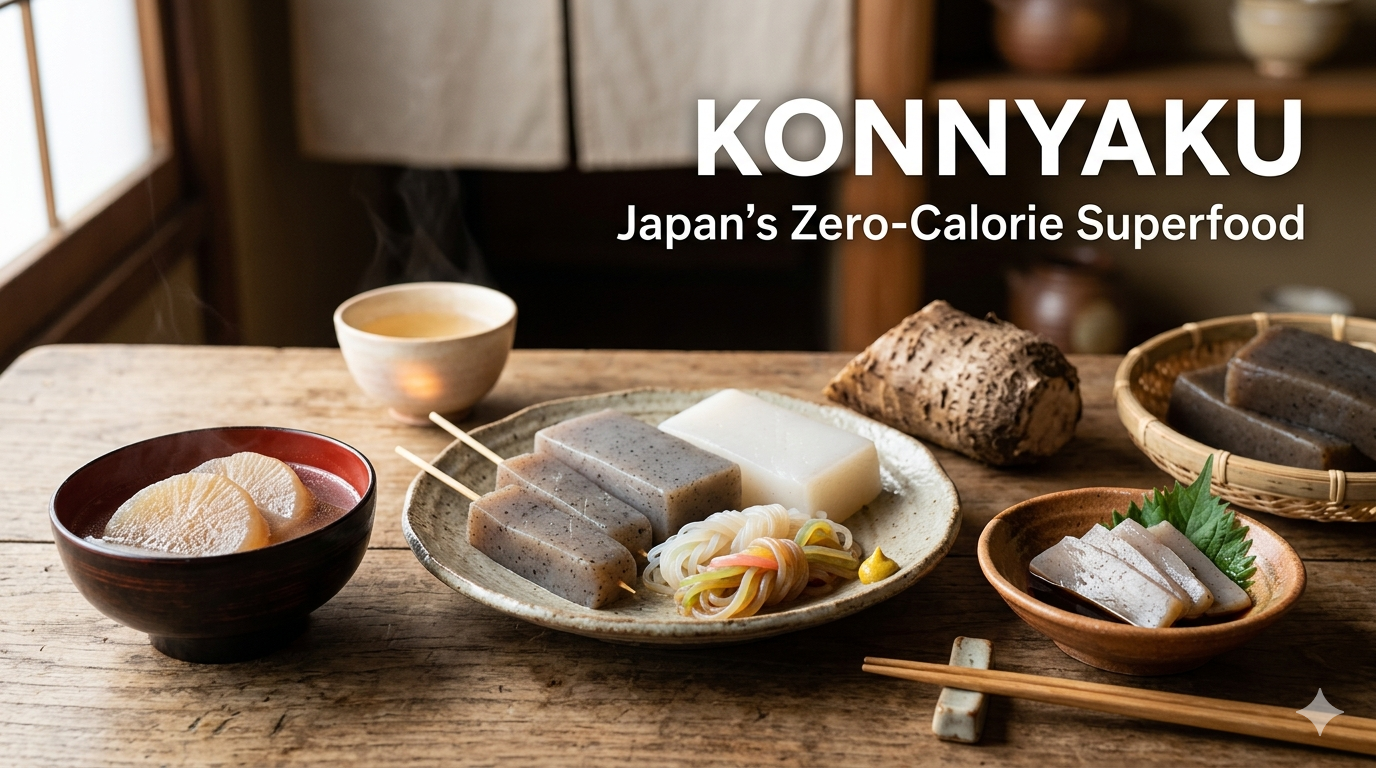
Let me ask you something: have you ever eaten a food that has almost zero calories, keeps you full, cleans your gut, and has been a beloved staple in Japan for over 1,400 years? If you said no — well, you haven’t tried konnyaku yet. And that’s about to change.
Konnyaku (蒟蒻), also written as “konjac” in English, is one of Japan’s most fascinating and misunderstood foods. It’s wobbly, it’s grey, it barely has a flavor of its own — and yet Japanese people absolutely love it. (Myself included, of course.)
You’ll find it in convenience stores, supermarkets, fancy ryokan dinners, street food stalls, and grandma’s kitchen alike. I personally can’t imagine an oden without it. In fact, if you made me choose my favorite oden ingredient, konnyaku wins every single time.
So what exactly is konnyaku, why do Japanese people treasure it so much, and how can you experience it when visiting Japan? Let’s dive in — with your stomach ready.
- 🍱 What Is Konnyaku? (And Why Does It Look Like That?)
- 💪 Why Konnyaku Is Surprisingly Good for You
- 🍜 How Konnyaku Is Eaten in Japan
- 🏔️ Gunma: The Kingdom of Konnyaku
- 🛒 Bought Konnyaku at a Japanese Supermarket? Here’s the Easiest Way to Eat It
- 🛍️ Beyond the Kitchen: Konnyaku Hit Products
- ✅ Quick Tips for Konnyaku First-Timers
- 🌸 Final Thoughts
🍱 What Is Konnyaku? (And Why Does It Look Like That?)
Konnyaku is a firm, jelly-like food made from the starchy root of the konjac plant (Amorphophallus konjac), sometimes called devil’s tongue or elephant yam. The plant grows underground and looks a bit like a large, lumpy potato — not exactly Instagram-worthy, but don’t judge a root by its appearance.
Making konnyaku from scratch is genuinely hard work. The raw konjac root contains oxalic acid and cannot be eaten as-is. It must be dried, ground into flour, then mixed with water and an alkaline coagulant (traditionally calcium hydroxide), kneaded, and boiled to solidify into that signature bouncy block. The process takes considerable time and skill — which makes it even more impressive that Japanese people have been doing this since the 6th century, when konnyaku arrived in Japan along with Buddhism.
Initially, it was a food of the nobility and high-ranking Buddhist priests, prized for its supposed medicinal properties. By the Edo period (1603–1868), it had spread to everyday households across the country. Today, you’d be hard-pressed to find a Japanese supermarket that doesn’t carry it.
You might notice konnyaku comes in different colors:
- Black/grey konnyaku — the most traditional type, made with the actual corm or with hijiki seaweed added for color and a subtle oceanic flavor
- White konnyaku — made from refined konjac flour, milder in taste
- Shirataki noodles (白滝) — konnyaku squeezed into thin, noodle-like strands
- Tama konnyaku (玉こんにゃく) — round, ball-shaped konnyaku, popular in the Tohoku region
💪 Why Konnyaku Is Surprisingly Good for You
Here’s where things get genuinely impressive. Konnyaku is about 97% water — and yet, it’s one of the healthiest foods you can eat. The key is a remarkable dietary fiber called glucomannan.
Konnyaku contains only about 7 kcal per 100g — that’s not a typo. For comparison, 100g of cooked rice has around 130 kcal. Konnyaku is one of the lowest-calorie foods on the planet.
But low-calorie alone doesn’t explain why health experts around the world are excited about it. Here’s a breakdown of konnyaku’s well-documented health benefits:
🌿 Gut Health & Digestion
Glucomannan cannot be broken down by your digestive enzymes. Instead, it travels through your intestines intact, acting as a prebiotic — food for the beneficial bacteria in your gut. Japanese people have nicknamed konnyaku the “broom of the stomach” (お腹の掃除屋) and the “intestinal scavenger,” and it’s a well-earned title. It promotes healthy bowel movements and helps keep your digestive system clean. Studies have shown it can increase bowel movement frequency by up to 30%.
⚖️ Weight Management
Because glucomannan expands significantly when it absorbs water, konnyaku makes you feel full — without adding calories. Research suggests that people who include konjac-based foods in their diet tend to consume up to 23–47% fewer calories at subsequent meals. It’s the rare food where eating more actually helps you eat less overall.
❤️ Heart & Blood Sugar
The U.S. FDA has officially recognized glucomannan’s ability to help lower LDL (“bad”) cholesterol. Additionally, because glucomannan slows digestion and coats the intestinal lining, blood sugar levels rise more gradually after eating — a significant benefit for people managing diabetes or metabolic syndrome. The fiber essentially acts as a gentle speed bump for your bloodstream.
🦴 Bone Health & Skin
Surprisingly, 100g of konnyaku contains about the same amount of calcium (43mg) as cabbage — making it a valuable alternative calcium source for vegetarians and vegans who avoid dairy. Konnyaku also contains ceramide, a compound that supports skin moisture and may help protect against dryness and conditions like atopic dermatitis. Beauty-conscious Japanese consumers have long believed in konnyaku’s skin benefits, and science is starting to back that up.
In short: it fills you up, keeps your gut happy, helps your heart, supports your bones, and may give you better skin. Not bad for something that’s basically fancy wobbly water.
🍜 How Konnyaku Is Eaten in Japan
Konnyaku is the ultimate chameleon ingredient. On its own, it has almost no flavor — which is actually its greatest strength. It soaks up whatever broth, sauce, or seasoning it’s cooked in, while adding its signature chewy, satisfying texture. Here are the most common ways you’ll encounter it in Japan:
🍢 Oden (おでん)
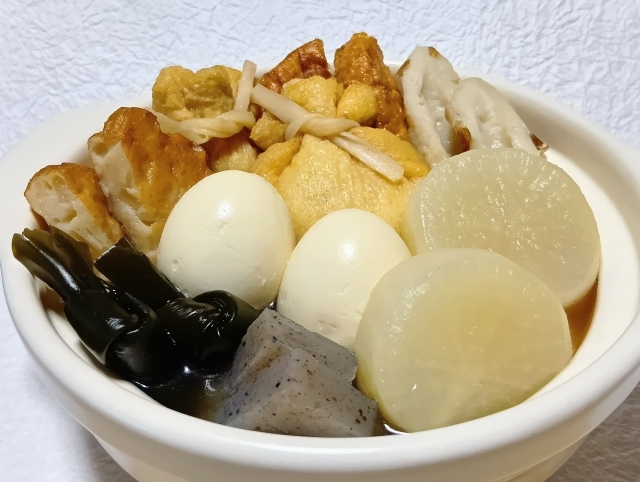
This is the classic. Oden is a beloved Japanese hot pot dish where various ingredients — fish cakes, tofu, daikon radish, boiled eggs — are simmered for hours in a dashi-based broth. Konnyaku triangles or squares are always part of the lineup. The long simmering time lets the broth penetrate deep into the konnyaku, making it wonderfully savory and satisfying. You’ll find oden at convenience stores (7-Eleven, FamilyMart, Lawson) from around October to March, and at dedicated oden restaurants and izakayas year-round.
🥩 Sukiyaki & Shabu-shabu
Shirataki noodles are a standard ingredient in sukiyaki, Japan’s beloved hot pot with thin-sliced wagyu beef, vegetables, and a sweet soy sauce broth. The noodles absorb the rich flavors beautifully. You’ll find sukiyaki at specialty restaurants across Japan, from budget chains to high-end establishments.
🍱 Nimono (煮物) — Simmered Dishes
Nimono is a catch-all term for simmered dishes, and konnyaku shows up in countless variations. It’s often tied into decorative knots (called musubi konnyaku) and simmered alongside root vegetables in soy sauce, mirin, and dashi. This is quintessential Japanese home cooking — the kind of dish that reminds Japanese people of their mother’s kitchen.
🔥 Miso Dengaku (味噌田楽)
Slices of konnyaku are grilled on skewers and glazed with a sweet miso paste — this is called dengaku style. The slightly charred exterior and the umami-rich miso create a combination that punches way above konnyaku’s caloric weight class. You’ll often find this at traditional izakayas and festival food stalls.
🥗 Shira-ae (白和え)
A traditional Japanese salad where konnyaku is dressed with mashed tofu, sesame, and seasonings. Light, refreshing, and deeply satisfying — a perfect side dish.
🍝 Shirataki Noodles in Modern Dishes
In recent years, health-conscious Japanese consumers and international keto/low-carb communities have embraced shirataki noodles as a pasta or ramen substitute. They’re now sold globally under names like “miracle noodles” or “Zen noodles,” and you can find them at many Western supermarkets. But in Japan, you can try them freshly prepared — in everything from stir-fry to curry to cold noodle dishes.
🏔️ Gunma: The Kingdom of Konnyaku
If konnyaku had a capital city, it would be in Gunma Prefecture, about 100km north of Tokyo. This mountainous inland prefecture produces an astonishing over 90% of Japan’s entire konnyaku supply. The cool climate, volcanic soil, and excellent drainage make it perfect for growing konjac corms, which take a full three years to mature before they can be harvested.
While most konnyaku sold across Japan is made from dried flour, Gunma produces konnyaku from fresh konjac taro, giving it a distinctly firmer texture and richer, more complex flavor. Locals will tell you (with complete conviction) that it tastes completely different — and honestly, they’re right.
🎡 Konnyaku Park — Yes, a Theme Park
Gunma is home to what is perhaps the world’s only konnyaku theme park: Konnyaku Park (こんにゃくパーク), located near Tomioka in Kanra Town. And yes, it’s as delightfully Japanese as it sounds.
- 🏭 Free factory tour (weekdays): watch the production lines for ita-konnyaku, shirataki noodles, and konnyaku jelly — all the machinery, explained in detail
- 🍽️ Free all-you-can-eat konnyaku buffet: about 15 different dishes, every day — fried konnyaku, konnyaku curry, konnyaku sashimi, konnyaku desserts, and more
- 🤲 Hands-on workshops (advance reservation required): make your own konnyaku or konnyaku jelly from scratch
- 🛍️ Souvenir shop: every konnyaku product imaginable, including konnyaku castella cake, konnyaku mochi, and seasonal fruit jellies
- ⛩️ Undama Shrine: a small shrine dedicated to… the konnyaku potato. Only in Japan.
Getting there from Tokyo: take the Hokuriku or Joetsu Shinkansen to Takasaki, transfer to the Joshin Electric Railway, and get off at Joshu Fukushima Station (about 5 minutes by car, or 25 minutes on foot).
🍢 Local Specialties to Try in Gunma
Ishidan Tama Konnyaku is a must-try at Ikaho Onsen. Round konnyaku balls on skewers, simmered in soy sauce broth, served three per skewer as you stroll up the famous 365 stone steps. Add a dab of spicy mustard and you’ve got one of Japan’s most satisfying street food moments.
Konnyaku Miso Oden is Gunma’s version of oden, featuring fresh-taro konnyaku with a richer, firmer bite and locally made miso. Once you try this, the supermarket version will feel like a pale imitation.
Sukiyaki Gunma-style uses locally produced Joshu wagyu beef alongside shirataki konnyaku noodles, Shimonita negi leeks, and shiitake mushrooms — virtually everything grown right there in Gunma. It’s a hot pot that tastes like the land itself.
🛒 Bought Konnyaku at a Japanese Supermarket? Here’s the Easiest Way to Eat It
You’ve done it. You’ve wandered into a Japanese supermarket, spotted a weird grey block in the tofu/chilled section for about ¥80–¥150, and decided to be adventurous. Good for you. Now what?
First, a quick note: konnyaku has a slightly alkaline smell when you first open the package. Rinse it well under cold water, then boil it briefly (3–5 minutes) or simply parboil it before using. This removes the smell entirely.
⚡ The Absolute Easiest Method: Konnyaku Steak
- Rinse and pat dry a block of ita-konnyaku
- Score the surface with a knife in a crosshatch pattern (helps it absorb flavor)
- Tear — not cut! Tearing creates rougher surfaces that soak up sauce better — into bite-sized pieces
- Dry-fry in a non-stick pan (no oil needed) on medium-high heat until it squeaks and starts to brown slightly
- Add soy sauce, mirin, and a pinch of sugar (roughly 2:1:0.5 ratio), or just use a tablespoon of mentsuyu (noodle sauce, sold at every supermarket)
- Toss until glossy and coated. Done.
This takes about 10 minutes, uses ingredients available at any convenience store, and produces something genuinely delicious. Sprinkle with sesame seeds or shichimi togarashi if you’re feeling fancy.
🥄 Even Easier: Tama Konnyaku with Mustard Miso
If you buy pre-made round konnyaku (tama konnyaku), they’re often sold already cooked in a soy sauce broth. Just eat them as-is, or warm them up and dip in the sweet miso sauce packets sometimes included. Perfect as a low-guilt snack while exploring Japan.
🛍️ Beyond the Kitchen: Konnyaku Hit Products
Konnyaku’s story doesn’t end with savory cooking. Japanese innovation has taken this humble root into some genuinely exciting territory.
🍇 Konnyaku Jelly (こんにゃくゼリー)
The biggest konnyaku product outside of traditional cooking is undoubtedly konnyaku jelly — fruit-flavored jelly made with glucomannan that has a distinctly chewy, bouncy texture unlike regular gelatin. The dominant brand is MannanLife’s “Konnyaku Batake” (こんにゃく畑), which holds around 60–70% of the konnyaku jelly market in Japan. You’ll find flavors like peach, grapefruit, apple, and orange at nearly every supermarket and drugstore.
A word of caution: konnyaku jelly has a firmer texture than standard jelly and does not melt in the mouth the way gelatin does. Please chew it thoroughly, especially when giving it to young children or elderly family members. The packaging warns you of this, and it’s worth taking seriously.
🍜 Shirataki / Miracle Noodles
Konnyaku noodles have become a global phenomenon in the keto and low-carb communities, marketed internationally as “miracle noodles” or “zero noodles.” In Japan, you can find fresh shirataki noodles used in everything from sukiyaki to yakisoba to a surprisingly convincing ramen substitute. They contain just 10 calories per 100g compared to around 150 calories for the same amount of pasta.
🍦 Konnyaku Soft Serve
At Konnyaku Park in Gunma, you can try a thick, creamy soft serve ice cream made with konjac and sweet potato. It sounds unusual. It tastes wonderful. Don’t skip it.
🧴 Konnyaku Sponges for Skincare
Did you know konnyaku also appears in your bathroom cabinet? Traditional Japanese konnyaku sponges (made from konjac fiber) have been used for centuries as gentle facial cleansers. The alkaline nature of konnyaku helps balance skin pH, and the sponge is soft enough for daily use on sensitive skin. You’ll find these in drug stores and beauty shops across Japan, and they’ve gained a dedicated following internationally too.
🍰 Konnyaku Sweets & Snacks
In Gunma and beyond, you’ll now find konnyaku in more unexpected forms: konnyaku castella (a traditional Japanese sponge cake made with konnyaku flour), konnyaku mochi, konnyaku gummies, and even konnyaku incorporated into chocolate and cookies. The goal is always the same — adding fiber and reducing calories while keeping the texture interesting.
✅ Quick Tips for Konnyaku First-Timers
- It’s odorless once prepped. The alkaline smell disappears after rinsing and briefly boiling. Don’t let it put you off.
- It has no real flavor — and that’s the point. Treat it like a texture ingredient, not a flavor ingredient. Let the sauce do the talking.
- It won’t fill you up like a meal on its own, but combined with other foods it significantly reduces overall calorie intake by adding bulk and promoting fullness.
- Vegetarian/vegan-friendly. Traditional konnyaku contains no animal products. Check labels for variants that might include seaweed or other additives.
- Gluten-free. Pure konnyaku is naturally gluten-free, though always check labels for mixed products.
- Chew the jelly. Konnyaku jelly is not like ordinary jelly. Chew it, don’t inhale it.
🌸 Final Thoughts
Konnyaku is one of those foods that initially baffles foreigners — “Why does Japan love this grey, wobbly, barely-there-flavored thing so much?” — and then slowly, inevitably, wins you over. It’s filling without being heavy. It’s healthy without being boring. And in the right dish — an oden simmered for hours, a Gunma-style sukiyaki, a simple miso dengaku at a festival — it’s genuinely, deeply delicious.
The next time you’re at a Japanese convenience store and you see a pack of konnyaku floating in murky liquid next to the tofu, don’t walk past it. Pick it up. Try it. And maybe, just maybe, you’ll understand why I can never, ever say no to it in my oden.
After all — it’s almost zero calories. You’ve got nothing to lose.
🔗 Useful Links
- Konnyaku: A Health Food Rich in Dietary Fiber — Nippon.com
- Konjac — Highlighted Japanese Ingredients (JETRO)
- Gunma Regional Cuisine & Konnyaku (Ministry of Agriculture, Forestry and Fisheries)
- Konnyaku: Gunma’s Superfood — Gunma Official Tourist Guide
- Konnyaku Park Official Website (Japanese)
- MannanLife (Konnyaku Batake) — For Overseas Customers
- Gunma Konnyaku — Kikkoman Food Forum


Share your thoughts