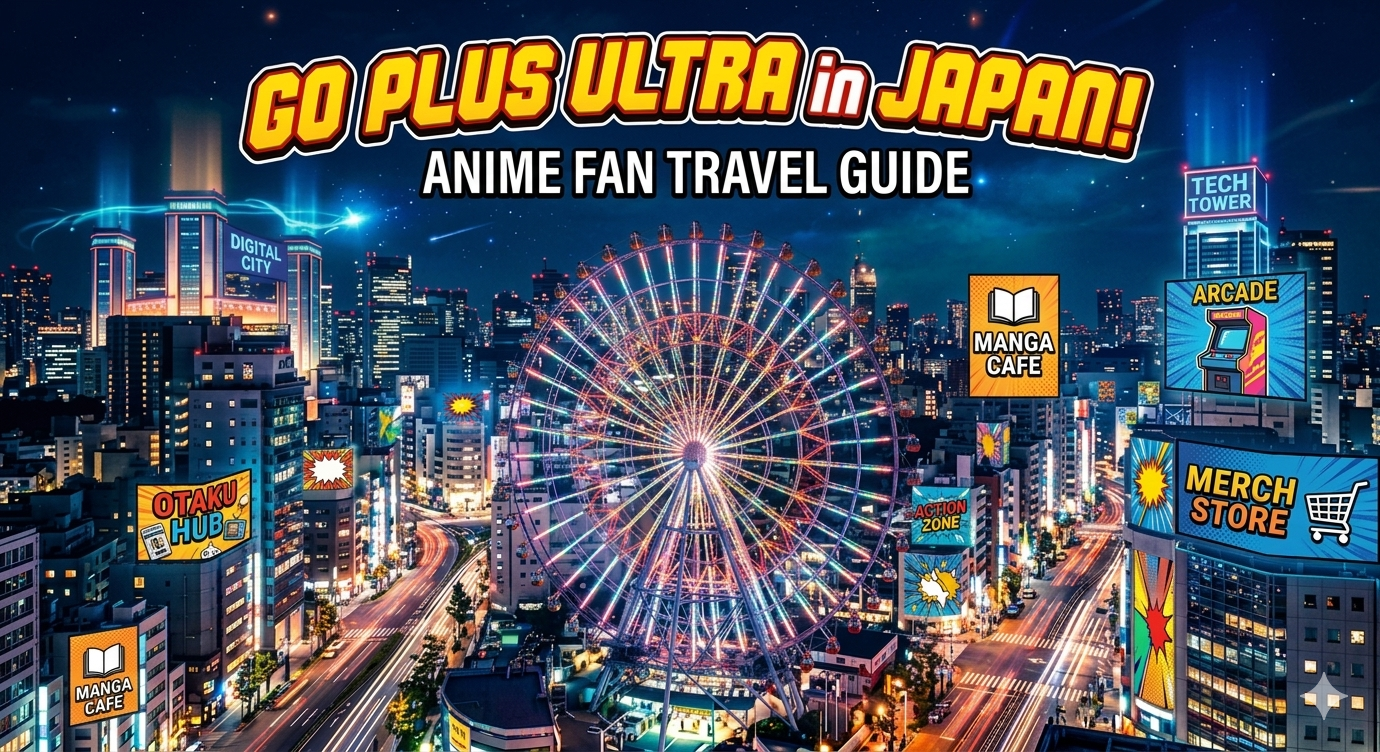
So you’ve watched My Hero Academia (僕のヒーローアカデミア / Boku no Hero Academia), cried more than you planned to, and now you’re staring at a map of Japan thinking: “Where exactly do I begin?”
Good news: Japan has your back — and your hero costume. Whether you’re chasing the vibe of U.A. High School, hunting for All Might merch that doesn’t exist outside Japan, or just want to eat a katsudon that would make Deku weep with joy, this guide covers everything a true MHA fan needs to know before boarding that flight.
Buckle up, young hero. It’s time to go Plus Ultra on your Japan trip. 💪
- 🦸 What Is My Hero Academia? (A Quick Refresher)
- 📍 Real Locations That Feel Straight Out of the Series
- 🎉 Immersive Events: Experience Quirks in Real Life
- 🛍️ Shopping: Where to Find the Good Stuff
- 🍱 Food: Eat Like a Hero (Or Villain, We Don’t Judge)
- 💡 MHA Fan Travel Tips — Read Before You Go
- 🗺️ Sample 2-Day MHA Fan Itinerary (Tokyo Base)
- 🌸 While You’re There: Japan Beyond the Quirks
- 🎯 Final Thoughts: Your Hero Journey Starts Here
🦸 What Is My Hero Academia? (A Quick Refresher)
Created by Kōhei Horikoshi and serialized in Weekly Shōnen Jump from 2014 to 2024, My Hero Academia is the story of Izuku Midoriya — a boy born without a superpower (called a Quirk / 個性) in a world where 80% of the population has one. Against all odds, he inherits the legendary ability One For All from the greatest hero alive, All Might, and enrolls at U.A. High School (雄英高校 / Yūei Kōkō), the most prestigious hero training academy in Japan.
The manga ran for an epic 10 years and 42 volumes. The anime adaptation, produced by Studio Bones, became a global phenomenon — and the fandom? Let’s just say it’s alive, passionate, and absolutely the kind of people who will plan an entire vacation around fictional school locations. No judgment here. We get it.
📖 Read the official manga: VIZ Media — My Hero Academia
📍 Real Locations That Feel Straight Out of the Series
MHA is set in a fictional version of Japan — but here’s the thing: Japan itself is the model. Walk through the right neighborhoods and you’ll swear Deku just ran past you on his morning training route.
🏫 The U.A. High School Vibe — Tama Area & Hachioji (Tokyo West)
No official filming location has ever been announced for U.A. High School. Horikoshi-sensei kept things delightfully vague. However, longtime fans and anime pilgrimage enthusiasts (聖地巡礼) widely agree that the western Tokyo suburbs — particularly the Tama area and around Hachioji — match the general atmosphere of the series beautifully.
Think about it: quiet residential streets with gentle slopes, wide open skies, and that distinctly suburban yet slightly countryside feel that U.A.’s surrounding landscape carries. The school itself sits on a hill above a peaceful town — and that exact geography exists all over the Tama hills area.
If you take the Keio Line or Odakyu Line out of central Tokyo toward Hachioji or Tama, and start walking through the residential back streets, you’ll find yourself thinking “Okay. This is the commute. This is where Deku would be jogging at 4am.” It’s not a verified holy land, but it’s an incredibly pleasant way to spend a half-day, especially in spring when the sakura trees make everything look like an opening credits sequence.
💡 Pro Tip: Pack a pair of earphones and listen to the MHA OST while wandering. Instant immersion guaranteed.
🌆 Yokohama Minato Mirai — Where Hero Battles Come to Life
For fans who love the cinematic battle sequences — those scenes where heroes leap between buildings, sparks fly, and the camera pulls back to reveal a dramatic skyline — Yokohama’s Minato Mirai district is your place.
The cluster of gleaming modern skyscrapers, the harbor views, the iconic Cosmo World ferris wheel glowing at night — it all has that unmistakable “this is where the final boss fight happens” energy. The area at night especially feels like it was designed as a backdrop for a showdown between heroes and villains.
Minato Mirai is easily accessible from Tokyo (about 30 minutes from Shibuya via the Tokyu Toyoko Line) and is 100% worth an evening visit. Bring your camera. Strike your best hero pose in front of the ferris wheel. Do it. You’ll thank yourself later.
🚉 Access: Minato Mirai Station (Minatomirai Line) — right in the heart of the district.
🎉 Immersive Events: Experience Quirks in Real Life
Japan takes its anime seriously — and when it comes to MHA, the country delivers experiences you simply cannot replicate anywhere else on earth. These events rotate frequently, so always check official sources before your trip.
🏙️ Sunshine City (Ikebukuro, Tokyo)
Sunshine City in Ikebukuro is a massive multi-use complex that includes a shopping mall, an aquarium, a planetarium, and the famous Sunshine 60 observation deck. It’s also one of the most frequent collaboration event venues in Tokyo.
MHA has hosted events here multiple times, featuring photo spots where you can pose alongside life-size character panels, Quirk-themed mini games, and limited-edition merchandise that sells out with terrifying speed. The venue’s scale makes it perfect for large-scale collaborations, and the Namba City-style layout means you can easily spend a whole day there even between events.
🔗 Official site: Sunshine City Official Website
🎢 Universal Studios Japan (USJ, Osaka) — The Real 4-D Experience
For the most viscerally exciting MHA experience money can buy, Universal Studios Japan in Osaka periodically runs “My Hero Academia The Real 4-D” — an immersive theater attraction where you’re not watching a hero battle, you’re in one.
We’re talking seat vibration synced to impacts, water mist effects timed to Todoroki’s ice attacks, wind gusts during All Might’s smashes — the kind of sensory experience that makes you genuinely believe you’ve been hit by a Delaware Smash. It’s temporary (USJ rotates its special attractions), so check the USJ website well in advance of your visit.
🎢 Osaka is about 2.5 hours from Tokyo by Shinkansen — easily doable as a day trip or overnight stay.
🔗 Official site: Universal Studios Japan Official (EN)
⚠️ Important: USJ attractions rotate seasonally. Always check the official USJ website for current lineups before booking.
🛍️ Shopping: Where to Find the Good Stuff
Let’s be honest — a significant portion of your travel budget is going to merch. That’s fine. That’s normal. That’s correct behavior. Here’s where to go.
🟡 JUMP SHOP — Official Shōnen Jump Merchandise
The JUMP SHOP is the official merchandise store for all things Shōnen Jump — which means One Piece, Naruto, Demon Slayer, and yes, My Hero Academia all under one roof. There are multiple locations across Japan, with convenient spots at Tokyo Station (Character Street), Tokyo Skytree, Tokyo Dome, and Shibuya PARCO.
For MHA fans specifically, expect to find officially licensed apparel, acrylic stands (アクリルスタンド) featuring your favorite characters, keychains, stationery, and seasonal limited items that rotate with the anime schedule.
A special note for fans coming from overseas: the All Might American comic-style design goods are particularly popular with Western fans, leaning into his whole “Symbol of Peace” cultural aesthetic. They make fantastic gifts that feel authentically Japan-exclusive.
🔗 Official site: JUMP SHOP Official Website
🔴 Animate Ikebukuro Flagship Store — The Mecca
If JUMP SHOP is a great hero, Animate’s Ikebukuro flagship store is All Might himself. It is the largest anime merchandise retailer in Japan, and the Ikebukuro main store is the biggest of the bunch — multiple floors packed wall to wall with anime goods across virtually every title you care about.
For MHA, Animate typically maintains a dedicated corner (sometimes an entire floor section) with goods you simply will not find outside Japan: Japan-exclusive illustration booklets, limited-run stationery featuring original drawn-down illustrations, drama CDs, and collaboration items timed to anime milestones. The selection changes frequently, which means every visit can surface something new.
Even if you’re not a hardcore collector, just walking through Animate is a sensory experience worth having. The sheer scale of anime fandom made physical is genuinely impressive.
🔗 Official site (EN): Animate Official Website (English)
📍 Address: 1-20-7 Higashi-Ikebukuro, Toshima-ku, Tokyo — 5 min walk from Ikebukuro Station East Exit
🗼 Tokyo Character Street (Tokyo Station)
Hidden beneath Tokyo Station’s Yaesu side is Tokyo Character Street (キャラクターストリート) — a dedicated shopping corridor housing official character shops for dozens of major franchises. You’ll find the JUMP SHOP here, along with other official stores. The convenient Tokyo Station location makes it perfect for a last-minute shopping run on your way out of the city.
🍱 Food: Eat Like a Hero (Or Villain, We Don’t Judge)
Anime collaboration cafés are one of Japan’s great gifts to fandom culture — and MHA has been a reliable participant in this tradition.
☕ Animate Café — The Collab Café King
Animate Café (operated by the same Animate group behind the stores) regularly runs official collaboration café events with major anime titles. During MHA collaborations, you can expect menus designed around the series with remarkable creativity:
- 🍛 Deku’s Katsudon — Izuku Midoriya’s beloved comfort food, often reimagined with character-themed plating, edible prints, or themed sauce arrangements that make the dish genuinely photogenic.
- ❄️🔥 Todoroki’s “Half-Cold Half-Hot” Dessert — Typically a two-part creation: one side featuring cold jelly or ice cream, the other a warm berry or caramel sauce. The visual split between the two is spot-on, and the contrast in temperatures as you eat it is genuinely fun.
- 🧃 Character drinks with illustrated ice cubes or themed latte art.
These menus change with each collaboration cycle, and photo documentation is basically mandatory — the food presentation quality is consistently blog-worthy (ブログ映え). Tables often come with character-specific placemats and trading coasters included with your order.
⚠️ Animate Café collaborations are strictly time-limited and usually require reservations made through the official website in advance. Spots sell out fast — sometimes within minutes of opening. Plan ahead!
🔗 Animate Café info: Animate Café Official Website
🍜 Beyond the Collab Café: Eat Like a Hero Anywhere
Even outside official collab events, you can lean into the MHA food lore:
- Katsudon (カツ丼) — Deku’s comfort meal. Available at virtually any teishoku (set meal) restaurant or convenience store in Japan. Grab one from a Matsuya or Yoshinoya and silently dedicate it to Izuku.
- Soba or Ramen — Perfect after a long day of hero pilgrimage walking. Many Tokyo soba shops look exactly like the kind of place Gran Torino would eat at.
- Convenience store snacks — Japan’s konbini (convenience stores) stock limited collab items during major anime events. Check 7-Eleven, Lawson, and FamilyMart for MHA packaging during promotional periods.
💡 MHA Fan Travel Tips — Read Before You Go
A few hard-earned pieces of advice for making your MHA pilgrimage run smoothly:
🗓️ Time your visit strategically. Major MHA events (collab cafés, Animate in-store campaigns, USJ attractions) often align with anime season premieres or manga milestones. Follow the official MHA English Twitter/X account (@MHAOfficial) for announcements.
💴 Cash and IC cards. Most collab cafés, JUMP SHOP locations, and smaller anime stores accept cash and IC cards (Suica, Pasmo). Some accept credit cards, but don’t assume — bring cash backup.
📦 Budget for baggage. You will buy more than planned. This is not a prediction. It is a law of physics. Consider shipping purchases home via Japan Post’s takuhaibin (宅配便) service from a convenience store — it’s cheap, reliable, and saves your spine.
🇯🇵 Learn the lingo. Knowing a few terms makes the experience richer: seichi junrei (聖地巡礼) = anime pilgrimage; genzaihin (限定品) = limited edition; urikireru (売り切れる) = sold out (the saddest phrase in anime shopping). For the series itself: Quirk = 個性 (kosei); Plus Ultra = さらに向こうへ.
📱 Get the apps. Google Translate’s camera mode handles Japanese menus and signs in real time. The Hyperdia or Google Maps app handles train navigation. Both are essential.
🗺️ Sample 2-Day MHA Fan Itinerary (Tokyo Base)
Short on time? Here’s a focused route that hits the highlights without turning your trip into a military operation:
Day 1 — West Tokyo & Ikebukuro
Morning: Take the Keio or Odakyu line into the Tama/Hachioji area for your U.A. High vibe walk. Grab breakfast at a local kissaten (coffee shop). Afternoon: Head to Ikebukuro — visit Animate Flagship (allow 2-3 hours minimum, seriously). Evening: Explore Sunshine City and the surrounding Ikebukuro streets, which have a great variety of anime-adjacent shops.
Day 2 — Shibuya, Tokyo Station, and Yokohama
Morning: JUMP SHOP at Shibuya PARCO or Tokyo Station Character Street (pick whichever is closer to your accommodation). Afternoon: Head to Yokohama — walk around Minato Mirai, admire the skyline that feels purpose-built for hero battles, grab dinner at the harbor. Evening: Catch the Cosmo World ferris wheel lit up at night. Take approximately 200 photos. Post none of them. Savor them privately like a treasure.
🌸 While You’re There: Japan Beyond the Quirks
Look, we know you’re here for MHA. But Japan has a habit of surprising even the most laser-focused anime tourist. Keep your eyes open for:
- Akihabara (Electric Town) — The classic anime shopping district for figures, older goods, and general sensory overload. A solid backup if other shops are sold out.
- Nakano Broadway — Often overlooked by tourists, this mall has deep-cut vintage anime merch. A treasure hunt zone for the dedicated.
- Ghibli Museum (Mitaka) — Only 20 minutes from Shinjuku, and requires pre-booked tickets. If you’re already in western Tokyo doing your U.A. walk, this makes a natural addition to the day.
- teamLab Planets (Toyosu) — Nothing to do with MHA but genuinely one of the most visually spectacular experiences in modern Japan. Worth the ticket price.
🎯 Final Thoughts: Your Hero Journey Starts Here
My Hero Academia gave us something rare in shōnen manga: a story where the message isn’t just “be strong” — it’s “help others, keep going, and go beyond what you think is possible.” That’s Plus Ultra not as a battle cry, but as a philosophy.
Visiting Japan as an MHA fan carries that same energy. You’ll walk streets that inspired the story. You’ll find objects that don’t exist in your home country. You’ll eat food that means something personal because of what you watched. And yeah, you’ll probably spend more than your budget allowed for, discover a collab café that you weren’t expecting, and end up shipping home a box of acrylic stands.
That’s the experience. That’s the pilgrimage.
Visit these spots, go Plus Ultra on your Japan trip — and remember: it’s fine to cry a little at the katsudon. We’ve all been there.
📌 Event schedules, product availability, and collaboration details change frequently. Always verify current information on official websites before your trip. URLs and events listed in this article were accurate at time of writing.
© My Hero Academia / Kōhei Horikoshi / Shueisha · My Hero Academia Project

Share your thoughts