Okay, let’s be honest. If you’ve ever watched Slam Dunk — the legendary basketball manga and anime by Takehiko Inoue — you’ve had one thought cross your mind at least once: “I need to stand at that crossing.”
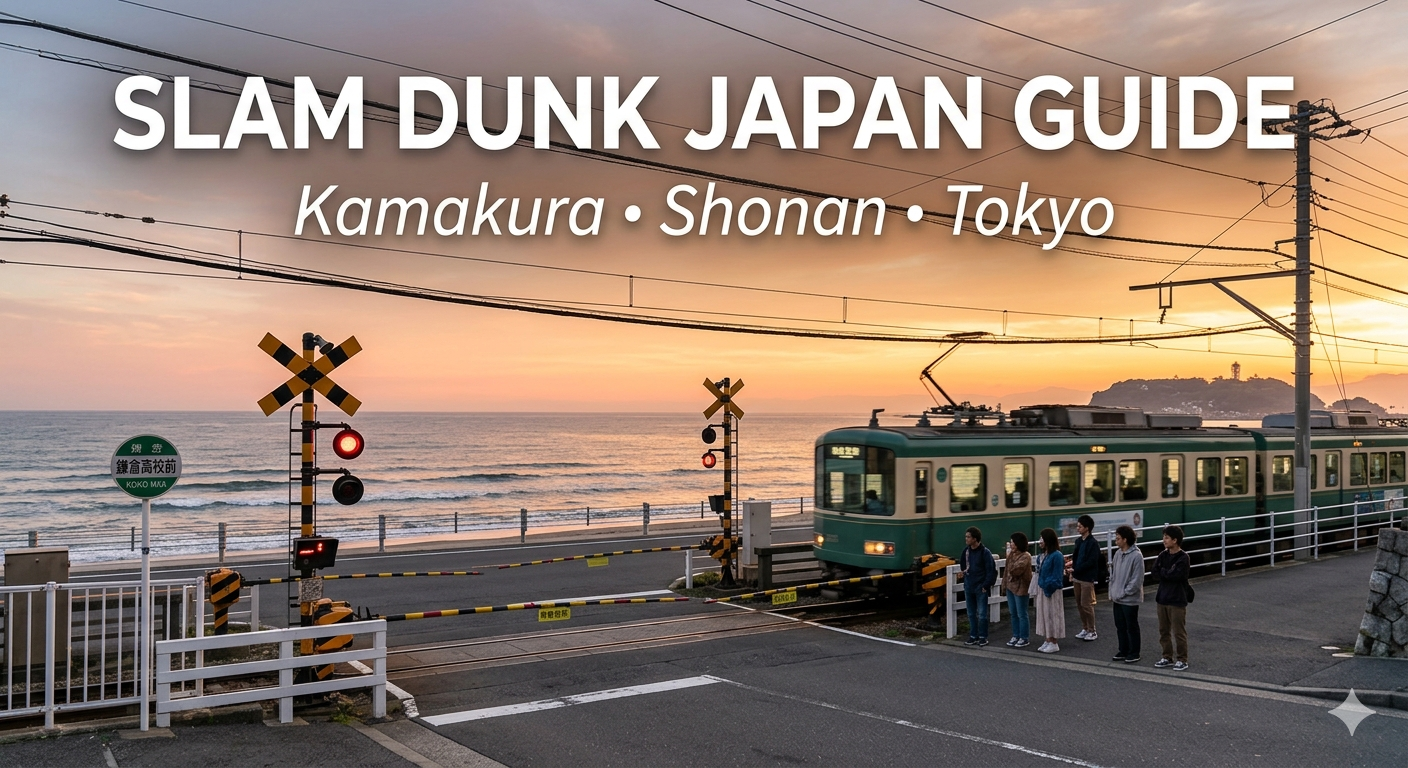
You know the one. The railway crossing near the sea. The red-and-white gates. The Enoden train rolling past. Hanamichi Sakuragi looking dramatically into the distance like a man who has just been rejected — again. That shot.
I know, because I’ve stood there.
And I’m telling you — the moment those gates came down and the Enoden rattled past, it all came flooding back. Every panel. Every dramatic monologue. Every impossible dunk. Standing at that crossing, with the sea breeze coming off Sagami Bay and the mountains sitting quiet in the background, I understood something I hadn’t expected: this isn’t just fan pilgrimage. This is Japan at its most quietly beautiful, framed like a painting that Inoue somehow knew would outlast the manga itself. I wanted to grab every Slam Dunk fan by the shoulders and say — you need to stand here.
So consider this your invitation.
Good news: it’s real. Better news: Japan is absolutely packed with Slam Dunk locations, shopping spots, and experiences that will make any fan feel like they’ve stepped straight into the pages of Volume 1. This guide covers everything — from the must-visit sacred spots (seichi junrei) in the Kamakura and Shonan area to Tokyo shopping stops, authentic street basketball courts, and even dagashi (retro Japanese candy stores) worthy of Sakuragi’s crew.
Strap on your Asics. Let’s go.
- 🏀 What Is Slam Dunk? (A Quick Intro for the Newcomers)
- 🚃 Part 1: The Sacred Spots of Kamakura & Shonan (Day Trip from Tokyo)
- 🏙️ Part 2: Urban Slam Dunk Spots in Tokyo
- 🛍️ Part 3: Shopping & Souvenirs — Gear Up Like a Shohoku Player
- 🍬 Part 4: Eat, Play & Experience Japan Like the Shohoku Crew
- 🗺️ Suggested Day Trip Itinerary: The Full Pilgrimage Route
- 📋 Practical Tips: Before You Go
- 💬 Final Thoughts: The Genius of Seichi Junrei
- 🔗 Useful Links Summary
🏀 What Is Slam Dunk? (A Quick Intro for the Newcomers)
Slam Dunk is a basketball manga created by Takehiko Inoue, serialized in Weekly Shōnen Jump from 1990 to 1996. It follows Hanamichi Sakuragi, a red-haired delinquent who joins the basketball team at Shohoku High School — not because he loves basketball, but because a girl named Haruko told him she liked basketball players. Relatable motivation, honestly.
What started as a comedy of errors turned into one of the greatest sports manga ever created. With 31 volumes and over 185 million copies sold worldwide, it’s in the same elite bracket as Dragon Ball and One Piece. The series is widely credited with sparking a basketball boom across Japan and much of Asia in the 1990s — and its influence is still felt today.
In December 2022, Inoue himself directed THE FIRST SLAM DUNK, an animated film that became the highest-grossing basketball film of all time, earning over $279 million globally. A whole new generation of fans was born. Pilgrimages to Kamakura surged. Residents near the famous railway crossing started losing sleep.
Which brings us neatly to our first section.
📎 Official film website: https://slamdunk-movie.jp/en/
🚃 Part 1: The Sacred Spots of Kamakura & Shonan (Day Trip from Tokyo)
The real-life settings for Slam Dunk are concentrated in Kanagawa Prefecture — specifically, the coastal stretch from Kamakura to Fujisawa. It’s about an hour from Tokyo, and you can do it all in a single day trip. The star of the show is the Enoshima Electric Railway, nicknamed the “Enoden” (江ノ電) — a charmingly retro tram that hugs the Pacific coastline and connects all the key spots.
📍 1. The Kamakura Koko-mae Crossing — The Spot
If Slam Dunk were a religion, this railway crossing would be Mecca, the Vatican, and Disneyland rolled into one. The Kamakura Koko-mae No.1 Railroad Crossing (鎌倉高校前第1踏切) became globally iconic thanks to its appearance in the anime’s opening sequence — Sakuragi standing by the gate, the Enoden passing, the ocean stretching out behind it. Across Sagami Bay, Enoshima Island sits on the horizon like a punctuation mark, and on a clear day — especially in winter and early spring — the snow-capped silhouette of Mt. Fuji floats above it all. That combination of train, sea, island, and mountain in a single frame is not a coincidence. Takehiko Inoue drew this place because it’s genuinely one of the most beautiful spots in the Kanto region.
The crossing is just a few seconds’ walk from Kamakurakokomae Station on the Enoden Line. Exit the ticket gate, turn toward the beach, and there it is. Fans from across the world come here to recreate Sakuragi’s iconic pose — arms at their sides, staring into the sea with the energy of someone who has just realized he might actually like basketball.
📷 The Best Shot: Where to Stand for the Perfect Photo
The classic composition — Enoden in the foreground, ocean behind, Enoshima in the distance — is taken from the slight rise on the road just uphill from the crossing. From this elevated angle, you can capture the full width of the crossing, the train rolling through, and the sea all in one frame without any foreground clutter. Check the Enoden timetable in advance (official site here) and time your shot for when the Fujisawa-bound train passes — that’s the direction matching the anime’s opening. Patience is your best lens filter.
For a second, entirely different mood, come back at dusk. As the sun drops toward the Pacific, the silhouette of Enoshima Island and the passing Enoden create a scene that looks almost cinematic — warm orange light, the quiet rattle of the train, the whole seaside atmosphere of the manga made tangible. It’s less busy than midday and arguably more beautiful.
🕐 Best Times to Visit
Timing your visit makes an enormous difference here. The crossing sits in a residential neighborhood that receives a staggering number of visitors — planning ahead is not optional, it’s the respectful thing to do.
- 🌅 Early morning (6:00–9:00 AM) — The golden window. Crowds are minimal, the light is soft and flattering, and the atmosphere feels genuinely peaceful. This is the time to get your shot without feeling rushed.
- 🌇 Late afternoon / sunset — A close second, especially in autumn and winter when the sun sets over the water. The golden-hour glow on Enoshima is something else entirely.
- 🌸 Spring (March–May) & Autumn (October–November) — The best seasons overall. Mild weather, high rates of clear sky, and better chances of seeing Mt. Fuji. Spring also brings the added bonus of cherry blossoms on the hills above the coast.
- 📅 Avoid: Golden Week (late April–early May), Obon (mid-August), and weekend afternoons. These are when the crossing becomes genuinely overcrowded, and the atmosphere is less “seichi junrei” and more “theme park queue.”
- 📆 Best overall strategy: Weekday morning, outside of school holidays, in spring or autumn. You’ll have the crossing, the light, and your dignity more or less intact.
⚠️ Heads Up, Pilgrim: This is an actual, functioning railway crossing in a quiet residential neighborhood — not a tourist attraction with ropes and ticket booths. The area gets very crowded, especially on weekends and holidays. Local residents still live here. Please be a respectful guest.
✅ Go early in the morning — between 6:00 and 9:00 AM is the sweet spot. The light is gorgeous, the crowds are minimal, and the locals haven’t been woken up yet by a hundred people saying “TENSAI DA!” in front of their houses.
✅ Respect local residents — Do not block traffic or stand on the crossing itself. Take your photo quickly and move on. Leave no trash. Be the Rukawa of tourists: cool, efficient, and silently respectful.
📍 2. Shonan Coast Sacred Sites — Beyond the Crossing
The crossing is the headliner, but the supporting cast of Slam Dunk locations along this coastline deserves its own spotlight. Once you’ve gotten your crossing photo, don’t get back on the train just yet — the whole area is a slow-walk-worthy cluster of scenic spots, each with its own manga connection.
🚴 Kamakura Seaside Park – Sakanoshita District (鎌倉海浜公園坂ノ下地区)
A short walk from the crossing along the coastal road brings you to this breezy seaside park, which matches the atmosphere of the scene where Rukawa Kaede cycles along the seawall on his road bike. The manga cover of the new re-edited Volume 2 depicts exactly this stretch — the Sagami Bay coast, the seawall, Enoshima in the distance. Walk it slowly. Pretend you are an impossibly talented basketball prodigy who also somehow has time to cycle every morning. You deserve this.
🏖️ Kugenuma Beach — The Reunion Scene
Located on the west side of Enoshima, Kugenuma Beach is known among fans as the setting for Sakuragi and Rukawa’s reunion scene after the inter-high tournament — one of the manga’s most quietly powerful moments. The beach faces Enoshima Island directly, making it ideal for a jog or a contemplative stroll, depending on how emotionally recovered you are from that scene. From here, the island looks close enough to swim to. Do not swim to it.
Access: about a 10-minute walk from Kugenuma Kaigan Station (Odakyu Line), or around 25 minutes on foot from the Kamakurakokomae crossing.
📍 3. Hiratsuka General Gymnasium — Where Shohoku Faced Ryonan
The Hiratsuka General Gymnasium (平塚総合体育館) is the real-world model for the arena used in the Kanagawa Prefecture finals — the legendary showdown between Shohoku and Ryonan. The building’s layout, structure, and interior atmosphere match the manga’s panels closely enough to make fans instinctively look for Hanamichi chalking his hands near the entrance.
The gymnasium reportedly features signed works by Takehiko Inoue himself — a quiet acknowledgment from the creator to a place that shaped his story. It’s still an active sports facility, so it isn’t a museum. But visitors can enter to view the space by removing their shoes at the entrance — standard Japanese gym etiquette — and paying their respects quietly. A short trip from Hiratsuka Station via JR Tokaido Line.
📌 Address: 1-1-1 Nakahara, Hiratsuka, Kanagawa
📍 4. Akibadai Cultural Gymnasium — Shohoku vs. Kainan
Less well-known than Hiratsuka but equally significant for deep-cut fans: Akibadai Cultural Gymnasium is identified as the real-life model for the match venue of Shohoku vs. Kainan — the Kanto powerhouse showdown that proved Shohoku belonged at the highest level. The interior atmosphere and structural feel of the building closely match the manga’s depiction, enough that standing inside feels like flipping through the pages of one of the most intense arcs in the series.
It’s a regular public gymnasium, so check local schedules before visiting and be mindful of ongoing events. Combine it with Kugenuma Beach for an efficient Fujisawa-area half-day.
🏙️ Part 2: Urban Slam Dunk Spots in Tokyo
The Shonan area might be the spiritual home of Slam Dunk, but Tokyo has its own basketball culture — and a few spots that fans shouldn’t miss.
📍 5. Yoyogi National Gymnasium — Japan’s Basketball Cathedral
Designed by legendary architect Kenzo Tange for the 1964 Tokyo Olympics, the Yoyogi National Gymnasium is one of Japan’s most iconic sports venues. While it’s not a direct frame-by-frame model from the manga, its towering suspended-roof silhouette and reputation as a top-tier arena for basketball events make it spiritually connected to the high-stakes gym atmosphere of Slam Dunk’s greatest matches.
If a basketball game is scheduled during your visit — and they frequently are — you can catch real Japanese hoops in an architecturally stunning venue. Even without a game, the building’s exterior is striking enough to justify a photo stop, especially from the Harajuku side of Yoyogi Park.
📎 Official: https://www.jpnsport.go.jp/yoyogi/
👟 6. ASICS Flagship Stores — Mitsui’s Shoes, For Real
Hisashi Mitsui. The three-point shooter. The comeback kid. The guy who cried on a gym floor and made an entire generation of readers do the same. He wore ASICS — specifically the “Japan L” model — and so did most of Shohoku’s starting lineup.
ASICS is a homegrown Japanese brand (founded in Kobe in 1949), and visiting one of their flagship stores is a genuinely fun stop for any fan who wants to see — and ideally try on — “the real thing.” The Shibuya store in particular carries a solid range of retro and performance basketball shoes.
📎 ASICS official store locator: https://www.asics.com/jp/en-jp/store-locator/
🛍️ Part 3: Shopping & Souvenirs — Gear Up Like a Shohoku Player
🏪 7. JUMP SHOP — Your Official Merch Headquarters
The JUMP SHOP is Shueisha’s official licensed store — the place to go for everything from Slam Dunk postcards to Shohoku High School uniform-inspired goods. There are multiple locations across Japan, with convenient Tokyo outposts at:
- 🗼 Tokyo Character Street (inside Tokyo Station — great for a last-minute pre-departure haul)
- 🌳 Tokyo Skytree / Solamachi
- 🎭 Shibuya PARCO (6F)
The Shonan-themed goods — postcards of the famous crossing, coastal artwork — are particularly popular and make excellent souvenirs. Don’t expect large-scale figures here; JUMP SHOP specializes in smaller, affordable items like stationery, acrylic stands, badges, and tote bags. Perfect for filling up that carry-on you definitely didn’t overpack.
📎 JUMP SHOP (Shibuya PARCO official page): https://en.shibuya.parco.jp/shop/detail/?cd=025844
🎬 8. THE FIRST SLAM DUNK Movie Goods — Figures, Keychains & Collector’s Items
The 2022 film’s merchandise wave hasn’t fully subsided — and honestly, it may never fully subside, given that the film keeps coming back for revival screenings. High-quality goods such as character figures, leather keychains, and illustrated art prints from THE FIRST SLAM DUNK can still be found at:
- 🎮 Animate stores (Japan’s largest anime retail chain, with stores across Tokyo and nationwide)
- 🎁 AmiAmi stores and their online shop
- 📦 Period-limited official pop-up stores (check the movie’s official SNS for announcements)
The quality of the film goods is genuinely impressive — these aren’t flimsy tourist trinkets. The leather keychains in particular have been widely praised for feeling premium and actually wearable. Even if you’re not a hardcore collector, picking up one piece of official film merch is a satisfying way to mark your pilgrimage.
📎 THE FIRST SLAM DUNK official website: https://slamdunk-movie.jp/en/
📎 Animate official: https://www.animate.co.jp/

🍬 Part 4: Eat, Play & Experience Japan Like the Shohoku Crew
🏪 9. Dagashi-ya — Candy Stores of the Showa Era
Remember those scenes where Sakuragi and his crew are just hanging around, being loud, eating cheap snacks, and generally existing with the confidence of people who have never heard the word “responsibility”? Those scenes happen in and around dagashi-ya — old-school Japanese candy stores selling retro snacks for anywhere from 10 to 100 yen a piece.
These shops are a genuine piece of Japanese cultural nostalgia, and finding one feels like discovering a time capsule. The Kamakura and Enoshima area still has pockets of retro, atmospheric shopping streets — look in the backstreets near Hase or Yuigahama — where the vibe matches the manga’s Shonan setting perfectly. Buy a bag of umaibo (corn puff sticks), eat them by the sea, and try to summon even 10% of Sakuragi’s absurd confidence.
🏀 10. Outdoor Basketball Courts — Actually Play
Here’s an idea that separates the serious Slam Dunk fans from the tourists: actually play basketball while you’re here.
Japan has a great outdoor hoops culture, and public courts exist across Tokyo. Yoyogi Park (代々木公園) and the surrounding area have accessible outdoor courts where locals play pickup games regularly. Show up, stretch a bit like you know what you’re doing, and politely try to join in. Japanese players tend to be friendly to respectful visitors, especially ones who are clearly Having A Moment because they just got off a train from Kamakura.
Pro tip: learning to say (Issho ni yatte ii desu ka? — “Can I play with you?”) before your trip is strongly recommended. It beats miming shooting motions and hoping for the best, which is also a valid strategy but somewhat less dignified.
📎 Yoyogi Park official: https://www.tokyo-park.or.jp/park/yoyogi/
🗺️ Suggested Day Trip Itinerary: The Full Pilgrimage Route
Here’s a practical one-day schedule to hit the Kamakura and Shonan highlights without rushing:
| Time | Activity |
|---|---|
| 🌅 6:30 AM | Depart Tokyo early (Shinjuku → Fujisawa via Odakyu, then Enoden) |
| ☀️ 8:00–9:00 AM | Arrive Kamakurakokomae Station — photograph the crossing while it’s peaceful and the light is soft |
| 🚴 9:00–10:00 AM | Walk the Sakanoshita coastal path (Rukawa’s cycling route) — grab coffee at a seaside café |
| 🚃 10:30 AM | Enoden to Hase / Kamakura — explore backstreet dagashi-ya and retro shops |
| 🏟️ Early afternoon | Optional: Hiratsuka General Gymnasium (Shohoku vs. Ryonan model) or Akibadai Cultural Gymnasium (Shohoku vs. Kainan model) in Fujisawa |
| 🏖️ Late afternoon | Kugenuma Beach — stroll with Enoshima views (Sakuragi & Rukawa reunion scene) |
| 🌇 Sunset | Return to the crossing for the golden-hour/dusk shot — completely different mood from the morning |
| 🛍️ Evening | Head back to Tokyo — JUMP SHOP in Shibuya or Tokyo Station, dinner in the city |
📋 Practical Tips: Before You Go
- 🎫 Enoden Day Pass: The Noriorikun pass gives unlimited Enoden rides for the day and includes discounts at local attractions. Buy it at Kamakura or Fujisawa station. More info: https://www.enoden.co.jp/en/tourism/ticket/noriorikun/
- 🌤️ Best seasons: Spring (March–May) and autumn (October–November) offer mild weather, clear skies, and the best chance of spotting Mt. Fuji from the crossing. Winter weekday mornings are surprisingly good — thin crowds, crisp air, and cinematic light. Summer is beautiful but very crowded and humid.
- 📸 Photography etiquette: Be quick at the crossing. Take your shot, enjoy the view, and step aside. Blocking traffic — even briefly — is genuinely dangerous and inconsiderate to locals.
- 🚃 Getting there: From Shinjuku, take the Odakyu Line to Fujisawa, then transfer to the Enoden. From Tokyo Station, take the JR Yokosuka Line to Kamakura and board the Enoden from there. Both routes take 60–75 minutes.
- 👟 Wear comfortable shoes: You’ll be walking and exploring. Wear your best Asics. It’s basically required at this point.
💬 Final Thoughts: The Genius of Seichi Junrei
There’s something genuinely moving about standing at the Kamakura Koko-mae crossing for the first time. It’s a small, unassuming railway crossing on a road next to the sea. Nothing has been built to celebrate it. There’s no gift shop, no bronze statue, no information board saying “YOU ARE NOW AT THE SLAM DUNK CROSSING.” It’s just… there. Real. Exactly as you imagined it.
That’s the magic of seichi junrei — anime and manga pilgrimage. The works you love are drawn from real places, real light, real seasons. Coming here closes the loop between fiction and reality in a way that no amount of re-reading or rewatching can replicate. The Enoden passes. The gates go down. You take your photo.
And for just a moment, you are Hanamichi Sakuragi — deeply dramatic, standing by the ocean, on the verge of becoming something great.
Just please don’t stand on the tracks. He wouldn’t either.
🔗 Useful Links Summary
- 🎬 THE FIRST SLAM DUNK Official: https://slamdunk-movie.jp/en/
- 🚃 Enoden Official: https://www.enoden.co.jp/en/
- 🎫 Enoden Day Pass Info: https://www.enoden.co.jp/en/tourism/ticket/noriorikun/
- 🏝️ Enoshima Island Guide: https://kamakuraguide.com/enoshima/enoshima-island/
- 🛍️ JUMP SHOP (Shibuya PARCO): https://en.shibuya.parco.jp/shop/detail/?cd=025844
- 👟 ASICS Store Locator: https://www.asics.com/jp/en-jp/store-locator/
- 🏟️ Yoyogi National Gymnasium: https://www.jpnsport.go.jp/yoyogi/
- 🌳 Yoyogi Park: https://www.tokyo-park.or.jp/park/yoyogi/
- 🎮 Animate: https://www.animate.co.jp/


Share your thoughts