
Sure, you could spend your entire trip eating conveyor-belt sushi, snapping photos of ramen, and calling it a cultural deep-dive. No judgment — we’ve all been there.
But here’s a thought: what if you actually learned to make this stuff?
Japan’s food culture isn’t just about what ends up on your plate — it’s about centuries of technique, seasonal respect, and an almost obsessive attention to detail that somehow makes even a bowl of plain rice taste like a religious experience. The good news? You don’t need to train for three years under a silent master in Kyoto to get a piece of that magic. You just need 60 to 90 minutes, a willingness to look slightly ridiculous rolling your first maki, and a healthy appetite.
This guide covers everything: the best cooking classes for travelers, the recipes you can recreate at home, and the exact ingredients and tools to stuff into your suitcase before you fly home. Let’s eat.
- 🎌 Part 1: Cooking Classes — Learn It, Eat It, Brag About It Forever
- 📚 Why Japanese Cooking Classes Are Worth Your Precious Travel Time
- 🛒 Part 2: No Time for Classes? Take Japan Home Instead
- 🛍️ Your Pre-Flight Shopping List: What to Buy Before You Leave Japan
- 🎌 Final Thoughts: Don’t Let the Best Part of Japan Stay in Japan
🎌 Part 1: Cooking Classes — Learn It, Eat It, Brag About It Forever
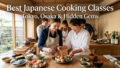
Japan’s traveler-friendly cooking class scene has exploded in recent years, and for good reason. Most classes are small-group, English-friendly, and taught by local home cooks or chefs who genuinely want you to understand why things are done a certain way — not just follow instructions like a robot. And yes, you eat everything you make. Every single thing.
Here are the three classes worth building your schedule around.
🍙 Onigiri & Miso Soup Workshop
- 📘 Level: Beginner
- ⏱ Duration: 60–90 minutes
- 💴 Price: From ¥3,000
- 🇯🇵 Instructor: Japanese local
- 🥬 Vegetarian-friendly options available
- 👥 Small group format
Onigiri looks deceptively simple. It’s just rice shaped into a triangle, right? Wrong. Apply too much pressure and you’ve got a rice hockey puck. Too little and it falls apart the moment you unwrap it. The art is in the feeling — a gentle firmness that keeps the rice together while leaving it light and fluffy inside.
In this class, you’ll learn the correct hand pressure, the right amount of salt, and the proper way to wrap nori so it stays crispy instead of turning into a soggy seaweed disaster. By the end of the session, you’ll be producing perfect triangles with the quiet confidence of someone who has been making these since childhood. You will then immediately eat at least three of them. This is expected and encouraged.
The miso soup component is equally valuable — you’ll learn how to build a proper dashi base, which is the flavor backbone of almost everything in Japanese cooking. More on that below.
▶ Browse onigiri cooking classes on Airbnb Experiences
🍣 Maki Sushi Roll Class
- 📗 Level: Beginner to Intermediate
- ⏱ Duration: 90–120 minutes
- 💴 Price: From ¥4,500
- 🔪 Sushi rice technique included
- 🔪 Basic knife skills covered
Your first maki roll will be lumpy. Your second will be… technically a cylinder of some description. By your third roll, something clicks, and suddenly you understand why people dedicate entire careers to this.
This class covers the full process: cooking and seasoning the sushi rice (which is trickier than it sounds — too much vinegar and it tastes like a salad dressing disaster), laying the nori correctly, distributing your fillings without overloading, and the all-important rolling technique using a bamboo mat called a makisu. Then comes the knife work — slicing cleanly through the roll in one smooth motion rather than hacking at it like you’re opening a coconut on a deserted island.
Will you be telling people back home that you “trained under a sushi chef in Japan”? Almost certainly. We support this entirely.
💡 Pro tip: A bamboo sushi mat (makisu) costs around ¥110 at Daiso. Grab one before you fly home — it’s the single most useful souvenir you can buy, and it takes up almost no space in your luggage.
▶ Browse maki sushi classes on Airbnb Experiences
🍜 Dashi & Miso Soup Deep Dive
- 📙 Level: All levels welcome
- ⏱ Duration: 60 minutes
- 💴 Price: From ¥2,500
- 📖 Dashi fundamentals covered
- 📖 Bring-home recipe card included
“Umami” has become a bit of a buzzword lately — slapped on everything from craft burgers to artisanal potato chips. But if you’ve only ever encountered it as a marketing term, you haven’t actually met it yet.
This class is where umami stops being a word and becomes a taste. You’ll learn to make dashi from scratch using kombu (dried kelp) and katsuobushi (bonito flakes) — the two ingredients that form the flavor foundation of Japanese cuisine. One sip of properly made dashi, and you’ll understand why Japanese food tastes the way it does. It’s not magic. It’s chemistry. Delicious, ancient chemistry.
The practical payoff is huge: once you understand dashi, you can recreate it at home using convenient dashi packs (essentially tea bags filled with the good stuff) available at any Japanese supermarket. Your miso soup will never be the same again. Neither will your instant noodle tolerance.
▶ Browse dashi & miso soup classes on Airbnb Experiences
⏰ Only have 2 hours total? Skip the full class, but try a quick miso soup tasting at a local cooking studio. Most take around 20 minutes — and will permanently ruin instant miso soup for you. Consider that a good thing.
📚 Why Japanese Cooking Classes Are Worth Your Precious Travel Time
It’s a fair question. You’re in Japan. There are temples to visit, arcades to get lost in, and entire neighborhoods of food stalls to work through. Why spend 90 minutes in a kitchen?
Here’s the case for it: food is the fastest route into a culture. Japan’s culinary traditions aren’t arbitrary — they reflect deep values around seasonality, respect for ingredients, and the pursuit of balance. In 2013, UNESCO recognized Washoku (traditional Japanese cuisine) as an Intangible Cultural Heritage — not because Japanese food is tasty (though it absolutely is), but because the culture surrounding it is genuinely irreplaceable.
According to Japan’s Ministry of Agriculture, Forestry and Fisheries, Washoku is defined by four key characteristics: nutritional balance based on a diverse array of ingredients, natural expression of the beauty of nature and the seasons, expression of the transition of the seasons, and close relationship with annual events. You won’t get that from a guidebook. But you might start to feel it the moment you taste dashi you made yourself.
A cooking class is also, frankly, one of the most efficient ways to learn. In 60 minutes with a knowledgeable local instructor, you’ll pick up more about Japanese kitchen culture than you would from reading a cookbook for a week.
🛒 Part 2: No Time for Classes? Take Japan Home Instead
Maybe your itinerary is already bursting at the seams. Maybe you’re traveling with someone who categorically refuses to spend holiday time in a kitchen. Valid. Here’s the good news: Japanese cooking is surprisingly approachable once you know the basics, and most of what you need costs less than a fancy airport coffee.
Master these three things before you leave, and you’ll be making Japanese meals at home for years.
🍚 How to Cook Perfect Japanese Rice (Without a Rice Cooker)
“But I don’t have a rice cooker.” Relax. Neither did anyone in Japan for most of Japanese history. All you need is a pot and a lid.
The magic ratio: 1 part rice to 1.2 parts water. That’s it. From there:
- Rinse the rice until the water runs clear, then soak for 30 minutes
- Bring to a boil over medium heat, then immediately reduce to the lowest simmer
- Cook for 12–13 minutes with the lid on — no peeking, no stirring
- Remove from heat and steam, lid still on, for 10 minutes
- Fold gently with a rice paddle and serve
The steaming step is non-negotiable. Skip it and you get dense, sticky rice. Respect it and you get light, fluffy, slightly glossy perfection. The Kikkoman home cooking guide covers this technique in detail if you want to go deeper.
🍜 How to Make Real Miso Soup (The Kind That Ruins Instant Packets Forever)
Instant miso soup is a perfectly fine product. This is not that. This is the real thing, and it takes about 10 minutes.
- Fill a small pot with 200–300ml of water and add one dashi pack
- Heat over medium — don’t boil, just coax it gently for 3–4 minutes
- Remove the dashi pack and dissolve in roughly 1 tablespoon of miso paste
- Add your toppings (tofu, wakame seaweed, sliced spring onion — all classics)
- Critical rule: never boil the soup after adding the miso. Boiling kills the aroma and dulls the flavor. Add miso, stir, serve.
The result is a clean, deeply savory broth that makes you wonder what you’ve been doing with your mornings. Marukome’s recipe guide (one of Japan’s most trusted miso brands) offers excellent variations once you’ve got the basic version down.
🍣 How to Roll Your Own Maki Sushi at Home
All you need is a bamboo sushi mat — the ¥110 one from Daiso is genuinely good — and a little patience with yourself.
- Make sushi rice: cook your short-grain rice, then fold in sushi vinegar while still hot
- Lay a sheet of nori rough-side-up on the bamboo mat
- Spread sushi rice evenly, leaving a 2cm gap at the top edge
- Place your fillings in a line across the middle (cucumber, avocado, crab stick — keep it simple at first)
- Roll away from you, using the mat to keep everything tight
- Seal the edge with a little water, and slice with a wet knife using one confident stroke
Your first roll will be messy. Your second will be better. By the third, you’ll feel dangerously competent. That confidence is entirely justified. The Kikkoman sushi guide is a great reference for sushi rice ratios and rolling variations.
🛍️ Your Pre-Flight Shopping List: What to Buy Before You Leave Japan
You don’t need a second suitcase. Just a few smart picks from any Japanese supermarket or 100-yen shop — and you’ll be cooking Japanese food at home for months.
🛒 Supermarket Essentials
| Item | Japanese | What to Know |
|---|---|---|
| Dashi Packs | 出汁パック | Tea-bag style sachets of bonito flakes and kelp. Drop one in hot water for instant real dashi. This is your umami shortcut — don’t leave without it. |
| Miso Paste | 味噌 | Shiro (white) = mild and slightly sweet, great for beginners. Aka (red) = deeper, richer, more intense. Try both. |
| Japanese Short-Grain Rice | 日本米 | The sticky, lightly sweet rice used for sushi and everyday meals. Look for “Japanese rice” or “sushi rice” on the label. |
| Nori Sheets | 海苔 | Dried seaweed for sushi rolls. Opt for the ones labeled “for sushi” — they’re thicker and crispier. |
| Sushi Vinegar | 寿司酢 | Pre-mixed rice seasoning for sushi. Takes the guesswork out of getting the ratio right. |
💴 100-Yen Shop Finds
▶ Daiso official site | Seria official site
| Item | Japanese | Why It’s Worth It |
|---|---|---|
| Bamboo Sushi Mat | まきす | Around ¥110. Essential for rolling maki. Lightweight, flat, and fits in any bag. |
| Wooden Ladle | お玉 | Perfect for serving miso soup. Doesn’t scratch your pots. Surprisingly satisfying to use. |
| Chopstick Set | お箸 | Lightweight and practical. Also doubles as a great low-cost souvenir. |
| Rice Paddle | しゃもじ | The right tool for folding rice without crushing the grains. Optional but genuinely useful. |
💰 Total damage: probably under ¥1,500. That’s less than a matcha latte at the airport. And unlike the latte, these will keep making your life better for months.
🎌 Final Thoughts: Don’t Let the Best Part of Japan Stay in Japan
Most souvenirs end up in a drawer within six months. A bottle of soy sauce goes in three weeks. A tin of tea, maybe two months. But the ability to make a proper bowl of miso soup, or roll a decent maki, or cook rice that actually tastes like rice? That stays with you.
Japan’s food culture is one of the most refined and accessible in the world. It rewards curiosity, punishes shortcuts (in the best possible way), and has an almost unreasonable ability to make simple ingredients taste extraordinary. The only thing better than eating it in Japan is being able to recreate even a fraction of it at home.
Whether you have 90 minutes for a cooking class or just enough time to grab a pack of dashi from the supermarket on the way to the airport, do something. Bring a piece of Japanese food culture home with you — not just in your photos, but in your kitchen.
Your future self, standing over a pot of properly made miso soup on a Tuesday morning, will thank you.
ℹ️ Prices and class availability are subject to change. Always check the latest details directly with the class provider. External links are provided for reference only and do not constitute endorsement.

Share your thoughts