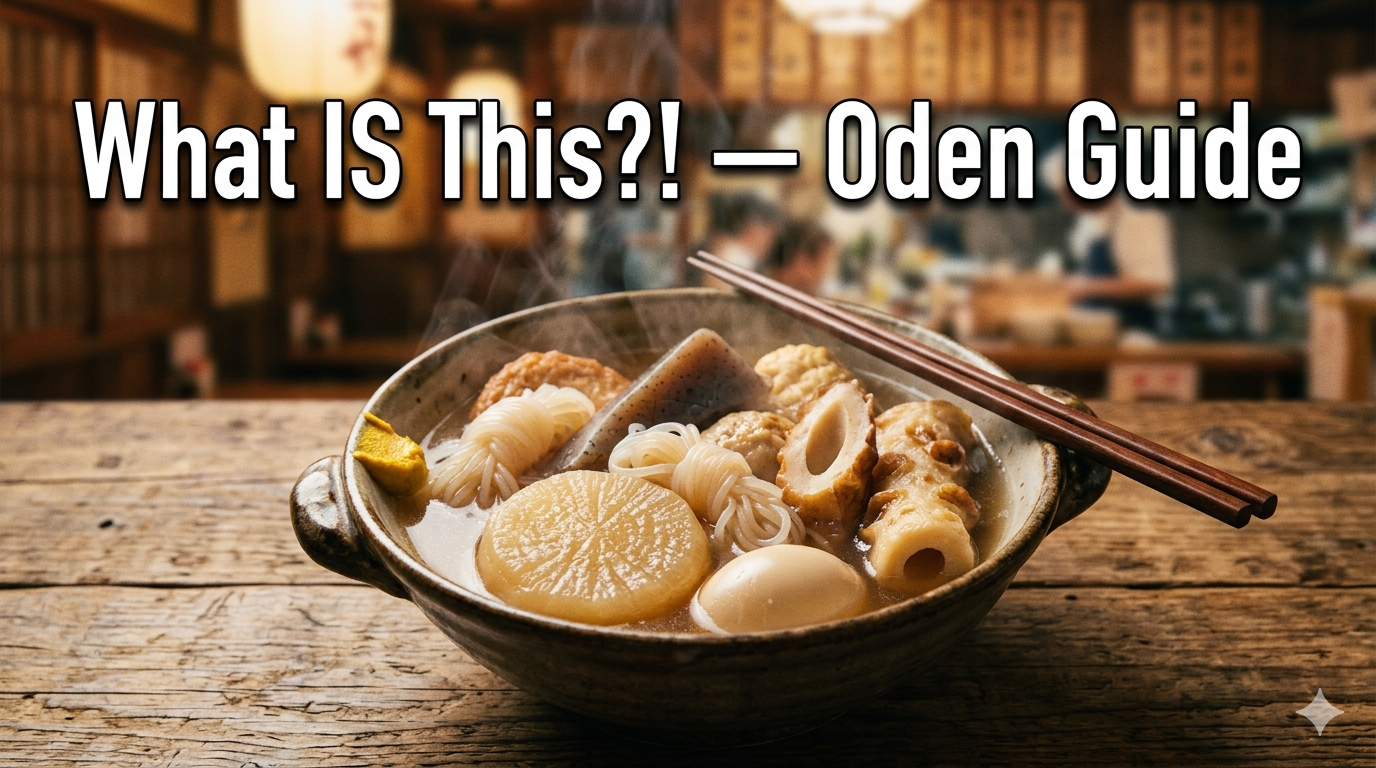
Picture this: you walk into a Japanese convenience store on a chilly autumn evening. There’s a warm, steamy counter near the entrance, filled with bubbling broth and strange-looking objects floating around.
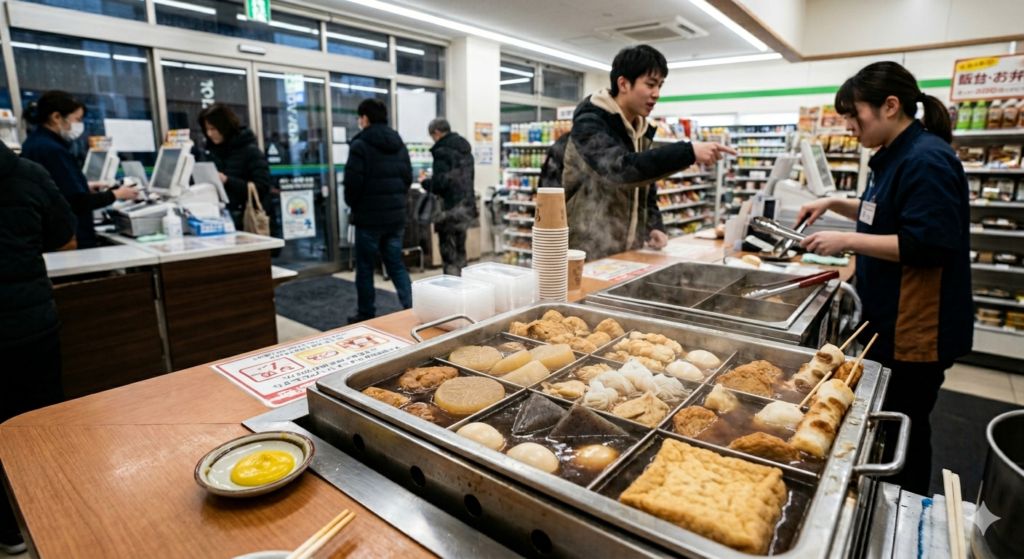
Some are brown. Some are white. One appears to be a tube. Another might be a sponge. You have absolutely no idea what you’re looking at — and yet every person around you seems perfectly calm, pointing at things and ordering with confidence.
Welcome to the world of oden (おでん) — Japan’s beloved winter hot pot dish that looks confusing at first glance, but is absolutely worth diving into.
I’m from Shizuoka Prefecture, where oden isn’t just a winter dish — it’s practically a way of life. So consider this your personal guide from someone who grew up eating oden as a childhood snack, an izakaya staple, and everything in between.
- What Is Oden? (The Short Answer: It’s Complicated)
- A Brief History: How Did Oden Come to Be?
- The Ingredients: A Field Guide to Oden’s Greatest Mysteries
- Don’t Forget the Mustard!
- Regional Variations: Why Oden Is Different Everywhere
- Shizuoka Oden: My Hometown’s Magnificent Black Masterpiece
- Where to Try Oden: From Convenience Stores to Izakayas
- Tips for First-Time Oden Eaters
- Final Thoughts: Why Oden Matters
What Is Oden? (The Short Answer: It’s Complicated)
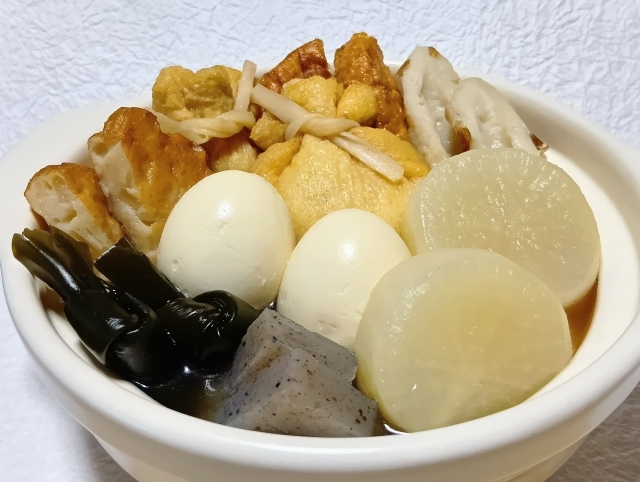
Oden is a type of Japanese hot pot dish where various ingredients are slowly simmered in a light, savory broth called dashi — typically made from kombu (kelp) and dried fish flakes. The broth soaks into every ingredient over hours of gentle cooking, turning each piece into a flavor-packed bite.
But here’s the thing — oden isn’t one dish. It’s a category of dish. The specific ingredients, the broth style, and even the condiments can vary wildly depending on where in Japan you are. A bowl of oden in Tokyo looks nothing like the oden I grew up with in Shizuoka. And both of those are completely different from what you’d find in Osaka or Hokkaido.
Think of it like pizza. Everyone knows what “pizza” means, but the pizza in Naples, New York, and Tokyo is three completely different experiences. Oden is Japan’s answer to that kind of regional culinary diversity — wrapped in warm, steamy broth.
A Brief History: How Did Oden Come to Be?
Oden’s roots go back to the Edo period (1603–1868), evolving from a dish called dengaku — tofu or konnyaku (we’ll get to that later) coated in miso paste and grilled on skewers. Over time, the “dipping things in hot broth” method became more popular, and oden as we know it today slowly took shape.
By the Meiji era (1868–1912), oden had become street food sold from yatai (food stalls) — warm, affordable, and perfect for cold nights. The dish spread across Japan and absorbed regional ingredients along the way, which is exactly why it looks so different from one prefecture to the next.
Today, oden is considered the ultimate comfort food of autumn and winter in Japan. When temperatures drop, oden pots come out — in homes, izakayas (Japanese pubs), and convenience stores nationwide.
The Ingredients: A Field Guide to Oden’s Greatest Mysteries
This is where things get interesting — and possibly a little overwhelming. Let’s break down the most common oden ingredients so you can order with confidence.
🐟 Fishcake Heaven: Japan’s Love for Surimi (Processed Fish)
Japan is an island nation, and the Japanese have been fishing for thousands of years. That deep love of fish led to the creation of surimi (すり身) — a paste made from ground, processed fish that can be shaped, flavored, and cooked in endless ways. Oden is practically a museum of surimi creativity.
Here are the surimi-based ingredients you’ll most commonly find in oden:
- Chikuwa (ちくわ) — A hollow, tube-shaped fishcake with a slightly chewy texture and a light, savory flavor. The hole in the middle makes it look like a tiny edible pipe organ. It’s one of the most iconic oden ingredients, and believe it or not, chikuwa has become so culturally embedded in Japan that it appears in anime! In the popular anime Laid-Back Camp (Yuru Camp △), the adorable dog character is literally named “Chikuwa” — a nod to how familiar and beloved this little fishcake is. (Laid-Back Camp on Wikipedia)
- Hanpen (はんぺん) — A soft, white, fluffy square made from white fish and yam. If chikuwa is the chewy one, hanpen is the cloud. It’s light, pillowy, and almost disappears in your mouth. Great for oden beginners.
- Satsuma-age (さつま揚げ) — Deep-fried fishcake patties, sometimes mixed with vegetables like burdock root or lotus root. They’re golden on the outside, springy on the inside.
- Fishcake rolls (各種ロール) — Various combinations of fishcake wrapped around ingredients like burdock root or cheese. Japan loves wrapping things in other things.
💡 Fun Fact: Japan consumes enormous quantities of surimi products. The technology and artistry behind fishcake-making is genuinely impressive — some producers have been refining their craft for over a century.
🥦 Daikon (大根): The Humble MVP
If oden had a starting lineup, daikon (Japanese radish) would be the captain. A thick, cylindrical slice of daikon slowly simmered in broth for hours becomes something magical — soft enough to cut with chopsticks, completely saturated with flavor, and deeply satisfying.
Before being added to oden, daikon is often pre-boiled in rice water to remove bitterness. After hours in the oden pot, it turns slightly translucent and becomes almost impossibly tender. For many Japanese people, the daikon is the first piece they reach for.
🥚 Boiled Egg (ゆで卵)
Perhaps the most universally understandable oden ingredient. A hard-boiled egg, simmered in dashi until its outer layers take on a beautiful brown tinge from the broth. Simple, familiar, and delicious. If you’re nervous about trying oden for the first time, start with the egg.
🫙 Konnyaku and Shirataki: Japan’s Most Mysterious Foods
And here we arrive at the ingredient that most confuses foreigners — and frankly, the ingredient I love most: konnyaku (こんにゃく).
Konnyaku (also called konjac in English) is made from the corm of the konjac plant — a root vegetable sometimes called “devil’s tongue” in English. The corm is processed into a flour, mixed with water and a coagulant, and formed into a firm, jelly-like block. It’s usually grey or white, occasionally speckled, and has the texture of… well, something between firm Jell-O and a very dense sponge.
Here’s the truly baffling thing about konnyaku: it has almost no flavor whatsoever. According to Wikipedia, it tastes “vaguely like salt, usually with a slightly oceanic taste.” Its main contribution to oden is texture — a springy, slightly chewy bite that Japanese people find deeply satisfying, and that many non-Japanese people find deeply confusing.
“Why would you eat something with no taste?” is a very reasonable question. The Japanese answer is essentially: “Because the texture and the way it absorbs broth is the whole point.”
Konnyaku has been part of Japanese cuisine since the 6th century, originally introduced by Buddhist monks from China. It’s valued not just for texture but for its impressive health benefits. Gunma Prefecture’s official tourism site describes konnyaku as a superfood — it’s high in glucomannan fiber, virtually zero calories, and has been shown to support digestion, lower blood sugar, and reduce cholesterol. Japanese people affectionately call it “the broom of the stomach.”
Over 90% of Japan’s konjac is grown in Gunma Prefecture, making it a point of serious local pride.
Shirataki (しらたき) is konnyaku’s noodle-shaped cousin. The name literally means “white waterfall,” which is honestly a beautiful name for what is essentially a zero-calorie noodle that looks like translucent thread. In oden, shirataki coils absorb broth beautifully and add a gentle chewiness to the pot. Outside Japan, shirataki has gained popularity as a low-carb pasta substitute — so you may have seen it at your local health food store under names like “miracle noodles” or “slim pasta.”
🌟 My honest recommendation: Don’t skip the konnyaku. Yes, it’s strange. Yes, it basically tastes like broth-flavored rubber. But there’s something deeply comforting about its texture — and once you understand it in context, it just fits. Trust the Japanese people on this one. They’ve had 1,400 years to figure it out.
🥔 Other Common Ingredients
- Atsu-age (厚揚げ) — Thick deep-fried tofu. Crispy on the outside from frying, soft on the inside, with a savory broth-soaked middle layer that is genuinely addictive.
- Mochi-kinchaku (もちきんちゃく) — A small pouch made of deep-fried tofu (abura-age) stuffed with mochi (sticky rice cake). When you bite into it, the melted mochi oozes out into the broth. This is a fan favorite.
- Gobō-maki (ごぼう巻き) — Burdock root wrapped in fishcake. Earthy, slightly fibrous, and deeply savory.
- Beef tendon (牛筋) — Slowly simmered until it becomes meltingly tender. A rich, collagen-rich ingredient with an almost gelatinous texture. Very popular in Osaka-style oden.
Don’t Forget the Mustard!
One crucial detail that many first-time oden eaters miss: karashi (からし), Japanese hot mustard, is the traditional condiment for oden.
Unlike Western yellow mustard, karashi is sharper and more pungent — closer to wasabi in its sinus-clearing intensity. A tiny dab on daikon or konnyaku transforms the whole experience. Many oden shops place karashi directly on the table for customers to use freely.
Start small. Karashi is no joke.
Regional Variations: Why Oden Is Different Everywhere
One of the most fascinating things about oden is how dramatically it changes across Japan. The same dish — in name — can look, taste, and feel completely different depending on where you eat it.
- Kanto (Tokyo) style: Clear, light dashi broth made primarily from katsuobushi (bonito flakes) and kombu. Delicate and elegant in flavor.
- Kansai (Osaka) style: Even lighter broth, often a pale golden color, with a focus on the natural sweetness of the dashi. Beef tendon is a common addition.
- Nagoya style: Features miso-based broth, giving it a richer, darker, more intense flavor profile.
- Hokkaido style: Often includes local seafood like crab and scallops, reflecting the north’s abundant marine harvest.
But the regional variation I know best — and the one closest to my heart — deserves its own section entirely.
Shizuoka Oden: My Hometown’s Magnificent Black Masterpiece
I grew up in Shizuoka Prefecture, which sits on the Pacific coast between Tokyo and Nagoya — home to Mount Fuji, some of Japan’s best green tea, and one of the most distinctive regional oden styles in the entire country.
Shizuoka oden is immediately recognizable because of its dramatically dark broth. While Tokyo oden is golden and clear, Shizuoka oden broth is jet black — almost intimidating to look at. The color comes from the concentrated soy sauce and beef tendon broth that’s been built up and replenished over years (sometimes decades) of continuous cooking.
But here’s what makes it extra special: everything is served on skewers, like a savory Japanese yakitori situation. And then — the finishing touch — it’s all topped generously with ao-nori (青のり, dried green seaweed flakes) and dashi-ko (だし粉, a powder made from ground sardines and mackerel).
According to the Japanese Ministry of Agriculture, Forestry and Fisheries, Shizuoka oden is recognized as one of the region’s official local dishes (郷土料理). It features ingredients like black hanpen (黒はんぺん) — a darker, denser fishcake made from blue fish — which was developed using the abundant seafood of Suruga Bay.
What I love most about Shizuoka oden isn’t just the taste — it’s the atmosphere. Near Shizuoka Station, there are two legendary alleys: Aoba Oden-gai (青葉おでん街) and Aoba Yokocho (青葉横丁), where around ten small oden shops line up side by side, their warm lights glowing and steam rising into the night air. These alleys trace back to after World War II, when over 200 oden stalls once filled this area. The stalls were eventually replaced by permanent shops, but the cozy, intimate atmosphere remains.
Sitting at a tiny counter, eating skewered oden with black broth and a generous dusting of ao-nori, with a cold beer in hand — there’s nothing quite like it. That’s my Shizuoka.
Where to Try Oden: From Convenience Stores to Izakayas
Here’s the beautiful thing about oden: you don’t need a special occasion or a reservation to experience it. It’s everywhere in autumn and winter.
🏪 Convenience Stores (コンビニ): The Most Accessible Option
Japan’s convenience stores — 7-Eleven, Lawson, FamilyMart — are famously excellent, and oden is one of their seasonal masterpieces. From around September or October through March, oden pots appear at the front counter of virtually every convenience store in Japan.
You simply point at what you want, and the staff fishes it out of the broth and puts it in a container for you. Each piece costs anywhere from ¥60 to ¥150 (roughly $0.40–$1.00). You can pick up three or four pieces and have a satisfying meal for under ¥500.
This is the perfect, low-pressure way to try oden for the first time. Start with the egg and the daikon. Add a piece of hanpen. Then, when you’re feeling brave, try the konnyaku. The staff will not judge you regardless of what you point at.
🍺 Izakayas (居酒屋): Oden with a Beer
Many izakayas — Japanese gastropubs — serve oden as part of their menu, especially during the colder months. At an izakaya, oden is typically ordered as a shared dish, with friends reaching into a communal pot and pairing each bite with beer, sake, or shochu.
There’s something deeply social about izakaya oden. The slow, unhurried act of simmering and choosing pieces lends itself to long, relaxed evenings. It’s comfort food in the truest sense.
🏮 Specialty Oden Shops
In cities like Shizuoka, Osaka, and parts of Tokyo, you can find restaurants that specialize exclusively in oden. These shops often have pots that have been simmering — and continuously added to — for years. The broth at such establishments has a depth and complexity that simply cannot be replicated at home. If you ever find yourself in Shizuoka, the Aoba oden alleys near the station are a must-visit.
Tips for First-Time Oden Eaters
- Start simple: Egg, daikon, hanpen. These are the most universally accessible ingredients for non-Japanese palates.
- Use a little mustard: Don’t skip the karashi. A tiny amount added to mild ingredients like daikon or egg elevates the whole experience.
- Drink the broth: If you’re given a small cup of broth, drink it. It’s often the best part.
- Be adventurous with konnyaku: Give it a genuine try. Chew it slowly and focus on the texture experience, not the flavor. You might surprise yourself.
- Explore regional styles: If you’re traveling through multiple regions of Japan, try oden at each stop. The differences are genuinely fascinating.
- Timing matters: Oden season is roughly October through March. Outside of this window, you may struggle to find it at convenience stores.
Final Thoughts: Why Oden Matters
Oden isn’t flashy. It won’t appear on Instagram the way a bowl of beautifully arranged ramen will. It’s not the Japanese food most tourists put on their “must-eat” lists. But oden is, in many ways, the most Japanese food there is.
It’s patient. It rewards slow cooking and long simmering. It embraces regional differences rather than standardizing everything into one form. It takes humble, everyday ingredients — a daikon radish, a fishcake, a grey block of tasteless jelly — and through hours of gentle heat and dashi, transforms them into something deeply satisfying.
And yes, the konnyaku is still my favorite. Grey, rubbery, essentially flavorless — and somehow, I love every bite of it. Don’t knock it until you’ve tried it soaked in a Shizuoka-style broth with ao-nori sprinkled on top.
Japan has many foods that will immediately win you over. Oden is the food that wins you over slowly — one strange, broth-soaked bite at a time.
📌 Quick Oden Reference
- What it is: Japanese hot pot dish with ingredients simmered in dashi broth
- When to eat it: Autumn and winter (October–March)
- Where to find it: Convenience stores, izakayas, specialty oden shops
- Must-try ingredients: Daikon, egg, hanpen, chikuwa, konnyaku
- Don’t forget: Karashi (hot mustard) as a condiment
- Regional highlight: Shizuoka oden — black broth, skewered, topped with ao-nori
🔗 Useful Links


Share your thoughts