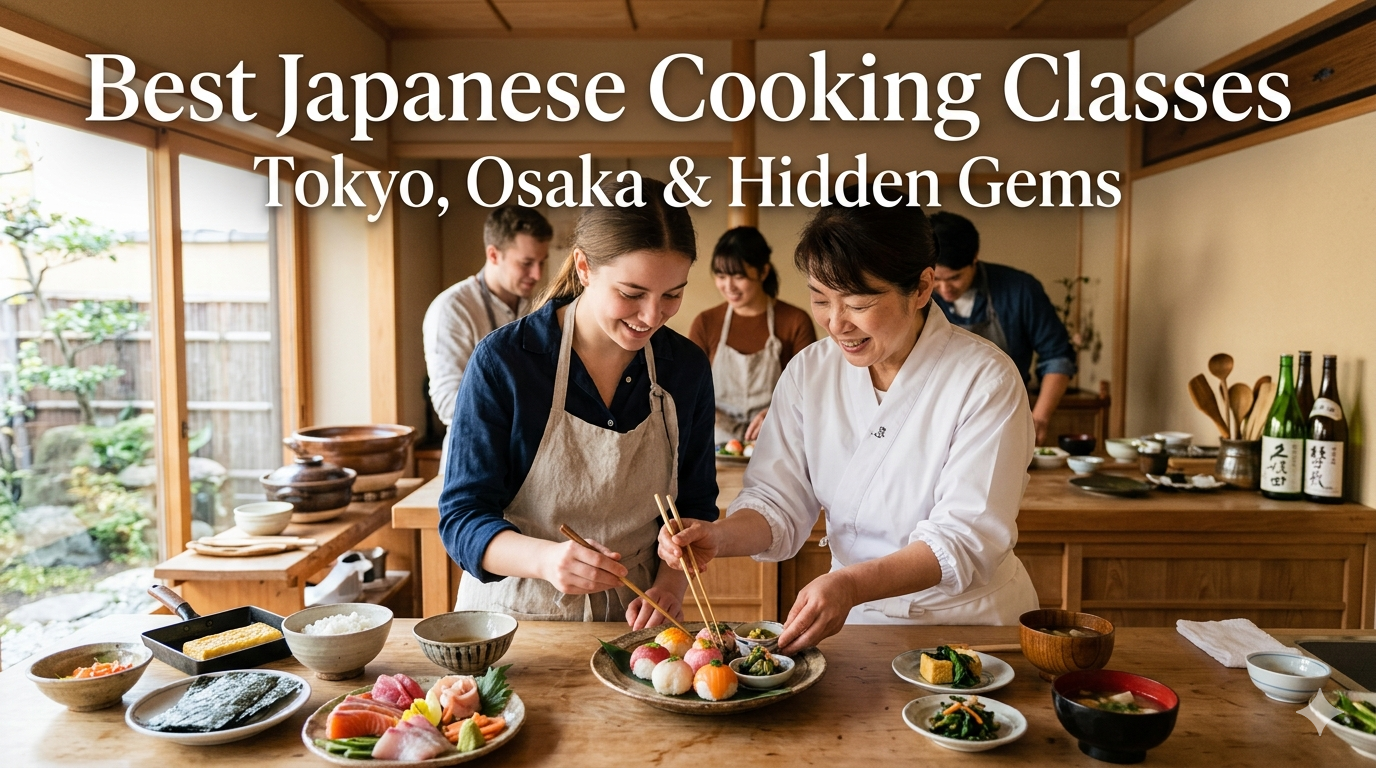
So You Want to Learn Japanese Cooking. Where Do You Even Start?
Here’s the honest truth about Japanese cooking classes in Japan: there are a lot of them. Like, a lot a lot. Type “cooking class Tokyo” into Google, and you’ll get approximately 47 million results and zero clarity. So we did the grunt work for you — researching, reading hundreds of real traveller reviews, and yes, eating a fair amount of test food in the process. (Tough job. We manage.)
What we were looking for: authentic experiences that teach you something real, small group sizes so you actually get to cook, English-friendly hosts who can explain why you’re doing what you’re doing, and — crucially — no tourist traps dressed up as cultural experiences.
The result is this guide. Whether you want to make ramen from scratch, roll perfect sushi in Asakusa, or learn the everyday home cooking that Japanese families actually eat on a Tuesday evening, there’s something here for you. Let’s get into it.
🗼 Tokyo — 東京
Tokyo is the obvious starting point, and it’s genuinely one of the best cities in the world to learn Japanese cooking — not because it has the most classes (though it does), but because the quality of private home cooking experiences here is exceptional. Our strong recommendation: if you only have time for one class in Tokyo, choose a home-style cooking class over a studio class. It’s a fundamentally different experience — more personal, more educational, and far closer to what Japanese people actually eat every day.
🏡 Mayuko’s Little Kitchen
Location: Various areas in central Tokyo | Setting: Private home kitchen
Best for: Authentic home cooking & genuine cultural immersion
From: ¥6,000〜
If you’ve researched Japanese cooking classes at all, you’ve probably already come across Mayuko’s. There’s a reason it keeps appearing at the top of every list — Mayuko teaches real Japanese home cooking in a private Tokyo kitchen in English, covering what Japanese people actually eat as an everyday meal. We’re talking ichiju sansai (one soup, three sides), seasonal vegetables, miso soup made from scratch, the stuff that doesn’t appear on restaurant menus because it’s just… what people make at home.
The atmosphere is relaxed and genuinely welcoming — more “eating at a friend’s house” than “attending a class.” Mayuko’s award-winning class covers the basics of Japanese food, seasonings, and table customs in a warm, friendly environment. Menu options include ramen, sushi rolls, bento boxes, and everyday meal sets — and the first group to book gets to choose.
⭐ TripAdvisor Travelers’ Choice (7 years running)
⚠️ 2026 Note: Mayuko’s kitchen is closed until approximately April 2026 due to maternity leave — but food tours are still being run by her team. If you’re visiting after May 2026, check availability directly. If you’re going sooner, the night food tour is a great alternative while the kitchen is on pause.
🔗 Official site: mayukoslittlekitchen.com
🔗 Book a class or food tour →
🍱 Washoku Class with Emi (Emi’s Kitchen)
Location: Nerima, Tokyo (approx. 40 min from central Tokyo) | Setting: Private home or cooking studio
Best for: Serious home cooking & detailed technique
From: ¥7,000〜
Emi is the kind of cooking teacher who makes you feel like you actually learned something, not just completed a tourism activity. After training with three renowned chefs, she became a culinary expert capable of preparing almost any authentic Japanese dish — and she uses 20+ ingredients per session to create meals that are fresh, healthy, and nutritionally balanced.
The class takes place either in her home or a professional studio, and you choose three dishes from her curated menu. Beyond the cooking itself, Emi is an excellent conversationalist — the class covers not just recipes, but Japanese table manners, food culture, nutrition science, and more, whatever you want to talk about. Traveler after traveler describes it as one of the highlights of their trip to Japan.
Nerima is a residential area — quieter and less tourist-heavy than central Tokyo, which is part of the charm. It’s also about a 20-minute walk from the Harry Potter Museum in Tokyo, and the Oedo line runs direct from Azabu-Juban to Nerima if you’re planning to visit TeamLab Borderless. Easy to combine with a full day out.
⚠️ Groups of 4+ should book 3–4 months in advance. Menu requests should be submitted at least 4 days before class.
🔗 Book Emi’s class via Traveling Spoon →
🍣 Sushi Making Tokyo (Asakusa)
Location: Asakusa, Taito-ku, Tokyo | Setting: Dedicated studio
Best for: First-time visitors, sightseers & quick sushi experience
From: ¥4,500〜
Sometimes you want a full cultural immersion. And sometimes you’ve got two hours between Senso-ji Temple and your next bullet train, and you want to make sushi. Sushi Making Tokyo is built exactly for the second scenario — and it executes it very well.
Located in historic Asakusa just a 3-minute walk from Asakusa Station, the class is taught by English-speaking instructors and covers both maki rolls and nigiri sushi from scratch. It’s beginner-friendly, well-organized, and consistently highly rated. The program has over 500,000 followers and received TripAdvisor’s Best of the Best award.
One reviewer tip: the location is in the Relink Kaminarimon Building — look for the big sign near Asakusa Station, then take the elevator up. Tables by the huge windows have a great view of Sumida River. Good to know before you wander the backstreets looking for it.
Gluten-free and vegan options are available. Groups of up to 90 people accepted — great for large groups or families.
🔗 Official site: washoku.site/sushimakingtokyo →
🛒 Washoku Market-to-Table Class
Location: Iriya / Taito area, Tokyo | Setting: Supermarket + home kitchen | Duration: ~4 hours
Best for: Food lovers & deep cultural experience
From: ¥8,000〜
This is the class for people who think “a cooking class” sounds nice but “actually understanding Japanese food culture” sounds better. The experience starts not at a kitchen counter but at a local Japanese supermarket — where you learn how to read labels, how seasonal ingredients are chosen, and why that particular variety of miso costs ¥800 while the one next to it costs ¥200. (Spoiler: there’s a real answer, and it matters.)
Then you cook. Everything. Together. The slower pace means you actually absorb what you’re doing rather than just completing steps. If you want to go home genuinely able to recreate Japanese food — not just with a recipe card but with actual understanding — this is the class.
🔗 Browse Tokyo market-to-table classes on byFood →
⛩️ Kamakura & Yokohama — 鎌倉・横浜
Kamakura is one of Japan’s most beautiful small cities — ancient temples, sea views, deer wandering around (okay, that’s Nara, but Kamakura has its own charms). It’s also a very easy day trip from Tokyo, and if you’re already heading there for the sights, adding a cooking class to the itinerary is a natural fit. The pace out here is noticeably calmer than central Tokyo, and the classes reflect that.
🏯 Japanese Home Cooking in Kamakura (with Naoko Tsunoi)
Location: Kamakura city centre | Setting: Private home
Best for: Intimate home experience & traditional meals
From: ¥5,000〜
Naoko Tsunoi has been running cooking workshops for international visitors in Kamakura since 2005, and her focus on healthy Japanese cooking that you can actually reproduce at home makes her stand out from many similar experiences. Her workshops cover traditional Japanese home cooking for foreign visitors, with an emphasis on recipes that can be adapted to ingredients available in other countries.
Menu options include sushi, donburi (rice bowls), and shojin ryori — the refined vegetarian cuisine historically associated with Buddhist temples in Kamakura. Given that Kamakura is full of ancient temples, this context makes the food all the more meaningful to cook and eat there.
The experience is intimate — small numbers, private home, the chance to visit a real Japanese kitchen and see how people actually live. One visitor described it as feeling “more like visiting a local home than attending a class,” which is precisely the point.
🔗 View Naoko’s classes on byFood →
🐙 Osaka — 大阪
Osaka has a word for its food culture: kuidaore (食い倒れ). It means “to eat yourself into ruin.” Osaka people say this about themselves with genuine pride. This is a city where strangers will stop you on the street to recommend their favourite takoyaki stand, where the conversation at any dinner table eventually circles back to food, and where even convenience store food is somehow better than in other cities. Taking a cooking class here isn’t just a tourist activity — it’s participating in something the city genuinely cares about.
🫙 Osaka Kitchen with Yoko-san
Location: Minami-Morimachi area, near Osaka Castle | Setting: Private home
Best for: Warm atmosphere, flexible menus & real Osaka personality
From: ¥7,500〜
Yoko is everything you’d hope a local Osaka cooking host would be. A food-loving, travel-loving, people-loving Osakan, she’s passionate not just about Japanese food but about its history and culture. She also published a cookbook in Dutch during the pandemic — over 50 Japanese home recipes — which gives you a sense of how seriously she takes the craft of teaching, not just cooking.
The experience starts with Yoko meeting you at Minami-Morimachi subway station and walking you to her apartment through local shopping streets, offering an impromptu neighbourhood tour along the way. You’ll cook four dishes from scratch in about 1.5 hours — options include rolled sushi, okonomiyaki, gyoza, or miso soup, depending on your preferences and the season. Vegetarian, vegan, and gluten-free options are available on request.
You can also add a sake tasting set for an extra charge — two kinds of sake in small bottles. Recommended.
🔗 Official site: osakakitchen.net →
🔗 Book via Traveling Spoon →
🍣 Sushi Making Osaka (Shinsaibashi)
Location: Shinsaibashi, central Osaka | Setting: Studio
Best for: Central access & quick sushi experience
From: ¥4,500〜
Same trusted provider as the Asakusa class, different city. The Osaka version is based in Shinsaibashi — a short walk from Dotonbori — and offers the same hands-on sushi making experience with English-speaking instructors. If you’re already planning to hit Dotonbori for takoyaki and street food in the evening, this makes an ideal afternoon activity beforehand.
Efficient, fun, beginner-friendly, and easy to slot into a busy Osaka itinerary without committing half a day. Classes run throughout the day, so timing is flexible.
🔗 Official site: sushimakingjapan.com →
How to Choose the Right Class for You
Before you book anything, it helps to be honest with yourself about what you actually want from the experience. Here’s a rough guide:
| You want… | Best pick |
|---|---|
| To cook what Japanese families really eat at home | Mayuko’s Little Kitchen (Tokyo) or Emi’s Kitchen (Nerima) |
| Sushi, quickly, near your sightseeing | Sushi Making Tokyo (Asakusa) or Sushi Making Osaka (Shinsaibashi) |
| A deep food culture experience with market visit | Washoku Market-to-Table (Tokyo) |
| Something relaxed & intimate outside the city | Naoko Tsunoi’s class (Kamakura) |
| Osaka energy, real home kitchen, local host | Osaka Kitchen with Yoko-san |
Practical Tips Before You Book
- Book early, especially for private home classes. Popular hosts like Emi and Yoko fill up weeks or even months in advance, particularly in spring (March–May) and autumn (September–November). Don’t leave it until the week before.
- Tell them your dietary needs upfront. Almost all of the classes listed here offer vegetarian, vegan, and gluten-free options — but only if you mention it when booking. Don’t assume.
- Arrive on time (or a bit early). Many classes take place in someone’s home or small studio. Being late isn’t just inconvenient — it’s genuinely impolite in Japanese culture.
- Ask questions. The best part of these smaller, private classes is direct access to a knowledgeable host. Ask about ingredients, techniques, where to buy Japanese pantry staples back home, everything. That’s what they’re there for.
- You don’t need to be able to cook. Every class on this list is beginner-friendly. You literally cannot be too inexperienced. Enthusiasm is the only prerequisite.
Final Thought
A cooking class in Japan is not just a way to fill a morning — it’s one of the best ways to actually understand Japanese culture rather than just observe it from a tourist’s distance. You sit in someone’s home. You handle real ingredients. You make something with your hands and then eat it together. You ask questions and get real answers. And you go home with recipes that actually work — and the knowledge to make them mean something.
That’s worth a few hours of your trip. Book the class.
📌 Quick Reference: Classes at a Glance
| Class | Location | Setting | From | Book via |
|---|---|---|---|---|
| Mayuko’s Little Kitchen ⚠️ (closed until ~May 2026) | Central Tokyo | Private home | ¥6,000 | Official site |
| Washoku Class with Emi | Nerima, Tokyo | Home / Studio | ¥7,000 | Traveling Spoon |
| Sushi Making Tokyo | Asakusa, Tokyo | Studio | ¥4,500 | Official site |
| Market-to-Table Class | Taito, Tokyo | Market + home | ¥8,000 | byFood |
| Naoko Tsunoi’s Class | Kamakura | Private home | ¥5,000 | byFood |
| Osaka Kitchen with Yoko | Osaka | Private home | ¥7,500 | Official site |
| Sushi Making Osaka | Shinsaibashi, Osaka | Studio | ¥4,500 | Official site |
⚠️ Prices and availability change — always check the official or booking page for the latest information before your trip.


Share your thoughts