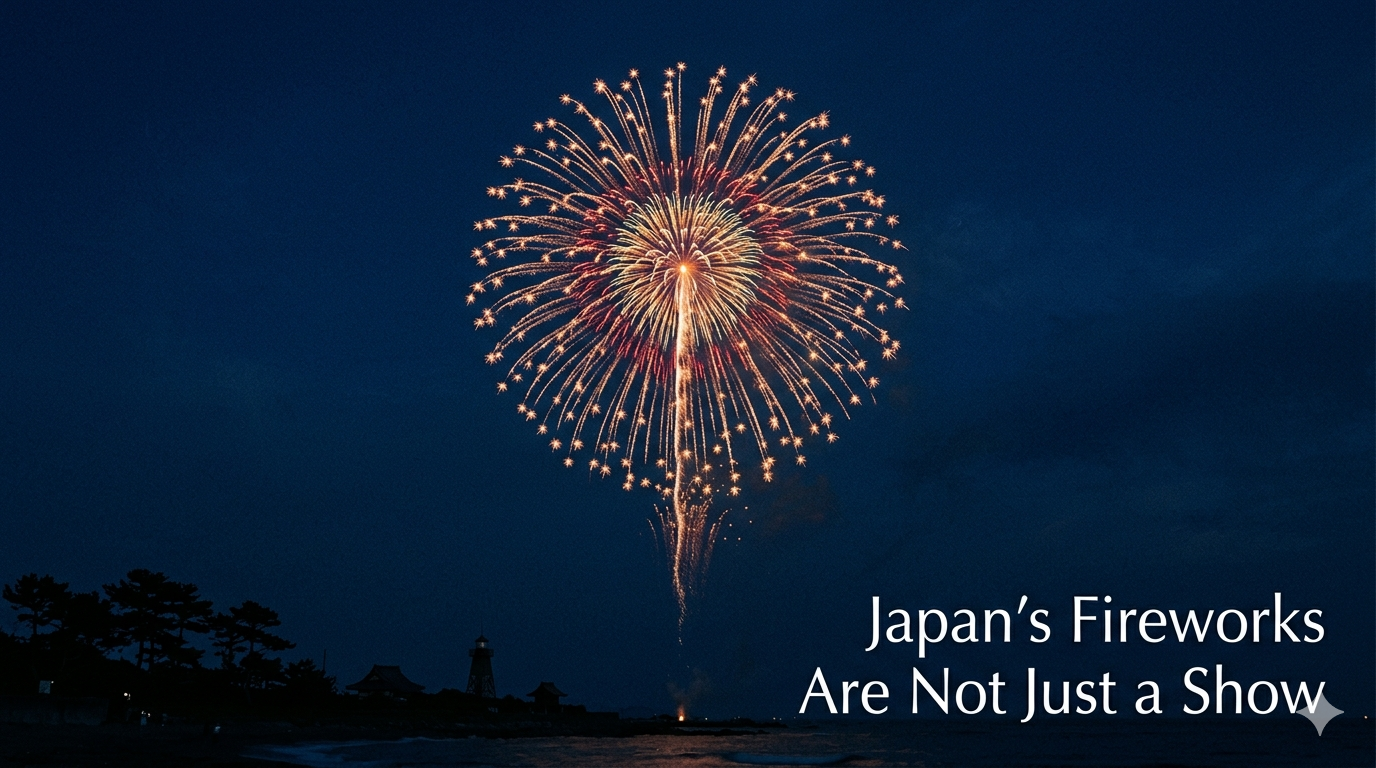
- Wait… Japan Has Fireworks Professionals?
- Japanese Fireworks: Art First, Spectacle Second
- A Brief History: Fireworks as Prayer
- Japan’s Three Great Fireworks Festivals (日本三大花火)
- The Crowd Problem — And How to Avoid It
- Hidden Gem Fireworks Festivals Worth Knowing
- Practical Tips for Visiting Fireworks Festivals in Japan
- Final Thoughts
Wait… Japan Has Fireworks Professionals?
Let’s get one thing straight before we dive in: in Japan, setting off fireworks is a licensed profession. That’s right — there are actual, certified hanabi-shi (花火師), or fireworks artisans, who spend years mastering their craft. Meanwhile, in many countries, “fireworks professional” just means the guy at the corner store who sells you a pack of sparklers and says “good luck.” Japan is playing a completely different game.
And it’s not just the professionals. Regular Japanese families love fireworks too. On summer evenings across the country, you’ll find kids and adults alike crouched in driveways and parks, doing tezutsu hanabi (hand-held fireworks) and sparklers — called senko hanabi — with the kind of meditative focus usually reserved for tea ceremonies. Yes, playing with sparklers in Japan can look like a spiritual experience. That’s how seriously they take it.
But before we get to the big festivals, let’s talk about why Japanese fireworks are different — because once you understand the philosophy behind them, you’ll never look at fireworks the same way again.
Japanese Fireworks: Art First, Spectacle Second
Most countries’ fireworks say: “Look how many we can shoot up! Look how loud! Look how big!” Japan’s fireworks say something different. They say: “Look how perfect this one is.”
Japanese fireworks culture is built on artistry and craftsmanship at a level that is genuinely world-class. Here are the key things that set Japanese fireworks apart:
🎆 The Perfect Circle
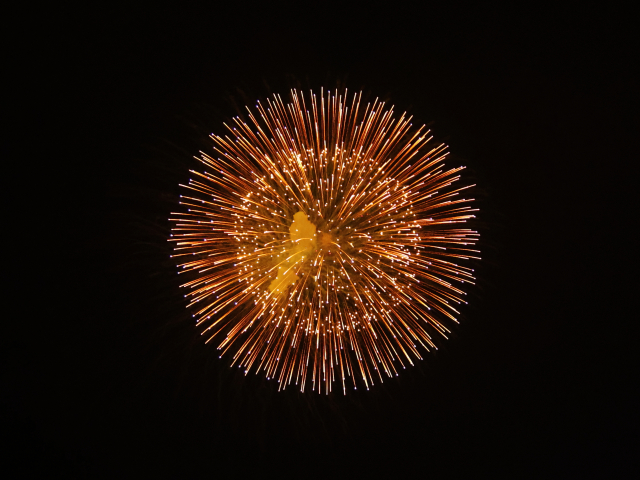
The ultimate goal of a Japanese fireworks shell is to open into a perfectly round sphere. Not oval. Not lopsided. A true, mathematically perfect circle of light. Achieving this requires the fireworks artisan to pack the tiny chemical “stars” (the individual light-producing particles) with extraordinary precision inside the shell — so that no matter which angle you view it from, it looks like a flawless ball of light expanding in the sky.
There’s even a specific technique unique to Japan called shin-iri warimono — fireworks with a multi-layered concentric ring structure inside. Think of it like a firework with a firework inside it, inside another firework. When it opens, you see ring within ring within ring, all perfectly symmetrical. It’s the kind of thing that makes the audience go genuinely quiet for a second before the applause comes.
🌈 Colours That Change Mid-Air
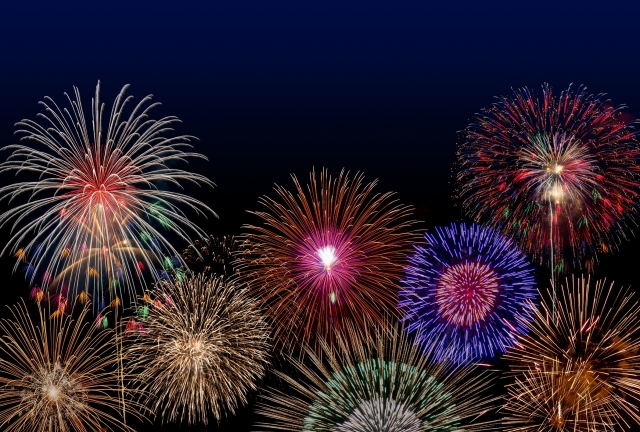
Here’s something that blows most first-time visitors’ minds: Japanese fireworks change colour as they burn. A single shell might open red, then shift to blue, then fade to white before disappearing. This gradient effect — and the science and craft required to make it happen consistently — is a hallmark of Japanese fireworks design.
Even more fascinating is the Japanese obsession with the kiekuchi (消え口), or the “moment of disappearance.” The ideal is for all the sparks to vanish at exactly the same moment, leaving the sky completely clean — no trailing embers, no lingering smoke trails. Just a perfect bloom of light, and then silence. The Japanese find deep beauty in that clean ending. There’s almost a mono no aware — a bittersweet appreciation for the transience of beautiful things — embedded in the design of every single shell.
📜 Every Shell Has a Name
In Japan, individual fireworks shells are given official names that describe exactly what they do. A name like Nobori-kojima-tsuki-yae-shin-henka-giku (昇小花付八重芯変化菊) tells an expert exactly what the shell will do at every stage of its flight and burst. These names are announced at competitions, and connoisseurs judge not just whether the firework looked good — but whether it matched its name perfectly.
Compare that to, say, a Fourth of July show in the US, where the announcer typically says “and here come… more fireworks!” Japan’s approach is closer to a wine expert describing every note in a glass — but for explosions.
A Brief History: Fireworks as Prayer
Japanese fireworks didn’t start as entertainment. They originated as a form of prayer — a way to mourn the dead, ward off evil spirits, and pray for protection against disease and disaster. The famous Sumida River Fireworks in Tokyo, for example, began in 1733 as a memorial service for the victims of a great famine and epidemic.
This spiritual origin is part of why Japanese fireworks feel different emotionally. Even today’s most dazzling displays carry a quiet solemnity beneath the spectacle. There’s something gentle and melancholic in the beauty — a feeling that you’re not just watching a show, but witnessing a kind of offering to the sky.
If you ever wonder why Japanese crowds sometimes watch fireworks in near-silence, this is why. It’s respect. It’s awe. And maybe just a little bit of trying not to cry.
Japan’s Three Great Fireworks Festivals (日本三大花火)
If you want to witness Japanese fireworks at their absolute peak, these are the three events you need to know. A word of warning, though: these festivals attract hundreds of thousands of people. The crowds are on a scale that can genuinely shock first-timers. Plan far in advance — we’re talking months, not weeks.
🏆 1. Omagari Fireworks — Akita Prefecture
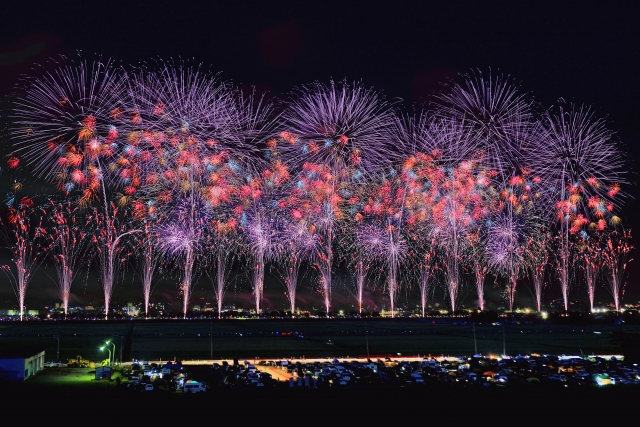
This is the Olympics of Japanese fireworks. Held annually in Daisen City, Akita, the Zenkoku Hanabi Kyogi Taikai (National Fireworks Competition) gathers the country’s top hanabi-shi to compete for the highest honour in the field — including the coveted Prime Minister’s Award. It’s been running since 1910, making it over 110 years old.
What makes Omagari unique is that it’s not just a show — it’s a serious competition, judged on technical perfection, artistry, and creativity. There’s even a daytime fireworks category, where artisans use coloured smoke instead of light to create aerial designs. Yes, daytime fireworks judged on the beauty of their smoke patterns. Japan, everyone.
📅 2026 Date: August 29 (Saturday)
📍 Venue: Omono River, Daisen City, Akita
🚃 Access: From JR Omagari Station, approx. 30 min on foot
🔗 Official site: https://www.omagari-hanabi.com/
⚠️ Note: Crowds exceed 600,000 people. Accommodation in the area books out many months in advance. Strongly recommend booking a package tour if attending.
🏆 2. Tsuchiura National Fireworks Competition — Ibaraki Prefecture
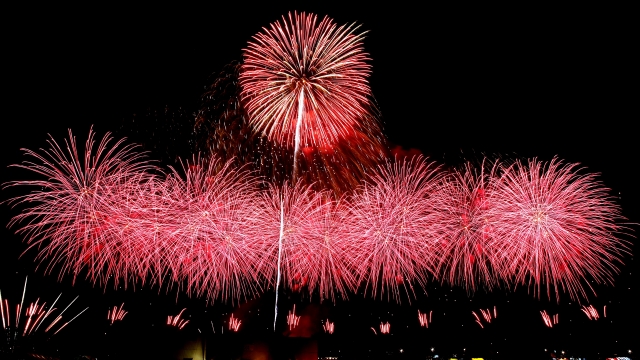
Another elite competition-style event, Tsuchiura Zenkoku Hanabi Kyogi Taikai has been running since 1925 and is famous for its autumn timing — held in November, when the air is cold, clear, and perfect for showing off the crisp colours of competition-grade shells. Three categories are judged: Starmine (rapid-fire sequences), 10-inch shells (judged on perfect circular form), and Creative Fireworks (open concept).
📅 2026 Date: November 1 (Sunday)
📍 Venue: Sakuragawa Riverbank, Tsuchiura City, Ibaraki
🚃 Access: From JR Tsuchiura Station (West Exit), approx. 30 min on foot or shuttle bus
🔗 Official site: https://www.tsuchiura-hanabi.jp/
🏆 3. Nagaoka Grand Fireworks — Niigata Prefecture
If Omagari is the Olympics, Nagaoka is the Super Bowl. Held over two nights in August on the banks of the Shinano River, this festival is massive in scale and deeply emotional in meaning. Nagaoka was devastated by bombing in WWII and later by the 2004 Chuetsu earthquake — and the fireworks here serve as both memorial and celebration of resilience.
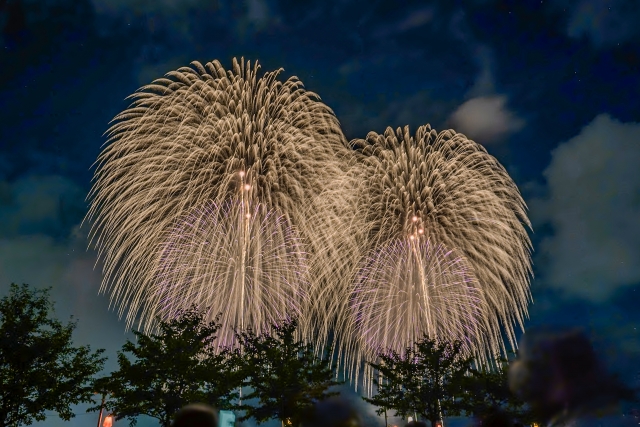
The signature piece is Phoenix — a 2km-wide cascade of golden and white sparks that fills the entire sky above the river, symbolising rebirth after disaster. When the Phoenix goes up, grown adults weep. It is not embarrassing. It is completely understandable.
📅 2026 Dates: August 2 (Sunday) & August 3 (Monday), 7:20 PM–9:10 PM
📍 Venue: Shinano River, Nagaoka City, Niigata
🚃 Access: From JR Nagaoka Station, approx. 30 min on foot
🔗 More info: Japan Fireworks Festival Guide
⚠️ Note: Attendance exceeds 500,000 over two nights. Book accommodation many months ahead.
The Crowd Problem — And How to Avoid It
Let’s be honest: the three great festivals are extraordinary, but they can also feel like a survival challenge. We’re talking about 500,000 to 800,000 people all trying to leave the same area at the same time. Train platforms become human sardine cans. The walk back to the station can take two hours. People sometimes just sit on the grass until 3am waiting for the crowds to thin out.
This is not a rumour. This is the reality.
So here’s what I actually recommend, especially if it’s your first time in Japan: skip the famous three and find a smaller local festival instead.
I’ve lived in several places around Japan, and some of my favourite fireworks memories come from events that would never make a “Top 10 Japan Fireworks” list. The quality of the fireworks is still excellent — because Japanese fireworks companies maintain high standards even for local events — but you can actually breathe, and you can find a spot on the grass and lie on your back watching the sky, which is genuinely the best way to watch fireworks ever invented.
Hidden Gem Fireworks Festivals Worth Knowing
🎇 Numazu Summer Festival & Kano River Fireworks — Shizuoka Prefecture
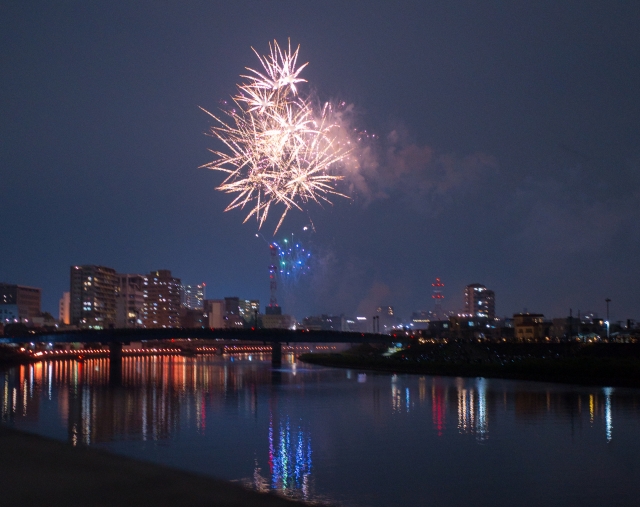
I used to live in Numazu, a port city on Suruga Bay at the foot of Mt. Fuji — yes, that Mt. Fuji — and the summer fireworks here are something special. The festival takes place along the Kano River that runs right through the city centre, which means you can watch from the riverside with a completely open view of the sky. No mountains blocking one side, no buildings getting in the way.
What’s great for visitors is that JR Numazu Station is only a 10-minute walk to the viewing area. There’s also a vibrant summer festival happening at the same time — food stalls, taiko drumming, street performers — so it’s a full evening out, not just a fireworks show. The finale involves a Niagara waterfall of sparks stretching across the river, which is absolutely worth staying for.
📅 Usually: Late July (2 nights) — check for 2026 dates closer to the time
📍 Venue: Kano River (between Eidai Bridge and Ayumi Bridge), Numazu City
🚃 Access: JR Numazu Station South Exit, 10 min walk
🔗 Tourist info: https://numazukanko.jp/
🎇 Zushi Beach Fireworks — Kanagawa Prefecture
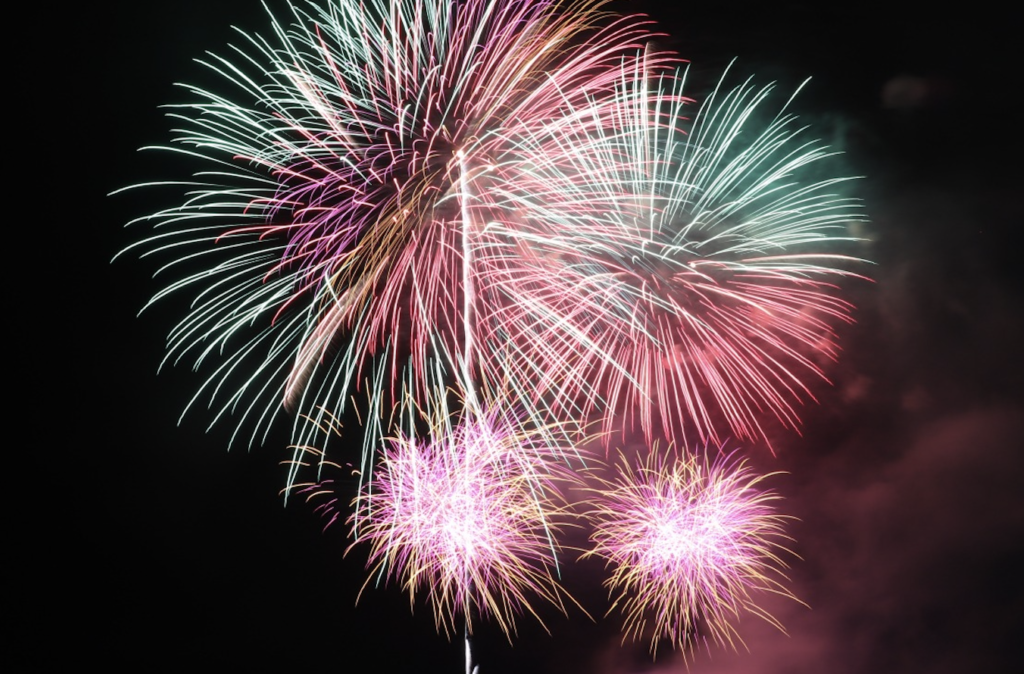
I also lived in Hayama for a while — a beautiful little coastal town on the Miura Peninsula near Kamakura. The nearest major fireworks event is the Zushi Beach Fireworks Festival, just a short walk away, and it’s the polar opposite of Omagari in the best possible way.
Zushi Beach is a small, beautiful bay where you can spread a blanket on the sand and watch about 7,000 shells go up over the ocean. The music is synchronised with the fireworks, so the whole thing feels like a live performance rather than a random light show. Because Zushi is a residential beach town — not a major tourist destination — the atmosphere is relaxed and local. And in May (yes, May — not August!), the ocean breeze is perfect and the evenings aren’t yet unbearably hot.
📅 2026 Date: May 21 (Thursday), 7:20 PM–8:15 PM
📍 Venue: Zushi Beach, Zushi City, Kanagawa
🚃 Access: JR Yokosuka Line “Zushi” Station or Keikyu Line “Zushi-Hayama” Station — walkable
🔗 Official site: https://zushihanabi.com/
🔗 City info: Zushi City Official Page
⚠️ Note: About 100,000 people attend, so it’s not “empty” — but it’s far more manageable than the big three. Paid seating is available; check the official site for details.
🎇 Miyazu Lantern Festival & Fireworks — Kyoto Prefecture
If you want one fireworks experience that is genuinely unlike anything else you’ll find in Japan — or the world — put Miyazu on your list. The small port city of Miyazu sits on a scenic bay in northern Kyoto Prefecture, just a short trip from one of Japan’s top scenic spots: Amanohashidate, the famous “Bridge to Heaven” sandbar that is counted among the three most beautiful views in Japan.
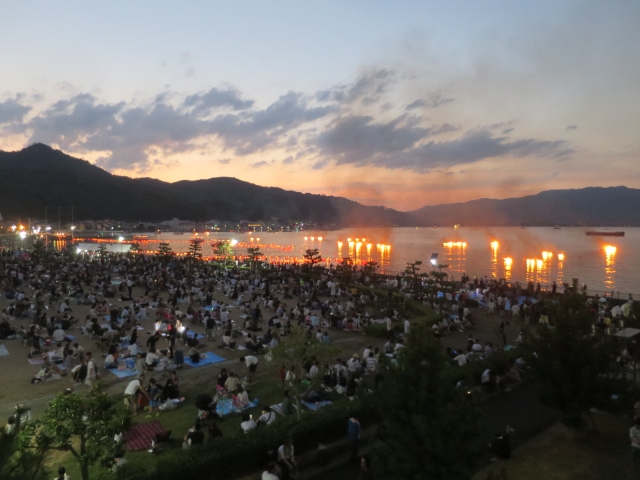
The Miyazu Toro Nagashi Hanabi Taikai is held every year on August 16th — the last night of the Obon festival, when the spirits of ancestors are said to return to the other world. And the way Miyazu sends them off is extraordinary. Around 10,000 red and white paper lanterns are set afloat on Miyazu Bay, drifting on the water and surrounding the ceremonial “spirit boats” (shōryō-bune) sent out by families who have lost someone in the past year. As the lanterns spread across the dark water and the bay begins to glow, the fireworks start from the sea.
The combination — a bay full of flickering lanterns below, fireworks bursting above the water’s surface — is something that photographs cannot fully capture. It’s both a celebration and a farewell, and the crowd watching from the shore tends to go very quiet. This is exactly what Japanese fireworks were born to be: a prayer, a tribute, a sending-off into the sky.
Because Miyazu is a small coastal town rather than a major city, the crowds are manageable — roughly 70,000 visitors spread around the bay, with plenty of open shoreline to find your own spot. And if you arrive a day or two early, you can explore Amanohashidate by cable car or bicycle. As hidden gem trips go, this is about as good as it gets in the Kansai region.
📅 2026 Date: August 16 (Sunday) — traditionally fixed to this date each year
📍 Venue: Shimizaki Park & Miyazu Bay, Miyazu City, Kyoto Prefecture
🚃 Access: Kyoto Tango Railway “Miyazu” Station, approx. 10 min walk northwest
🔗 Official info: Miyazu Chamber of Commerce (Hanabi page)
🔗 Tourism: Amanohashidate Tourism — Miyazu Toro Event
💡 Tip: Viewing boat tickets are also available — watching the lanterns drift around you from the water is an unforgettable experience. Check the Amanohashidate tourism site for booking details closer to the date.
Practical Tips for Visiting Fireworks Festivals in Japan
Here are a few things that will make your experience much smoother:
- Wear a yukata (summer kimono) if you want to blend in. Many visitors rent one for the occasion. You’ll fit right in and get great photos. Japanese people will be delighted.
- Arrive early. For major festivals, arriving 2–3 hours early is normal. Bring something to sit on — a small picnic mat works perfectly.
- Take the train. Driving to any large fireworks festival in Japan is an act of optimism that usually ends in tears. Trains run extra services on festival nights.
- Buy food from stalls (yatai) on-site. Festival food — takoyaki, yakisoba, kakigori — is part of the experience. Don’t skip it.
- Look up. Seriously, just look up. Japanese fireworks are designed to fill the entire sky. Don’t spend it looking at your phone.
- Stay for the finale. The closing sequence, called the uchi-dome, is almost always the highlight of the night. Never leave early.
Final Thoughts
Japanese fireworks are one of those experiences that genuinely exceed expectation — and the expectation is already very high. Whether you’re watching a competition shell burst into five concentric rings of colour and then vanish without a trace, or lying on a beach in Zushi watching 7,000 shells sync to music, or trying to process the Phoenix at Nagaoka while the person next to you is quietly weeping — this is an art form unlike anything else in the world.
It started as a prayer. Centuries later, it still feels like one.
So this summer, put down the tourist checklist for a day, find a river or a beach, spread out a mat, and just look up. Japan will take care of the rest.
📌 2026 Schedule at a Glance
| Festival | Date (2026) | Location |
|---|---|---|
| Zushi Beach Fireworks | May 21 (Thu) | Zushi, Kanagawa |
| Nagaoka Grand Fireworks | Aug 2–3 (Sun–Mon) | Nagaoka, Niigata |
| Numazu Summer Festival Fireworks | Late July (TBC) | Numazu, Shizuoka |
| Miyazu Lantern & Fireworks Festival | Aug 16 (Sun) | Miyazu, Kyoto Pref. |
| Omagari National Fireworks | Aug 29 (Sat) | Daisen, Akita |
| Tsuchiura National Fireworks | Nov 1 (Sun) | Tsuchiura, Ibaraki |
⚠️ Always check official websites for the latest information, as dates and times can change.
=========================================================
END OF POST
=========================================================
NOTES FOR WORDPRESS / COCOON:
– Paste the body section into the “Code Editor” view of the block editor (top right ⋮ → “Code Editor”) for perfect formatting, then switch back to visual
– The table will render as a styled block table in Cocoon
– The
-
- list will render cleanly as a Cocoon bullet list block
-
- – H2 and H3 headings will use Cocoon’s default heading styles
-
- – The
-
- separator will render as Cocoon’s decorative separator
-
- – If you want coloured heading decorations, apply Cocoon’s “Heading” style settings in Appearance > Cocoon Settings > Style after pasting
-
- – Emoji headings (🏆🎆🎇) are plain Unicode and display correctly in all modern browsers
- – Word count: approximately 2,000 words


Share your thoughts