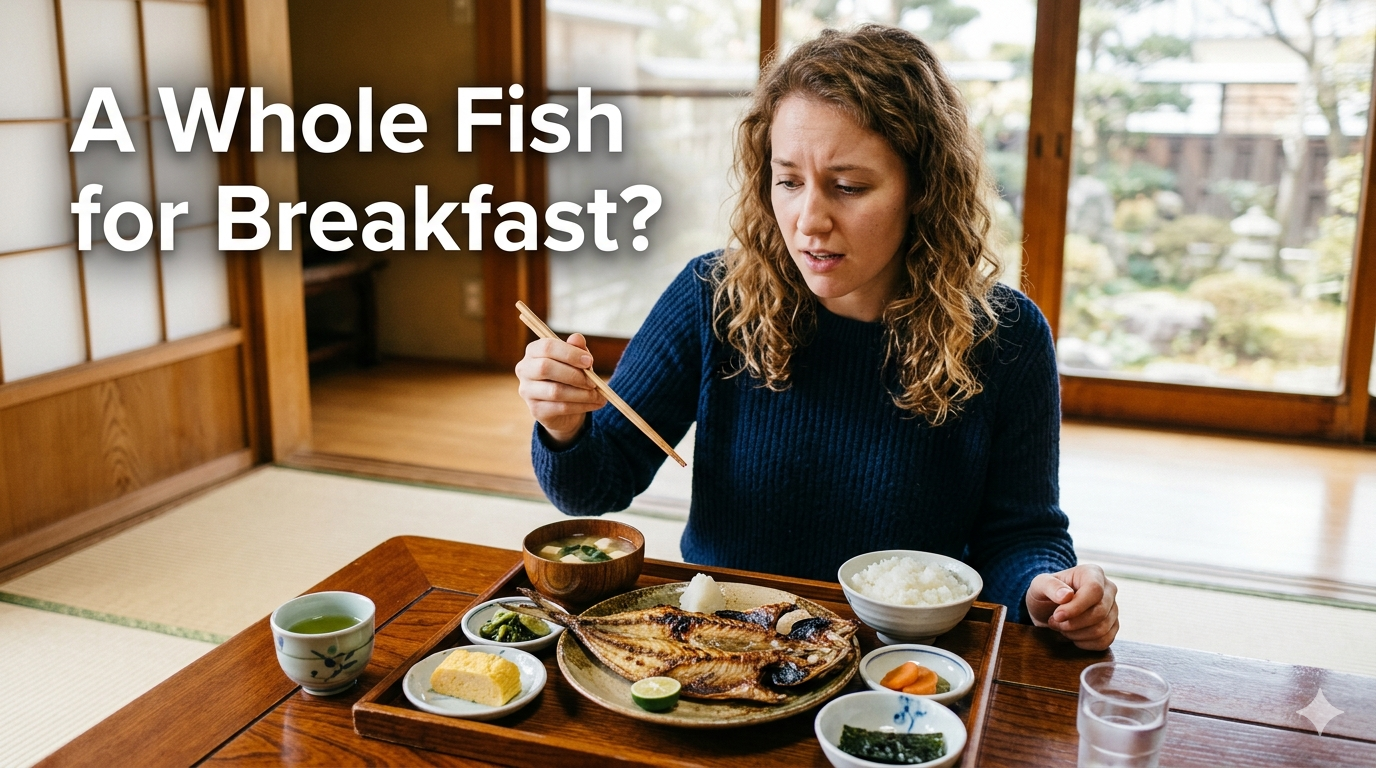
So there you are. You finally did it — you booked a stay at a real Japanese ryokan (traditional inn). The tatami floor, the yukata robe, the onsen bath… you feel like you’ve stepped straight into a Studio Ghibli film. Morning comes. Breakfast arrives. And on the tray, next to the miso soup and the perfectly steamed rice, is a whole fish — head, tail, bones and all — staring up at you.
You pick up your chopsticks. The fish stares back. Now what?
Don’t panic. That fish is called himono (干物), and once you know what it is and how to eat it, it might just become one of your favourite things about Japan. This guide has you covered — from history and flavour science to exactly how to eat it without making a mess (or at least, how to make less of a mess than most people do, Japanese included).
- 🐟 What Is Himono, Exactly?
- 🏯 The Ryokan Breakfast: A Rite of Passage
- 🍽️ How Do You Actually Eat Himono? (There IS a Right Answer)
- 😋 Why Does Himono Taste SO Good? (The Science of Flavour)
- 🐠 Not All Himono Are the Same: A Handy Guide
- 📍 The Holy Land of Himono: Japan’s Top Production Regions
- 🗺️ No Ryokan? No Problem: Where to Eat Himono Like a Local
- 🌅 Final Thoughts: Embrace the Fish
🐟 What Is Himono, Exactly?
Himono (干物) literally means “dried thing.” In practice, it refers to fish that has been cleaned, opened flat (butterfly-style), seasoned — usually with salt or a light brine — and then dried, either in the sun or with carefully controlled airflow. The result is a fish with concentrated flavour, a slightly firm texture, and a beautiful golden colour when grilled.
This isn’t jerky. This isn’t fish crackers. Think of it as the Japanese answer to aged cheese or cured ham: a traditional preservation technique that, somewhere along the way, turned into something genuinely delicious.
📜 Did You Know?
Himono is ancient. We’re talking Jomon Period ancient — that’s over 10,000 years ago. Archaeologists have found dried shellfish remains in Jomon pottery. Japan has been perfecting this art longer than most civilisations have existed.
By the Edo Period (1603–1868), dried fish had become a staple across Japan. And today, the tradition lives on — not out of necessity, but because the flavour simply cannot be beaten.
🏯 The Ryokan Breakfast: A Rite of Passage
If staying at a ryokan is on your Japan bucket list (and it absolutely should be), prepare yourself for the morning meal. Japanese ryokan breakfast is nothing like grabbing a coffee and a croissant. It is an event.
The spread typically includes:
- Steamed white rice (gohan)
- Miso soup (miso shiru)
- Pickled vegetables (tsukemono)
- Rolled egg omelette (tamagoyaki)
- Tofu, natto (fermented soybeans), or small side dishes
- And the star of the show: a grilled himono
Most visitors have heard of sashimi. Many have tried teriyaki. But himono — a whole butterflied fish, grilled to perfection — is a genuine “wait, what do I do with this?” moment for first-timers.
You may know how to eat around a fish in your home country. But Japanese fish come to the table differently. No fillets here. Just a beautifully simple, honest fish doing exactly what it was meant to do: taste incredible.
✈️ Personal Note from the Author
I lived in Numazu, Shizuoka — the self-proclaimed capital of Japanese himono. I ate dried fish for breakfast so regularly that plain toast started to feel like something was missing. If there’s one thing I can tell you with authority, it’s this: once you fall for himono, you won’t stop thinking about it back home.
🍽️ How Do You Actually Eat Himono? (There IS a Right Answer)
Here’s the good news: there is a correct way to eat himono. Here’s the better news: most Japanese people don’t do it perfectly either, so you are in excellent company.
The fish is typically served opened flat, skin side down, flesh facing up. Here’s the step-by-step:
- Start from the back (spine side). Use your chopsticks to gently separate the flesh from the backbone. Work your way down.
- Eat the top half of the flesh. The fish is split open, so the top half lifts away quite cleanly from the bones if you work carefully.
- Remove the backbone. Once the top is done, lift the spine — it should come away in one clean piece if you’re lucky. This is the moment of truth.
- Eat the bottom half. Now you have access to the flesh on the other side.
- Do NOT flip the fish. In Japanese dining etiquette, flipping the fish is considered bad luck (it resembles capsizing a boat). Eat the underside by reaching underneath after removing the backbone.
⚠️ The One Rule to Remember
Don’t flip the fish. Work top-to-bottom, remove the spine, then eat the bottom half from above. It’s a small thing, but locals will quietly notice — and quietly appreciate — that you know.
What about the head? The cheek meat near the jaw is actually considered a delicacy in Japan. If you’re feeling adventurous, go for it. As for the fins and tail — leave those. You’re not a seagull.
And the bones? You’ll find small pin bones scattered in the flesh. Pick them out gently with your chopsticks or — if you’re at a casual meal — just eat around them. Don’t stress. This is breakfast, not a performance.
😋 Why Does Himono Taste SO Good? (The Science of Flavour)
Here’s where it gets genuinely fascinating. The drying process behind himono isn’t just about preservation — it’s flavour alchemy.
When fish is dried, two major things happen:
- Water content drops, which concentrates every flavour molecule in the flesh. The fish becomes a more intense, richer version of itself.
- Enzymatic reactions occur, breaking down proteins into amino acids — the building blocks of umami. Specifically, inosinate (IMP) increases significantly during the drying process, giving himono its deep, savoury punch.
Grilling the dried fish then adds the Maillard reaction — the same browning reaction that makes grilled steak or toasted bread smell irresistible. The skin crisps. The edges caramelise. The flesh stays moist inside.
The result is a fish that is simultaneously more intensely “fishy” (in the best way) and more complex than fresh fish. It’s the umami equivalent of turning up the volume on everything you love about seafood.
🔬 Umami, Explained Simply
Umami is the fifth basic taste (alongside sweet, sour, salty, bitter). It’s the deep, savoury, “moreish” sensation you get from soy sauce, parmesan cheese, mushrooms, and — you guessed it — properly dried fish. Japan gave the world the word, and himono is one of its purest expressions.
🐠 Not All Himono Are the Same: A Handy Guide
Walk into a himono shop and you’ll quickly discover this is not a one-fish situation. Here are the most common varieties you’re likely to encounter:
| Fish | Japanese Name | Flavour Profile |
|---|---|---|
| Horse mackerel | Aji (アジ) | The classic. Rich, savoury, slightly oily. The most popular. |
| Mackerel | Saba (サバ) | Bold and fatty. Strong flavour — not for the timid. |
| Pacific saury | Sanma (サンマ) | Seasonal autumn fish. Slightly bitter, deeply savoury. |
| Yellowtail | Buri / Hamachi (ブリ) | Meaty and rich. A premium option. |
| Squid | Ika (イカ) | Chewy, intensely flavoured. Technically not a fish, but very much a himono. |
| Atka mackerel | Hokke (ホッケ) | From Hokkaido. Large, mild, and incredibly juicy. A crowd favourite. |
If you’re a himono beginner, start with aji (horse mackerel). It’s the most approachable, the most widely available, and — not coincidentally — the fish most associated with Numazu, the king of himono production.
📍 The Holy Land of Himono: Japan’s Top Production Regions
Japan takes its himono seriously — seriously enough that different cities have developed distinct styles and reputations over centuries.
Numazu, Shizuoka (沼津市) — This is the big one. Numazu accounts for roughly 40% of Japan’s total dried fish production, making it the undisputed capital of himono. Sitting at the foot of Mt. Fuji, with access to the deep, cold waters of Suruga Bay, Numazu has ideal conditions: excellent fish, sea breezes, and dry winter air. The town’s himono shops are legendary, and the local aji no himono (dried horse mackerel) is considered the benchmark against which all others are measured.
Odawara, Kanagawa (小田原市) — Another powerhouse. Odawara’s history with dried fish stretches back to the Edo Period, when it served as a key post town on the old Tokaido road. Travellers would pick up himono as provisions for the journey. That tradition continues today.
Himi, Toyama (氷見市) — Famous for its winter yellowtail (kan buri), Himi produces some of Japan’s most prized dried fish. The cold Japan Sea air creates ideal drying conditions.
Choshi, Chiba (銚子市) — One of Japan’s largest fishing ports, Choshi specialises in sardines and mackerel. If you’re eating saba no himono anywhere in eastern Japan, there’s a good chance it came through Choshi.
🗺️ No Ryokan? No Problem: Where to Eat Himono Like a Local
A ryokan stay is magical, but it’s not the only way to experience proper himono. Here are your options:
🏪 1. Go Straight to Numazu
Numazu is about 90 minutes from Tokyo by shinkansen or express train. The Numazu Minato Shinsenkan (沼津みなと新鮮館) and the surrounding harbour area are packed with himono shops where you can buy vacuum-packed dried fish to take home — or, in many cases, have it grilled on the spot. This is the pilgrimage for fish lovers.
🍱 2. Teishoku Restaurants
A teishoku (定食) is a set meal — rice, soup, pickles, and a main dish. Many traditional teishoku restaurants serve grilled himono as a lunch or dinner option. Look for the kanji 定食 on signs, or restaurants with plastic food displays showing a grilled fish set.
🏠 3. Cook It Yourself
Every supermarket in Japan sells himono in the fish section, vacuum-packed and ready to grill. If you have access to a kitchen — or even just a fish grill at your Airbnb — this is one of the most satisfying and affordable ways to eat like a Japanese person at home. Grill skin-side down first, flip once (on the grill, not on the plate), and serve with rice and miso soup. Done.
🛒 4. Department Store Basement Food Halls (Depachika)
The basement food floors of Japanese department stores (depachika — 地下) are a wonderland, and they almost always include premium himono from top producers. Isetan, Takashimaya, and Mitsukoshi are good bets in major cities. You can find beautifully packaged dried fish perfect for gifts or for eating in your hotel room (if you have a microwave — not ideal, but we won’t judge).
🎁 Pro Travel Tip
Vacuum-packed himono is one of the best food souvenirs from Japan. It travels well, it’s lightweight, and nothing says “I really understand Japanese food culture” like bringing home dried fish from Numazu. Check airline regulations for fish products before packing — but most vacuum-sealed products are fine in checked luggage.
🌅 Final Thoughts: Embrace the Fish
Here’s the truth about himono: it doesn’t matter if you eat it perfectly. It doesn’t matter if you leave half the bones and a bit of flesh behind, or if you accidentally poke the eye with your chopstick (it happens to the best of us). What matters is that you try it — really try it, with rice, in the morning, ideally with Mt. Fuji visible through the window if the universe is feeling generous.
Himono is one of those foods that quietly represents everything remarkable about Japanese culinary culture: patience, technique, respect for ingredients, and an instinct for extracting maximum flavour from simple things. It’s been part of Japanese life for over 10,000 years, and for good reason.
So the next time a whole dried fish appears on your breakfast tray, don’t panic. Pick up your chopsticks, start from the back, remove the spine, and eat with confidence. You’ve got this.
And if it all falls apart into a pile of bones and flakes? Just smile and eat every last delicious piece. That’s what the rest of us do.
📝 Quick Recap: Himono Essentials
✅ What it is: Butterflied, salt-dried, and grilled fish — a 10,000-year-old Japanese tradition
✅ How to eat it: Top flesh first → remove spine → bottom flesh. Never flip the fish on the plate.
✅ Why it’s delicious: Drying concentrates umami; grilling adds caramelised complexity
✅ Best starter fish: Aji (horse mackerel)
✅ Where to find it: Ryokan breakfast, teishoku restaurants, supermarkets, Numazu harbour
✅ Best place to buy: Numazu, Shizuoka — Japan’s himono capital
Itadakimasu! 🙏

Share your thoughts