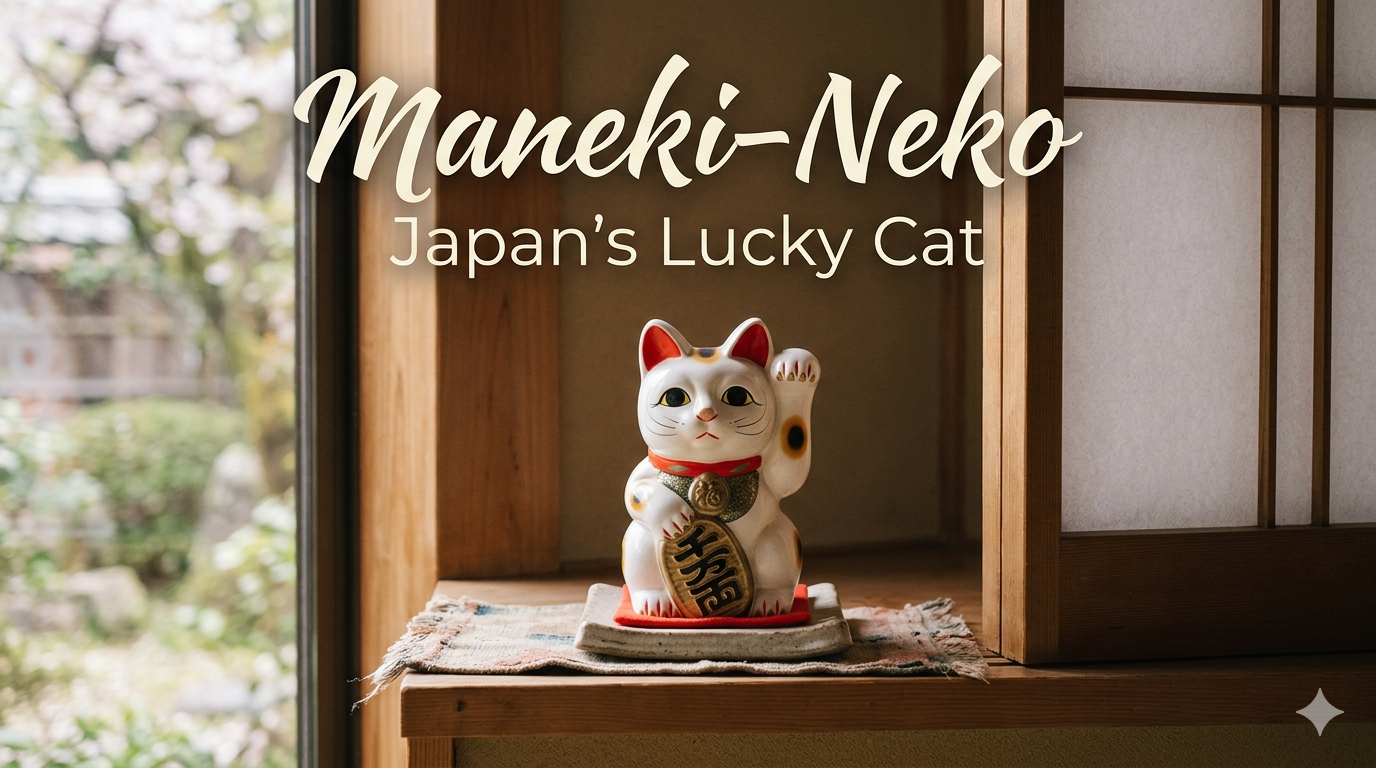
I’ll be honest with you — I’m completely obsessed with cats. I share my home with one (or, more accurately, my cat shares their home with me), and that’s exactly why I get it. I understand, on a deeply personal level, why Japan developed an entire culture around a little ceramic cat with a raised paw. Cats have a way of making you believe they hold ancient wisdom, quiet power, and maybe — just maybe — the key to your fortune. Japan simply made it official.
So if you’re visiting Japan and you spot a cat figurine in a shop window, one paw raised as if hailing a taxi, don’t walk past it. Stop. Listen. That cat is talking to you. And by the end of this article, you’ll know exactly why you should bring it home.
🐱 What Is a Maneki-Neko?
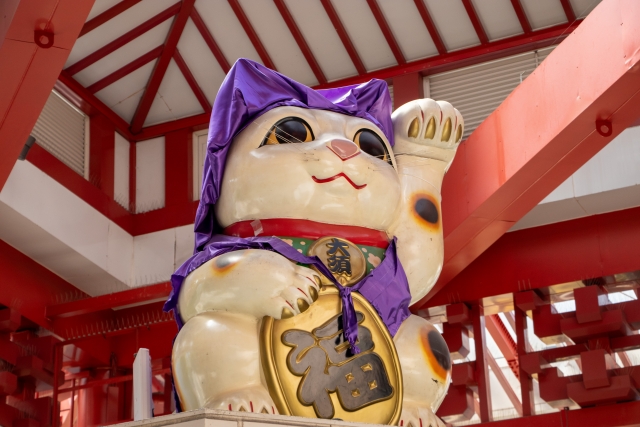
Japan is full of cats — neko in Japanese — roaming temples, fishing villages, and island sanctuaries. But the Maneki-Neko (招き猫), literally “beckoning cat,” is a very special kind of feline. It’s a figurine, usually ceramic or porcelain, of a cat sitting upright with one paw raised in a welcoming gesture. You’ve seen it in the windows of Japanese restaurants, ramen shops, and hotels around the world. It might look like a cheerful decoration. It is so much more.
The raised paw isn’t a wave — it’s an invitation. In Japanese culture, this gesture means “come here,” and the Maneki-Neko has been inviting good luck, wealth, customers, and happiness through doors for centuries.
📖 Where Did It Come From? The Origin Stories
Like any great legend, the Maneki-Neko has more than one origin story. Here are the leading contenders:
⚡ The Gotokuji Temple Legend (Setagaya, Tokyo)
The most dramatic story involves a cat, a feudal lord, and a very well-timed thunderstorm. In the early Edo period, Ii Naotaka, the lord of the Hikone domain, was passing by a run-down temple called Kōtoku-in (later renamed Gotokuji) when a cat at the gate raised its paw and seemed to beckon him inside. Being the kind of person who trusts cats (a man of excellent judgment), he followed. Moments later, lightning struck the very spot where he had been standing. The cat had literally saved his life.
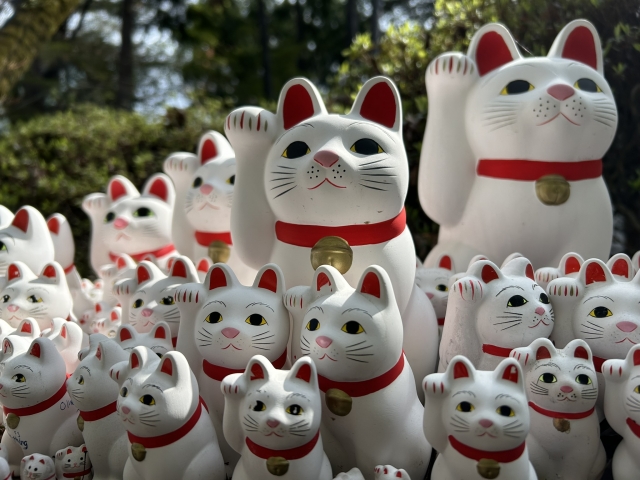
A grateful Ii Naotaka sponsored the temple’s restoration, and Gotokuji became the temple of the Maneki-Neko. The figurines sold there today — simple white cats without a coin, calm and elegant — are called Shōfuku Byōji (招福猫児), and you can still buy them on the temple grounds.
There’s an interesting historical footnote here. At the time of the cat’s legendary beckoning, the temple was actually associated with the Kira clan — yes, the same clan connected to the famous 47 Ronin story. The Kiras had fallen from power in 1590, leaving the temple without support. The cat’s intervention, which brought the wealthy Ii clan to the temple’s door, effectively saved the institution twice: once from the storm, and once from obscurity. That’s a seriously talented cat.
And the story doesn’t end there. Ii Naotaka’s connection to the Maneki-Neko lives on in a delightful way: Hikonyan, the beloved mascot of Hikone City (Naotaka’s domain), is directly modeled on the Gotokuji lucky cat. Hikone City officially recognizes Ii Naotaka as “the first person ever beckoned by a Maneki-Neko.” A title most of us would be honored to hold.
One more secret to look for at Gotokuji: the temple’s three-story pagoda. Hidden within it are several Maneki-Neko figurines. How many can you find? (Photos hinting at their locations are coming up later in this article — consider it your lucky cat treasure hunt.)
🌙 The Imado Shrine Legend (Taitō, Tokyo)
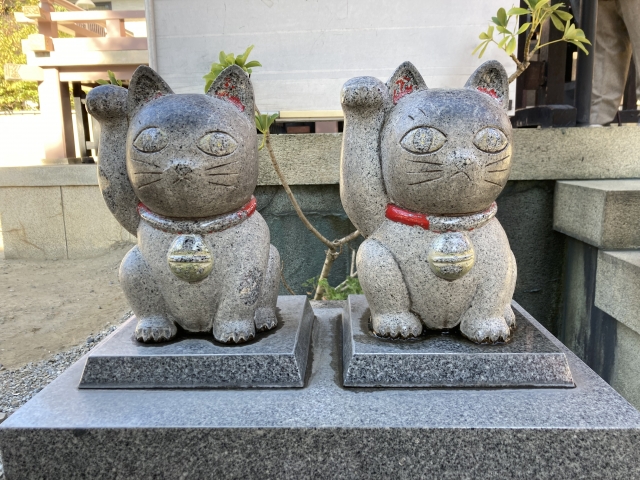
The second great origin story is quieter, and perhaps more moving. In the late Edo period, an elderly woman living in the Imado area of what is now Taitō Ward was so poor that she was forced to give up her beloved cat. That night, the cat appeared to her in a dream and said: “Make a figure of me, and fortune will come to you.”
She crafted a small clay cat in the style of Imado-yaki (今戸焼), a local pottery tradition, and began selling the figures. They became enormously popular — especially among geisha, entertainers, and the owners of teahouses and restaurants. The dream cat had told the truth.
🐭 The Deeper History: Cats as Sacred Mousers
Before either legend, cats had already earned their place in Japanese culture through practical heroism. As far back as the Nara period (710–794 AD), cats were brought to Japan — likely from China — to protect precious silkworms and written scrolls from mice. A cat wasn’t just a pet; it was a guardian of civilization. The samurai of the rodent world.
By the Edo period, things got even more cat-friendly. Tokugawa Tsunayoshi, the fifth shogun, issued his famous “Laws of Compassion” (Shōrui Awaremi no Rei), which among other things prohibited keeping cats on leashes. Cats were free to roam the streets, and the people loved them for it. Their mysterious night vision, their cool independence, their ability to appear and disappear at will — all of this made cats seem like creatures with access to the supernatural. People began to attribute meaning to their colors, their movements, their very presence.
Artists took notice. Utagawa Kuniyoshi, one of the great ukiyo-e masters, was famously obsessed with cats and filled his work with anthropomorphized felines doing very human things. Hiroshige and Kunisada slipped cats into their prints as quiet, charming background characters. By the time the Meiji era arrived, the cat was fully established in the Japanese imagination as a symbol of luck, warmth, and good fortune.
🐾 How to Read Your Maneki-Neko
Here’s where it gets fun. A Maneki-Neko isn’t just decoration — it’s a coded message. Every detail means something.
Which Paw Is Raised?
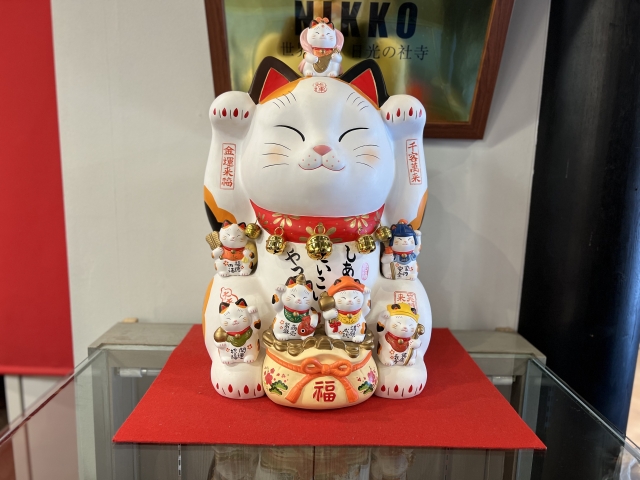
Right paw raised → Invites money and good fortune. Great for shops and businesses.
Left paw raised → Invites people, customers, and meaningful relationships. Ideal for attracting good company — or possibly a spouse.
Both paws raised → Invites everything at once. Maximalist luck for maximalist people.
What Color Is It?
White → General good luck and positive energy (the classic)
Black → Wards off evil and bad luck (the goth option, equally valid)
Red → Health and longevity
Gold or Yellow → Wealth and financial success
Pink → Love and romance
What Is It Holding?
Look closely at what your Maneki-Neko is carrying. These items aren’t random:
- 🪙 Koban (gold coin) — financial luck
- 🎒 Ōiri-bukuro (lucky bag) — attracting many customers
- 🔔 Bell (suzu) — calling in good fortune
- 🎋 Kumade (rake) — raking in luck
- 🔨 Uchide no kozuchi (magic mallet) — grants wishes when shaken
- 🐟 Tai (sea bream) — prosperity and celebration
Why Is It Usually a Calico Cat?
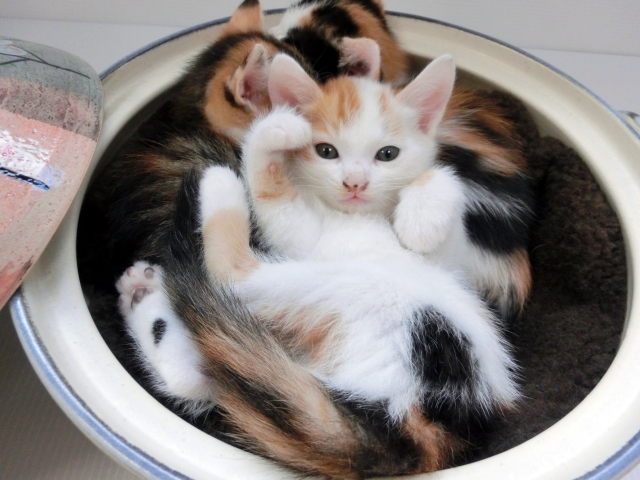
You may have noticed that most Maneki-Neko are styled after calico cats (三毛猫, mike neko — literally “three-fur cat”). This is no accident. Calico cats are already rare, but male calico cats are extraordinarily rare — thought to occur roughly once in every 30,000 births. In Japanese tradition, a male calico cat is considered a powerful bringer of good luck. Since you probably can’t keep one in your apartment, the figurine is the next best thing.
📍 Where to Meet Maneki-Neko in Japan
🏯 Gotokuji Temple — Setagaya, Tokyo
The birthplace of the legend. Hundreds — possibly thousands — of white Maneki-Neko figurines are arranged in rows at the temple’s ema (votive offering) area, donated by visitors as thanks for wishes granted. It’s one of the most quietly beautiful sights in Tokyo: a sea of patient, raised-paw cats, all waiting. Don’t forget to look for the hidden figurines in the pagoda.
🔗 Gotokuji Temple Official Website
📍 2-24-7 Gotokuji, Setagaya, Tokyo
⛩️ Imado Shrine — Taitō, Tokyo
The other origin story lives here. This small, charming shrine is also famous as a spot for en-musubi — the tying of fateful connections between people. Whether you’re looking for love, friendship, or just good vibes, the Maneki-Neko at Imado has been working overtime for centuries.
🔗 Imado Shrine Information
📍 1-10-2 Imado, Taitō, Tokyo
🐈⬛ Jijōin Temple — Shinjuku, Tokyo
A lesser-known but wonderful spot. Legend has it that during the Muromachi period (15th century), the warlord Ōta Dōkan was lost in the area when a black cat beckoned him to safety at this temple. In gratitude, he donated a stone Jizō statue — which came to be called the Neko Jizō (“Cat Jizō”). It’s only displayed to the public once a year, which makes the timing of your visit either very lucky or a reason to come back.
📍 2-11-5 Naito-machi, Shinjuku, Tokyo (Please check locally for the annual public viewing date)
🦊 Fushimi Inari Taisha — Kyoto
Primarily famous for its thousands of vermilion torii gates, Fushimi Inari is also cat territory — actual cats roam the grounds freely, and fox and cat imagery weave together in this sacred space dedicated to the deity of agriculture and prosperity. A pilgrimage here, among the foxes and the cats and the gates, feels like walking through a dream.
🔗 Fushimi Inari Taisha Official Website
📍 68 Fukakusa Yabunouchi-cho, Fushimi, Kyoto
😺 Tokoname — The Maneki-Neko Capital of Japan
If you’re serious about Maneki-Neko, you need to make the journey to Tokoname City in Aichi Prefecture, one of Japan’s oldest pottery towns and the place where a huge proportion of all Maneki-Neko figurines are made. Here you’ll find:
- 🐱 Tokonyan — a giant Maneki-Neko face watching over the city, visible from the expressway, with a warmth that will stop you in your tracks
- 🐾 Maneki-Neko Street (Tokoname Maneki-Neko-dori) — a charming walking path lined with cat art and ceramic cats of all shapes
- 🏛️ Maneki-Neko Museum — over 700 Maneki-Neko from across Japan and the world
- 🎨 Maneki-Neko Art Museum — a more intimate, artistic take on the icon
🔗 Tokoname Tourism Official Website
🏠 Where Should You Put It at Home?
You’ve chosen your cat. You’ve carried it across the Pacific. Now where does it live?
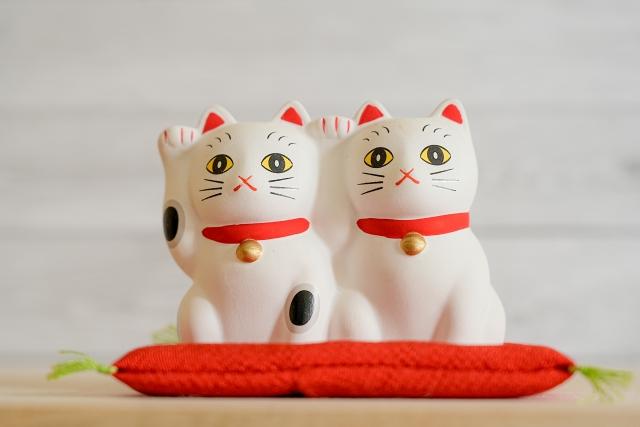
There are no strict rules, but the general wisdom is: bright, clean, elevated, and welcoming. A Maneki-Neko placed high near the entrance of a home or shop is thought to call in good energy from outside. In a home, try the entrance hall or a living room shelf. In a shop, near the register or facing the front door.
If you’re inclined toward feng shui, consider placing your cat in the southeast corner of a room (traditionally associated with wealth), and match the color to your intention — gold for money, black for protection, pink for love.
Most importantly: put it somewhere it will be seen, somewhere clean, and somewhere it feels at home. Cats, even ceramic ones, have standards.
You’ll find Maneki-Neko almost everywhere in Japan — from souvenir shops to temple grounds — but if you want something truly special, consider picking one up at Gotokuji or in Tokoname, where they are still handmade.
Most Maneki-Neko typically cost between ¥1,000 and ¥5,000, depending on size, material, and whether they are handmade.
💬 A Final Word from a Fellow Cat Person
I live with a cat. I know what it’s like to have a small, inscrutable creature share your space and occasionally — when it suits them — look at you with complete, unconditional recognition. There is something in that exchange that feels ancient and meaningful, even if your cat is mostly thinking about their next meal.
Japan understood that feeling centuries ago, and they built a whole tradition around it. The Maneki-Neko is not just a souvenir. It’s a little ambassador from a culture that looked at a cat and saw wisdom, protection, and the possibility of good things to come — and decided to keep that energy close.
So yes. When you’re in Japan, find your cat. Let it beckon you. And bring it home.
After all — it chose you.
✍️ About the Author: A lifelong cat enthusiast and Japan lover who believes that every home is improved by at least one raised paw pointing toward good fortune.


Share your thoughts