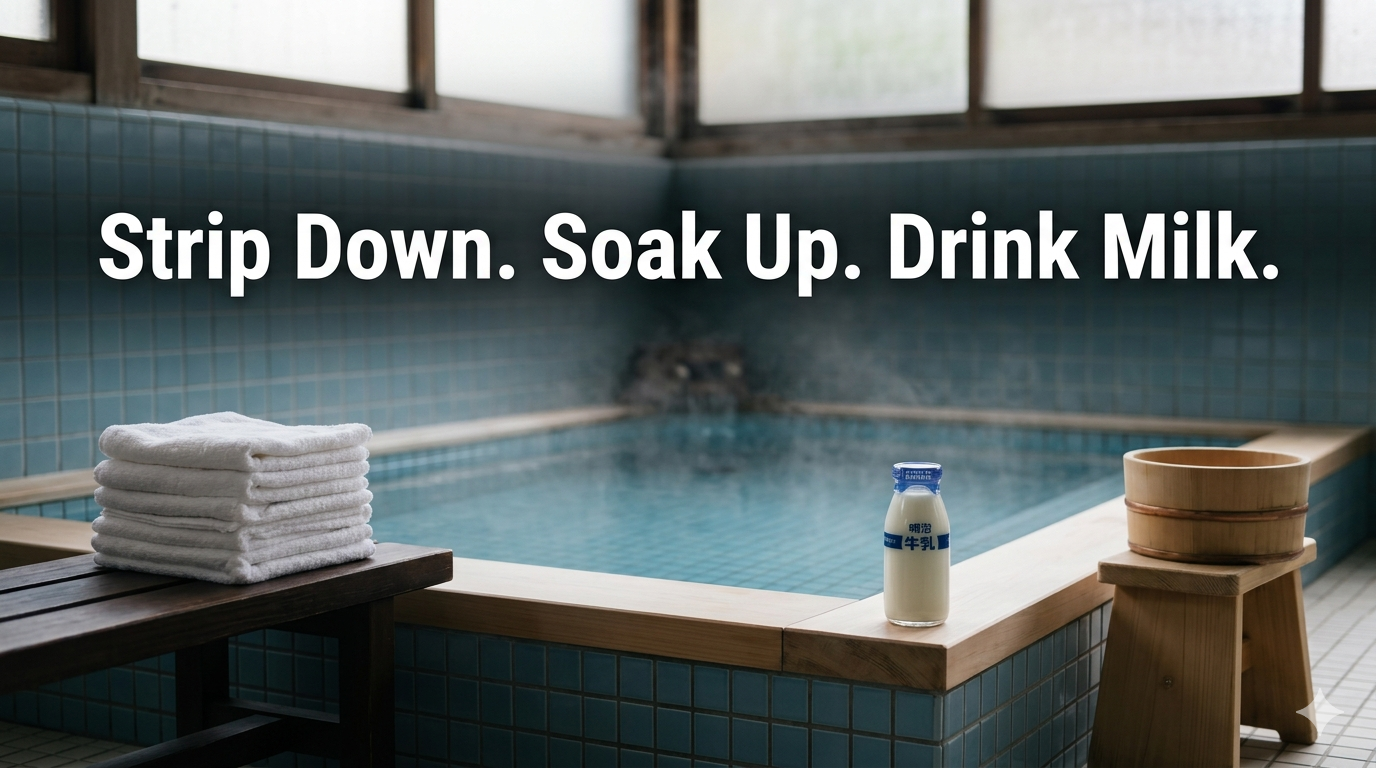
- Why You Absolutely Need to Try a Tokyo Sento (Yes, Even You)
- 🛁 Sento vs. Onsen: What’s the Difference, Actually?
- 📜 A Very Brief, Very Fascinating History
- 💰 How Much Does It Cost? (Less Than You Think)
- 🎒 What to Bring — and Why You Need a Tenugui
- 🚿 How to Actually Use a Sento (Step by Step)
- 📋 Sento Etiquette: The Unwritten Rules
- 🥛 The Post-Bath Milk: A Sacred Ritual
- ☕ Sento Turned Café: When the Bathhouse Gets a Second Life
- 🖋️ Do You Have Tattoos? Here’s What You Need to Know
- 🌟 The WELCOME! SENTO Campaign: Tokyo Is Literally Inviting You
- 💬 Final Thoughts: Just Go
- 📌 Quick Reference: Sento Essentials
Why You Absolutely Need to Try a Tokyo Sento (Yes, Even You)
Let’s be honest. You did not fly all the way to Japan to do the same things you do at home. You didn’t come here to eat at familiar chain restaurants, sleep in a generic hotel room, and go to bed at a reasonable hour. You came to Japan to feel something different.
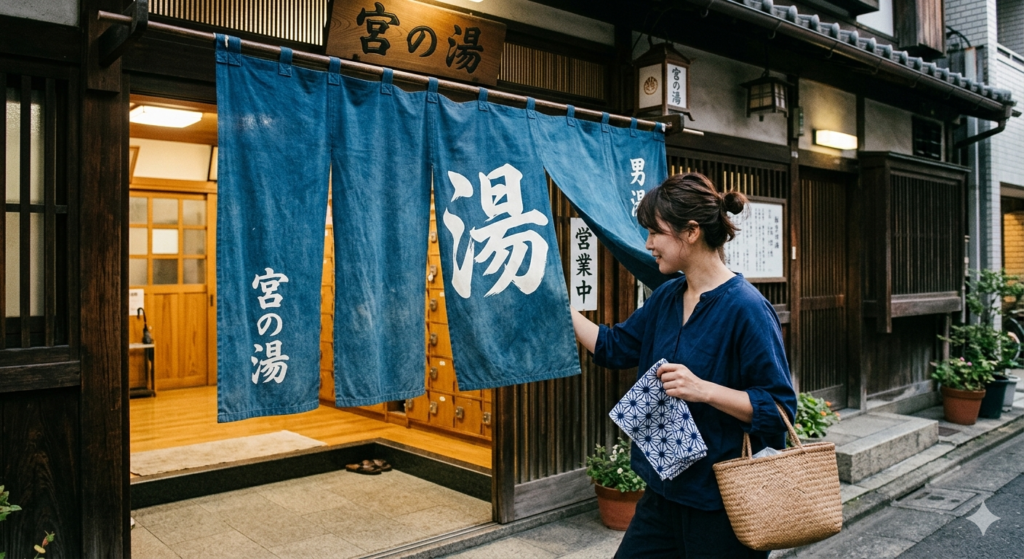
So let me tell you about the experience that locals have quietly been enjoying for centuries, hidden in plain sight behind those distinctive curtained doorways in your neighborhood: the sento (銭湯) — Tokyo’s beloved public bathhouse.
Tokyo is one of the most modern megalopolises on the planet. And yet, tucked between convenience stores and ramen shops, around 430 sentos still operate across the city. That number is shrinking — more on that later — which makes visiting one right now an act of cultural preservation as much as personal relaxation. So go. Let’s talk about how.
🛁 Sento vs. Onsen: What’s the Difference, Actually?
These two words get tossed around interchangeably, but they are not the same thing — and the distinction matters.
An onsen (温泉) uses natural hot spring water. Japan sits on a volcanic archipelago, which means geothermally heated, mineral-rich water bubbles up from the ground in many regions. To legally call itself an onsen, a facility must use water that either emerges at 25°C or above, or contains specific minerals at legally defined concentrations. Onsen are often found in scenic mountain towns — Hakone, Nikko, Beppu — and are deeply associated with ryokan (traditional inns) and weekend getaways. (We have a full guide to onsen — including tattoo policies — right here.)
A sento, on the other hand, uses heated municipal tap water — not spring water. It is an urban public bathhouse, historically serving city residents who did not have bathtubs at home. Think of it as the neighborhood gym, community center, and bathroom all rolled into one steaming, tiled room.
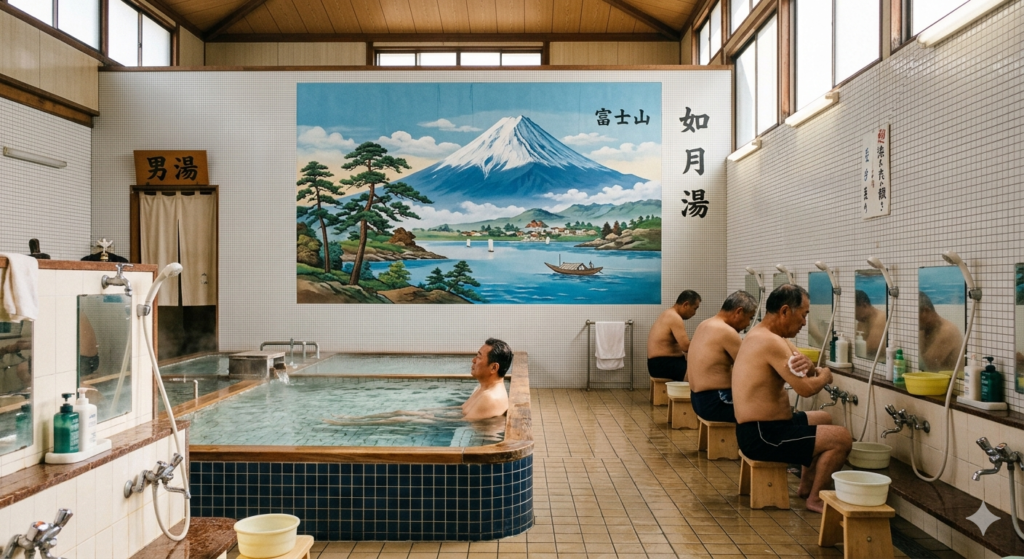
Does that make sento less special? Absolutely not. Many Tokyo sento actually do draw on natural spring water from underground — including the famous black mineral water (kuroyu) found in parts of Tokyo. But the main point is this: sento is a city experience. It belongs to the streets, the commuters, the grandmothers who have been going to the same bathhouse for 40 years. And now, briefly, it can belong to you too.
📜 A Very Brief, Very Fascinating History
The first commercial sento in Edo (old Tokyo) opened in 1591, near what is now Tokiwabashi. It wasn’t even a hot-water bath at first — customers crouched through a low doorway called the zakuro-guchi (石榴口, or “pomegranate mouth”) into a steam chamber. The concept was so novel that people lined up out of sheer curiosity.
Hot-water soaking became the norm by the Edo period (1603–1868), and sento quickly became the social heart of urban neighborhoods — a place where all classes, professions, and ages mingled in democratic nudity. You couldn’t bring your status into the bath with you. Everyone was equal in the water.
At their peak in 1968, Japan had nearly 18,000 sento nationwide. Then home bathtubs became affordable and widespread, and the numbers began to fall. By 2025, only around 2,847 remained across Japan, with about 430 operating in Tokyo. The decline is real — and it makes each surviving sento a small miracle worth experiencing.
Here’s an almost unbelievably charming fact: those iconic Mt. Fuji murals painted on the walls above the main bath? There are reportedly only three people left in Japan who still know how to paint them in the traditional style. The art form is quite literally disappearing in real time.
💰 How Much Does It Cost? (Less Than You Think)
Here is where things get almost absurdly good. The adult admission fee for sento in Tokyo is ¥550 — regulated by the metropolitan government. Individual sento cannot legally charge more. That’s roughly $3.50 USD for a proper Japanese bathing experience, a Mt. Fuji mural, and possibly a very cold milk drink afterward. You’ve paid more for a bad cup of airport coffee.
Even better: the Tokyo Metropolitan Government and the Tokyo Sento Association have been running a “WELCOME! SENTO” campaign, certifying 63 bathhouses across the city as officially tourist-friendly. These locations offer multilingual support, cashless payment, and bath amenities — and tourists with a discount coupon can get in for just ¥300. Check out the official campaign website at welcome-sento.com to find participating bathhouses and grab a coupon.
Sauna, if available, is usually an extra ¥200–¥400 on top of admission. Towel rental is typically around ¥100–¥130. Soap, shampoo, and conditioner can be bought at a vending machine inside or brought from your own bag.
🎒 What to Bring — and Why You Need a Tenugui
Let’s cover the practical items first — sorted by what you genuinely need to bring versus what you can sort out on arrival — and then I’ll make a passionate case for one specific thing you should buy before you go.
✅ Bring these:
A small towel (or tenugui — more on this in a moment) for the bathing area, and a larger towel for drying off afterward. Technically you can rent both at most sento for around ¥100–¥130, but having your own is more comfortable and saves the faff of locating the rental counter when you’re already half-undressed. A change of clothes is obviously essential. And bring cash — more on that shortly.
🛒 Available at the sento (buy or rent on arrival):
Shampoo, conditioner, and body wash can typically be purchased from a vending machine or small shop counter inside the sento — so you don’t strictly need to pack them. That said, if you have a preferred brand or sensitive skin, bring your own. Towel rental (small and large) is available at most locations, usually for ¥100–¥130 per item. Some WELCOME! SENTO certified locations include basic amenities in the entry fee. If in doubt, check the sento’s website before you go — many list exactly what’s available.
The honest summary: You could walk in with literally just a change of clothes and some cash, and figure out the rest at the counter. But bringing a small towel and your own toiletries is more relaxing than arriving unprepared.
Now: the tenugui (手ぬぐい).
A tenugui is a thin, flat Japanese cotton towel — typically around 35cm × 90cm — and it is one of the most brilliant, underrated objects in Japanese daily life. Unlike a Western terry cloth towel, it dries almost instantly. It doesn’t get smelly. It’s lightweight enough to stuff in any pocket. You can use it as a hand towel, a washcloth, a headband, a gift wrapping cloth, a decoration — the versatility is genuinely impressive. Traditionally, tenugui were given as gifts, used as theatrical props in kabuki, and carried by craftspeople as a mark of their trade.
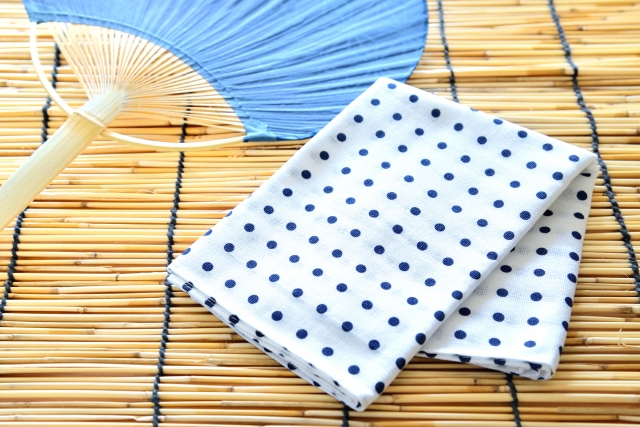
For sento specifically, a tenugui is the perfect companion: use it in the bathing area (it won’t trap soap), wring it out in seconds, and pat yourself dry with it in the changing room. It will still be mostly dry by the time you need to pack it away.
You can find beautiful tenugui at department stores, traditional craft shops (look around Asakusa, Yanaka, or Koenji), or — delightfully — at some of the sento themselves as campaign merchandise. The WELCOME! SENTO campaign even gives away an original tenugui towel to visitors who complete a short survey at participating bathhouses. Free tenugui AND a cheap bath? The universe is generous sometimes.
Bring a tenugui. You’ll use it every day for the rest of your trip, and it’ll be one of the best souvenirs you take home.
🚿 How to Actually Use a Sento (Step by Step)
First-timers sometimes panic at the door. Don’t. The process is simpler than you think, and the regulars are not judging you — they’re mostly just trying to enjoy their soak in peace.
Step 1 — Shoes off. At the entrance, you’ll find a getabako (下駄箱), a shoe locker. Take off your shoes, place them inside, and take the key. This is standard in many Japanese spaces.
Step 2 — Pay at the front desk. Either at a traditional bandai (番台) — an elevated cashier booth — or a modern reception counter. Important: many sento are still cash-only, so don’t assume your IC card or credit card will work. The 63 WELCOME! SENTO certified locations are much more likely to offer cashless payment, but outside of those, a ¥1,000 note in your pocket is essential. Check the sento’s website in advance if you’re unsure — and when in doubt, carry cash. You won’t regret it, and there’s almost certainly a convenience store nearby where you can withdraw some. Pay, receive your locker key, and note which gender section you need.
Step 3 — Changing room. Find your locker. Undress completely — yes, completely. No swimwear is permitted in the baths. Take a breath.
If this is making you slightly anxious, that’s completely understandable — and also worth unpacking, because the Japanese relationship with communal nudity is genuinely different from what most Westerners are used to.
The concept is called hadaka no tsukiai (裸の付き合い) — literally “naked friendship,” or more loosely, “meeting each other without barriers.” In Japanese bathing culture, nudity in this context carries no sexual connotation. It is about cleanliness, equality, and a kind of radical openness: when everyone has shed their clothes, they’ve also shed their job titles, their social status, their guard. Historically, sento was one of the few places where a merchant and a laborer would sit side by side as equals, where elderly neighbors would catch up with young parents, where the ordinary social hierarchies of daily life dissolved in the steam.
Nobody in that changing room is looking at you. They’re thinking about the hot water, or what to have for dinner, or nothing at all. The moment you’re in, you’ll feel it too — that slightly remarkable sensation of having nothing to prove and nothing to hide. It passes from awkward to peaceful faster than you’d expect.
Everyone in that room is doing the same thing. That is the point.
Step 4 — Wash first, always. Before entering the communal bath, sit at one of the individual washing stations — a low stool in front of a mirror with a shower head and taps. Wash your entire body thoroughly with soap and shampoo. Rinse completely. This is the cardinal rule of sento etiquette, and the reason the communal water stays clean.
Step 5 — Enter the bath. Lower yourself slowly. The water is typically 40–42°C (104–108°F) — hot enough that you’ll want to ease in. The main tub is communal. Do not bring your tenugui into the tub. Fold it on your head or set it aside. Soak. Breathe. This is the good part.
Step 6 — Dry off before returning. When you leave the bathing area, wring out your towel and dry yourself thoroughly before stepping back into the changing room. Bringing a puddle back into the dry area is considered inconsiderate.
Step 7 — The milk. More on this shortly. It’s important.
📋 Sento Etiquette: The Unwritten Rules
Sento operates on a quiet social contract. Nobody lectures you, but everyone notices. Here’s what to keep in mind:
No soap or shampoo in the communal tub. Rinse off all products before getting in. The shared water is for soaking, not washing.
No towel in the bath. Your small towel stays outside the tub — on the edge or folded on your head.
No photos. This should go without saying, but: absolutely no photography in the bathing area. Not of the space, not selfies, nothing. People are naked. Respect that.
Keep noise moderate. A sento is a place of relaxation. Loud conversations, splashing, or running are considered rude — especially in the bathing area.
Don’t drain the bath or leave taps running at washing stations. Water is shared and waste is noticed.
Rinse your washing station after use. Leave it clean for the next person.
That’s genuinely most of it. Wash first, be quiet, respect others’ space. The regulars will appreciate you for it, and you might even get a friendly nod from an 80-year-old grandmother who’s been coming to this same bath for 50 years. That nod is worth more than any souvenir.
🥛 The Post-Bath Milk: A Sacred Ritual
You have just soaked in hot water for 20–30 minutes. Your muscles are loose, your skin is glowing, and your entire nervous system has been thoroughly reset. You walk out of the bathing area into the changing room, towel around your shoulders.
And there, in a vending machine or a small refrigerator near the entrance, is a bottle of cold milk.
The post-bath milk is not a marketing gimmick. It is not nostalgia for its own sake. It is one of the most physically perfect food pairings that exists: your body temperature is elevated, you’ve lost fluids, and the cold, protein-rich milk slides down with a satisfaction that is genuinely difficult to describe in polite language. The classic is plain cold milk — sento gyunyu (銭湯牛乳) — often in a small glass bottle.
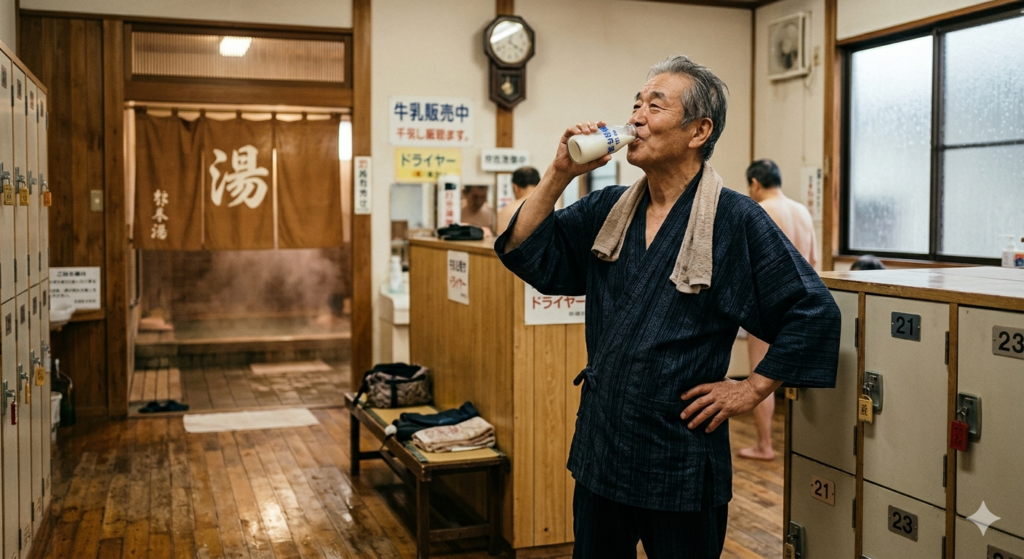
And right next to it, there will almost certainly be a brown bottle. That’s koohii gyunyu (コーヒー牛乳) — coffee milk — and it deserves its own moment of appreciation. Sweet, creamy, and somewhere between a café au lait and a very good chocolate-adjacent dream, it is the kind of drink that tastes unremarkable on a normal day and absolutely transcendent after a hot bath. If you’re not a plain-milk person, this is your version. If you are a plain-milk person, consider getting both. You’ve earned it. Fruit milk — a sweetened, strawberry-flavored drink that tastes like a happier decade — also makes a frequent appearance in the fridge lineup.
The proper technique, as demonstrated by generations of sento veterans, is to stand with one hand on your hip, tilt your head back slightly, and drink the entire thing in one sustained go. Does this look slightly ridiculous? Yes. Does it feel incredible? Also yes.
Some sento have gone further with their café offerings. The sento-adjacent café at Hinodeyu in Asakusa serves a homemade coffee milk made with carefully sourced milk and their own original coffee blend — available even if you’re just stopping by for the café, not the bath. Their sento café has become something of a local institution.
Don’t skip the milk. It’s a whole thing.
☕ Sento Turned Café: When the Bathhouse Gets a Second Life
Here’s a Tokyo phenomenon that deserves its own section: the converted sento café. As bathhouses have closed due to aging operators and dwindling customers, some have been saved — not demolished, but lovingly transformed into cafés and community spaces that preserve the original architecture.
The result is something genuinely magical: you walk into what looks like a sento (because it is one), take off your shoes at the original wooden shoe lockers, sit in what was once the changing room, and order a coffee while staring at a Mt. Fuji mural through a glass panel into the old bathing area.
MATCHA & ESPRESSO MIYANO-YU in the quiet Nezu neighborhood (a 2-minute walk from Nezu Station on the Chiyoda Line) is perhaps the most celebrated example. The Miyano-yu sento operated for 57 years before closing in 2008. In 2021, it was reopened as a café with the original shoe lockers, the wooden cashier’s bandai, and artwork commissioned from Tokyo Bath Association collaborators. The menu runs to matcha lattes, specialty espresso drinks, and homemade sweets. The color scheme — green, white, and black — was chosen to reflect matcha and coffee. If you’re in the Yanaka–Nezu–Sendagi area (谷根千, a neighborhood well worth wandering), this is a non-negotiable stop.
📍 MATCHA & ESPRESSO MIYANO-YU
2-19-8 Nezu, Bunkyo City (SENTO Building 1C) · 2 min from Nezu Station
Rébon Kaisaiyu in Iriya (3 min from Iriya Station) is another extraordinary survivor. The Kaisaiyu bathhouse dates to around 1928 — rebuilt after the Great Kanto Earthquake — and operated until 2016 before closing due to the owner’s age and aging equipment. The building was saved and reopened as a café in 2020, with the original shoe lockers, the bandai (which visitors can sit in for photos), the men’s and women’s changing room divider still intact, the weight scales, the clocks, and the high wooden-beamed ceiling. Their signature menu pairs homemade ice cream with house-roasted coffee — a “mariage” (marriage of flavors) concept. The entire space feels like stepping into a very well-preserved, extremely cozy time capsule.
📍 rébon Kaisaiyu (Instagram)
2-17-11 Shitaya, Taito City · 3 min from Iriya Station
Wed–Sun: 12:00–18:00 (Sat/Sun/Holidays open from 10:00)
These spaces aren’t just cafés — they’re community archives. The owners speak about them in terms of “connecting memories” and carrying forward the social function that sento always served: a place where different kinds of people could exist together comfortably, without their walls up.
🖋️ Do You Have Tattoos? Here’s What You Need to Know
The tattoo situation at Japanese bathing facilities has its own history, explained in full in our onsen tattoo guide — the short version is that tattoos became associated with yakuza culture in Japan, and many facilities banned them as a result. That association is slowly changing, particularly in urban sento, as foreign visitor numbers have risen and attitudes have shifted.
Here’s the good news specifically for sento: traditional public bathhouses (sento) operate under different rules than resort onsen. Many smaller neighborhood sento have never had an explicit tattoo ban. The policy at a lot of sento is essentially: if it’s not posted as prohibited, it’s typically tolerated — especially for decorative Western-style tattoos, as opposed to traditional Japanese full-body irezumi.
That said, policies vary and change. The safest approach is always to check the specific sento’s website or call ahead before visiting. A simple “Tattoo OK desu ka?” at the front desk takes about ten seconds and saves everyone time.
The 63 WELCOME! SENTO certified locations (findable at welcome-sento.com) are a good starting point for tattooed visitors — many are explicitly welcoming. For more specific tattoo-friendly options in Tokyo, we’ve done the research in our separate guide — here are a few highlights:
🛁 Kosugiyu (小杉湯) · Koenji
Open since 1933 and designated a National Registered Tangible Cultural Property in 2021, Kosugiyu runs a rotating calendar of specialty baths (milk baths, citrus baths, tomato baths — yes, tomato). English pamphlets available. Tattoos fully welcome, no covering required.
🔗 kosugiyu.co.jp · Entry: ¥550 · Closed Thursdays
🛁 Daikoku-yu Onsen (大黒湯) · Near Asakusa
A sento that uses real onsen water — a rarity in the city. Outdoor bath, carbonated spring baths, sauna, cold plunge. Ten-minute walk from Asakusa. Tattoos fully welcome.
🔗 daikokuyu.com
🛁 Konparuyu (金春湯) · Ginza
Established in 1863. Yes, 1863. In the middle of Ginza. Seasonal herb baths, small and intimate, and the quiet pleasure of soaking in one of Tokyo’s oldest surviving sento while luxury boutiques hum outside. Tattoos welcome.
🔗 konparuyu.com
🛁 Musashi Koyama Onsen Shimizuyu (清水湯) · Shinagawa
This one draws kuroyu — dark mineral water from 200 meters underground. The skin-softening black water is normally associated with serious ryokan stays; here you get it for ¥550. Tattoos fully welcome.
🔗 shimizuyu.com
⚠️ Policies can change. Always confirm directly with the bathhouse before visiting.
🌟 The WELCOME! SENTO Campaign: Tokyo Is Literally Inviting You
In September 2025, the Tokyo Metropolitan Government launched the official WELCOME! SENTO campaign, partnering with the Tokyo Sento Association to certify 63 bathhouses as “inbound-friendly model sento.” These locations offer multilingual signage, cashless payment, English-speaking support, and rental amenities. Tourists with a coupon from participating hotels or tourist information centers can bathe for just ¥300 instead of ¥550.
Visitors who complete a short survey at a participating sento receive a free original tenugui hand towel — which is, as I hope I’ve established, a wonderful thing to receive for free.
Find the full list of participating bathhouses, grab your coupon, and plan your visit at: 🔗 welcome-sento.com
💬 Final Thoughts: Just Go
There is no Japanese cultural experience that is more accessible, more affordable, and more misunderstood by visitors than the sento. It costs less than a train ticket. It requires almost no Japanese language. It is welcoming to foreigners — increasingly explicitly so. And it gives you something that no temple visit or teamLab experience can quite replicate: the sensation of being, briefly and completely, part of the fabric of daily life here.
You’ll sit in water that’s probably too hot. You’ll figure out the washing station. You’ll accidentally try to pay with a card at a place that only takes cash (check first!). And then you’ll come out into the cool evening air with your face flushed and your muscles completely uncoiled, and you’ll hold a small cold bottle of milk with both hands, and you’ll understand something about Japan that you couldn’t have understood any other way.
Buy the tenugui. Find a WELCOME! SENTO location. Wash first. Soak long. Drink the milk.
You’ve got this. 🛁
📌 Quick Reference: Sento Essentials
| Item | Details |
|---|---|
| 💴 Entry Fee (Tokyo) | ¥550 (adult) · ¥300 with WELCOME! SENTO coupon |
| 🏛️ Official Campaign | welcome-sento.com |
| 🧺 What to Bring | Tenugui (small towel), body wash/shampoo, change of clothes |
| 🛁 Before the Bath | Wash your entire body at a washing station first — always |
| 🚫 Never Do | Enter bath without washing, wear swimwear, take photos inside |
| 🥛 After the Bath | Cold milk. Non-negotiable. |
| 🖋️ Tattoos | Many sento are OK — confirm in advance · Full guide here |
| 🌡️ Water Temperature | Typically 40–42°C (104–108°F) — ease in slowly |
Share your thoughts