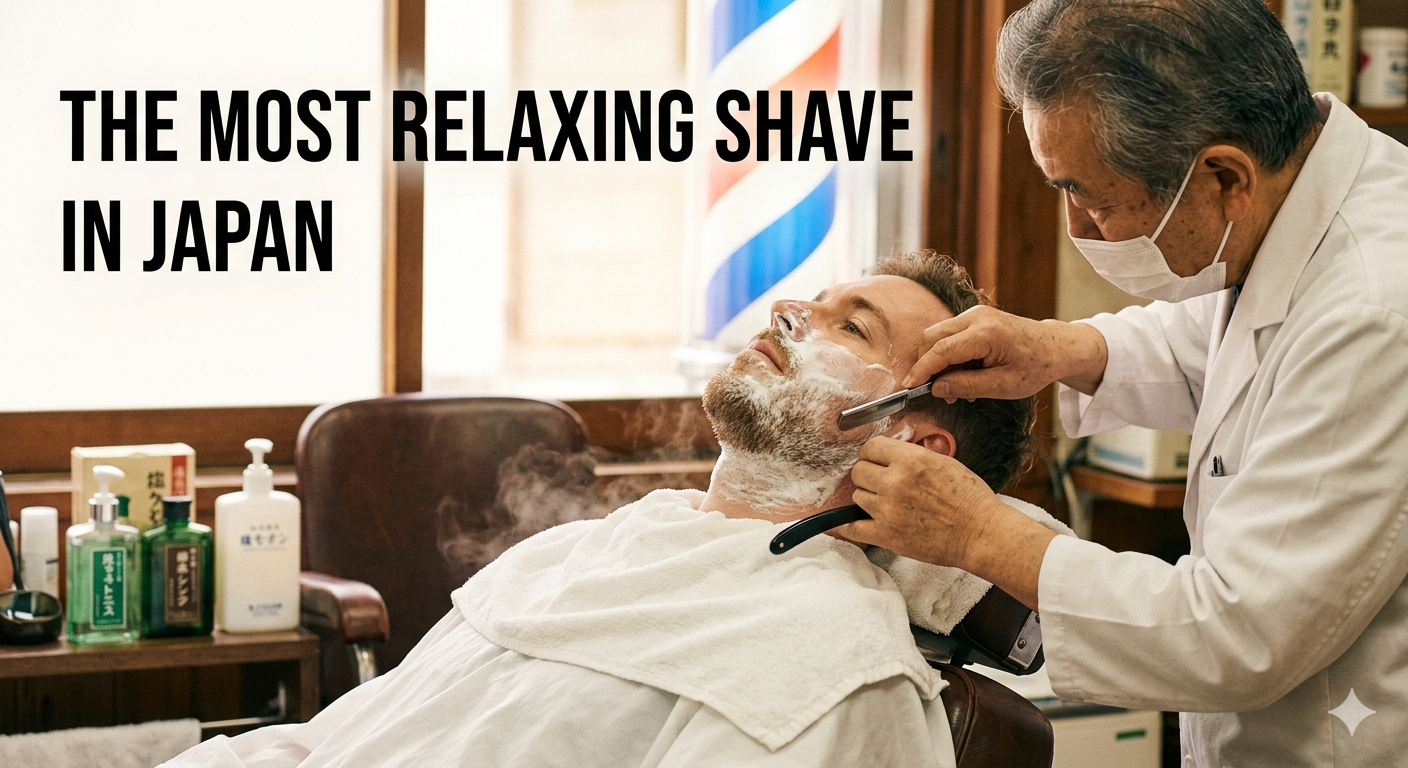
Straight-razor shaving, hot towels, and ear cleaning — Japan’s tokoya offer a grooming ritual unlike anything else on the planet.
Written by a Tokyo resident · 15 min read
Grooming · Japan Travel · Culture
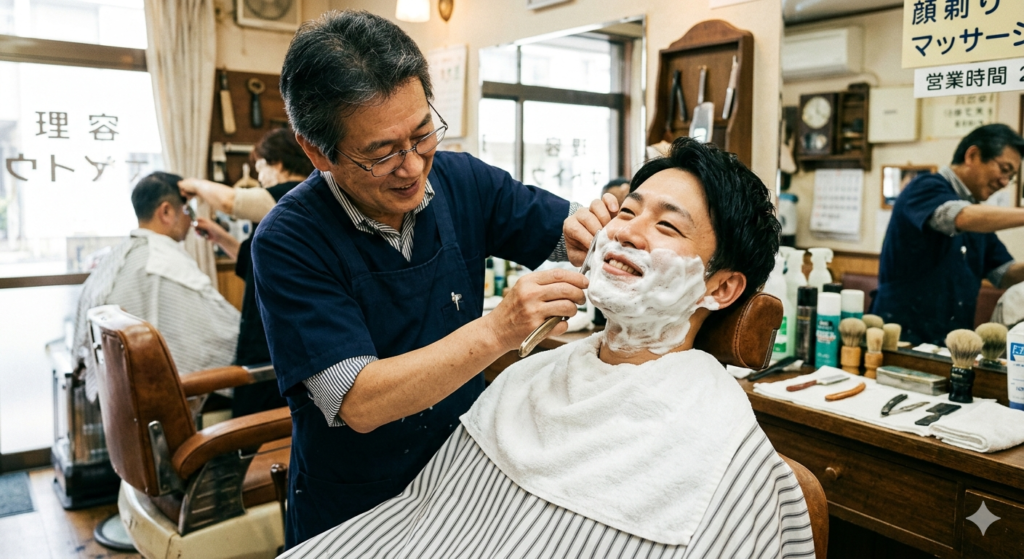
“I went in for a haircut. I came out a changed person. Also, I was half-asleep and my skin was glowing. That was three years ago. My partner hasn’t been to a regular salon since.”
Let me tell you about the tokoya (床屋) — Japan’s traditional barbershop. It’s not just a place to get your hair cut. It is, quite honestly, a meditative, pampering, craft-driven experience that makes your average strip-mall haircut feel like getting your hair pulled by a bored raccoon.
My partner is completely hooked. Every time, they sit down, the hot towels come out, the straight razor appears, and 20 minutes later — out cold. Sound asleep in the barber’s chair, trusting a near-stranger with a blade near their face. That’s how good this is.
And me? I come in nervous every single time. I come out glowing, slightly dazed, and quietly planning my next visit before I’ve even left the chair.
- What Actually Happens in a Japanese Barbershop?
- The Wet Shave — A Much Closer Look
- Can Women Get a Shave at a Japanese Barbershop?
- Tokoya vs. Beauty Salon: What’s the Difference?
- Practical Tips: What to Know Before You Go
- A Brief History of the Japanese Barbershop
- How to Find a Tokoya Near You
- Useful Phrases
- Final Thoughts
What Actually Happens in a Japanese Barbershop?
Here’s the full menu of what a traditional tokoya typically offers. Not every shop does everything, but most cover the essentials.
🪒 Wet shave (顔剃り)
Straight razor, hot towel, shaving foam — the full ritual. Removes peach fuzz and dead skin cells, leaving skin improbably smooth.
✂️ Neckline finishing (襟足)
Clean, precise neckline work with a straight razor. Makes a haircut look fresh for weeks, not days.
👂 Ear cleaning & massage
Gentle ear pick cleaning followed by a relaxing ear and scalp massage. Unexpectedly wonderful. Borderline life-changing, if we’re being honest.
🌡️ Hot towel (蒸しタオル)
Warm towels applied before and after shaving to soften skin and open pores. Deeply relaxing. The moment the first towel lands on your face, your nervous system just… gives up fighting.
✂️ Haircut
Often included in a set menu with shaving and treatment, or available à la carte.
The Wet Shave — A Much Closer Look
This is the star of the show, and it deserves more than a quick paragraph.
The Hot Towel: Where It All Begins
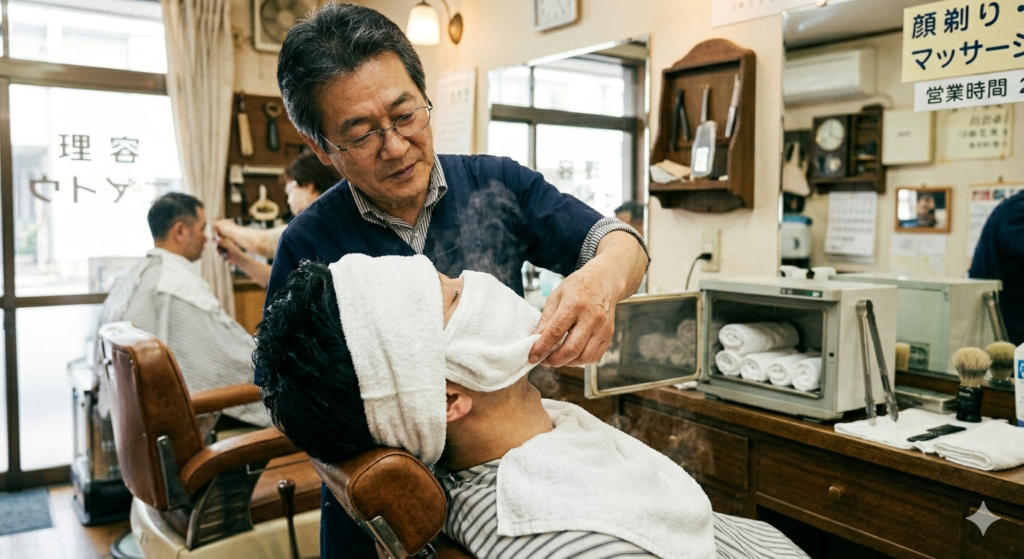
The barber picks up a thick, warm, steamed towel — not uncomfortably hot, but that perfect temperature where your skin says thank you — and drapes it over your face. Just your nose poking out. You are now a very relaxed burrito.
Your skin softens. Your pores open. Your stress levels drop approximately 40%. You start to remember what it felt like to be a functional human being.
This isn’t decorative theatre. The steam serves a genuine purpose: it loosens the hair follicles, plumps the skin with moisture, and makes every stroke of the razor cleaner and more comfortable. The towel might come and go two or three times throughout the process — a fresh hot one mid-shave to re-soften, and a cool one at the end to close the pores and tighten everything up.
The Foam: Cloud-Like and Luxurious
Then comes the foam. Not the tinny aerosol stuff you squeeze out of a supermarket can on a Monday morning. This is thick, cloud-like lather, applied warm with a soft brush in slow, deliberate circular motions.
It smells clean. It feels impossibly soft. Your face is now wrapped in something that resembles expensive meringue. You are, genuinely, considering moving to Japan.
The Razor: Precise, Controlled, and Completely Terrifying (for About Three Seconds)
Then — the kamisori (剃刀). Japan’s traditional straight razor.
If you’ve never had a straight-razor shave before, there’s a brief moment where your lizard brain says: a stranger is holding a blade near your face. That moment passes quickly. Very quickly. Because within about two strokes, you realise that this person has done this approximately ten thousand times, and they are operating at a level of craft precision that borders on the meditative.
The barber works in short, controlled strokes — with the grain first, then across it, then carefully against it in more delicate areas. The pressure shifts constantly, adjusting to the contours of your cheekbones, your jaw, your upper lip. Not a single nick. Not a hint of irritation.
The sensation itself is hard to describe to the uninitiated. It’s not the scraping feeling of a disposable razor. It’s more like… your skin is being very gently read. Each pass takes away exactly what needs to go, nothing more. The blade catches the light and moves and you feel it, but it’s comfortable. Satisfying, even. My partner once described it as “the most specific kind of relaxation I’ve ever experienced.” I think that’s exactly right.
The Ears: A Bonus You Didn’t Know You Needed
Many tokoya — especially the more traditional ones — also attend to the ears. And I mean properly.
Some barbers will trim the fine hairs that grow inside and around the outer ear with the straight razor, with a level of care and precision that is both impressive and slightly surreal. Others offer ear pick cleaning (耳掃除), where a slender tool is used to gently clean the ear canal while you lie there in a state of extreme trust and extreme relaxation.
The first time this happened to me, I didn’t know how to feel. By the time it was over, I was ready to recommend it to everyone I’ve ever met.
The Finish: That Skin
When the barber is done, they apply a cool towel and then — usually — a light toner or moisturiser. And then you look in the mirror.
Your skin is mochi-mochi. That Japanese word for the bouncy, soft, pillowy texture of fresh mochi rice cakes? It applies completely to how your face feels. There is a plumpness, a smoothness, a glow that you did not walk in with.
This isn’t magic. It’s exfoliation. A professional wet shave removes not just facial hair but also the top layer of dead skin cells — a thorough, physical exfoliation that no fancy face scrub fully replicates. The result is improved skin cell turnover, better absorption of serums and moisturisers, and visibly smoother, more luminous skin.
My partner’s skincare routine works harder now, full stop, because of regular tokoya visits. The serums actually land.
Can Women Get a Shave at a Japanese Barbershop?
Yes. Absolutely yes.
Many tokoya happily offer facial shaving to women — and women’s skin actually responds beautifully to this kind of exfoliation. The peach fuzz removal alone produces a noticeably smoother finish that makes foundation sit better and skin look more radiant.
Don’t be shy about walking in. A simple 女性でも大丈夫ですか? (josei demo daijoubu desu ka? — “Is it okay for women too?”) will clarify things instantly, and most traditional barbers will welcome you without hesitation.
Tokoya vs. Beauty Salon: What’s the Difference?
This is the question that confuses a lot of visitors. Japan has two types of hair professionals with completely different licences, legally distinct from each other.
| Feature | Tokoya 床屋 (barbershop) | Biyoushitsu 美容室 (salon) |
|---|---|---|
| Licence | Riyoshi 理容師 | Biyoshi 美容師 |
| Straight razor | ✅ Legally permitted | ❌ Not permitted by law |
| Hair colouring & perms | Less common | Full service |
| Hot towel & facial shave | Standard | Not offered |
| Vibe | Traditional, calm, craft-focused | Trendy, style-forward |
| Price range | ¥3,000–¥6,000 | ¥4,000–¥15,000+ |
The key fact: if you want a straight-razor shave, you must go to a tokoya. By Japanese law, only a licensed riyoshi (理容師) is legally permitted to use a straight razor on a client’s face. A beauty salon cannot offer this, full stop.
Practical Tips: What to Know Before You Go
💴 Bring Cash
This is important. A significant number of tokoya — particularly the older, more traditional ones — are cash only. Japan’s cash culture is well-documented, but it still catches visitors by surprise.
Before heading out, check whether the shop lists payment methods online (Google Maps sometimes shows this), or simply stop at a convenience store ATM first to be safe. ¥1,000–¥2,000 extra in your wallet will spare you the embarrassment of an apologetic mime in a barber’s chair.
🗣️ English May Be Limited — But It’s Fine
Most traditional tokoya are run by older barbers who may speak little to no English. This is not a problem at all, but it’s worth knowing in advance so you’re not flustered.
A few strategies that work well:
- Use Google Translate’s camera function to read the menu board on arrival.
- Point at the price menu — most shops have laminated cards or boards showing services with prices. Pointing and nodding is universally understood.
- Learn three phrases (see below) — even a stilted attempt at Japanese is always warmly received.
- Show, don’t say — if you want to indicate the length you want for a haircut, bring a photo on your phone. Japanese barbers work excellently from visual reference.
Don’t let the language barrier put you off. The experience communicates entirely through sensation. You sit down. Things happen. You feel wonderful. No translation required.
⏰ Walk-Ins Are Mostly Fine — But…
Most tokoya accept walk-ins without issue, especially on weekdays. For weekend visits or if you want a longer combined treatment (haircut + shave + ear cleaning), calling ahead is appreciated. If calling feels daunting, a quick message via Google Maps or the shop’s website using Google Translate usually works.
🕐 Budget Your Time
A haircut alone: 30–45 minutes. Haircut plus full shave and treatment: 60–90 minutes. Come with time to spare. The whole point of this experience is that it is unhurried.
💈 The Barber’s Pole Is Your Friend
The iconic red, white, and blue spiral pole outside — adopted directly from Western barbering tradition during the Meiji era — is your most reliable visual signal. If you see that pole, it’s a tokoya. Go in.
A Brief History of the Japanese Barbershop
Barbering in Japan stretches back to the Edo period (1603–1868), when skilled craftsmen called kamiyui tended to the grooming of townspeople and samurai alike. They were essential figures in daily life — visiting homes, operating stalls along busy streets, and maintaining the elaborate topknots that defined the era’s aesthetic.
Western-style barbering arrived in the Meiji era (1868–1912) alongside suits, pocket watches, and railways. The two traditions merged into what we now call the tokoya. The barber’s pole was adopted from the West; the kamisori technique stayed Japanese.
What makes the contemporary tokoya remarkable is how faithfully the old methods survived. The straight razor, the multi-towel ritual, the angle and pressure of the blade — these are skills still passed down through apprenticeships, with young barbers spending years mastering the basics before they ever touch a customer’s face unsupervised.
Today, Japan has tens of thousands of licensed barbershops. Many are run by barbers in their 60s and 70s who have been doing this for four or five decades. Going to a tokoya isn’t just a grooming errand. It’s a visit to a living craft tradition. One that happens to leave your skin looking improbably good.
How to Find a Tokoya Near You
Google Maps search terms: 床屋 or 理容室 — these Japanese terms return more accurate results than searching “barber” in English.
Filter by rating: 4.0 stars and above is a reasonable threshold for a first visit.
Check the photos: Look for the classic barber pole. If locals have uploaded interior shots showing a traditional chair setup and the laminated service menu on the wall, that’s a reliable sign.
Read the Japanese reviews: Look for the word 顔剃り (facial shave) in the reviews — if regulars mention it, the shop almost certainly offers it well.
For English-friendly options: Search “barber Tokyo” (or your city) in English — some Western-style barbers in tourist areas offer similar services with English menus and card payment.
Useful Phrases
顔剃りをお願いします
Kao-sori wo onegaishimasu
“I’d like a facial shave, please.”
髭剃りだけでもできますか?
Hige-sori dake demo dekimasu ka?
“Can you just do the beard/facial shave?” (without a haircut)
女性でも大丈夫ですか?
Josei demo daijoubu desu ka?
“Is it okay for women too?”
現金のみですか?
Genkin nomi desu ka?
“Cash only?”
どのくらい時間がかかりますか?
Dono kurai jikan ga kakarimasu ka?
“How long will it take?”
Final Thoughts
Japan is famous for taking ordinary things and doing them with extraordinary care — convenience store sandwiches, department store gift wrapping, hotel check-in. The tokoya is that same philosophy applied directly to your face.
It is unhurried. It is precise. The hot towel lands and something in you uncoils. The foam is ridiculous in the best possible way. The razor is terrifying for exactly three seconds and then becomes the most comfortable sensation you’ve experienced this year. The ear cleaning is something you will never adequately explain to people back home but will absolutely attempt to. And the skin you walk out with — that mochi-mochi, radiant, freshly-exfoliated glow — will have you reconsidering your entire skincare routine.
My partner walked in sceptical. They walked out a convert. Now every visit to Japan includes at least one tokoya appointment. Sometimes two. We have no regrets and many glowing selfies.
Practical reminder: Bring cash. Learn three phrases. Don’t be deterred by the language gap — the barber knows exactly what they’re doing, and your job is simply to sit down, let the hot towel land on your face, and try not to fall asleep.
(You will fall asleep.)
Have you tried a tokoya? Drop your experience in the comments — especially if you convinced someone else to go.


Share your thoughts