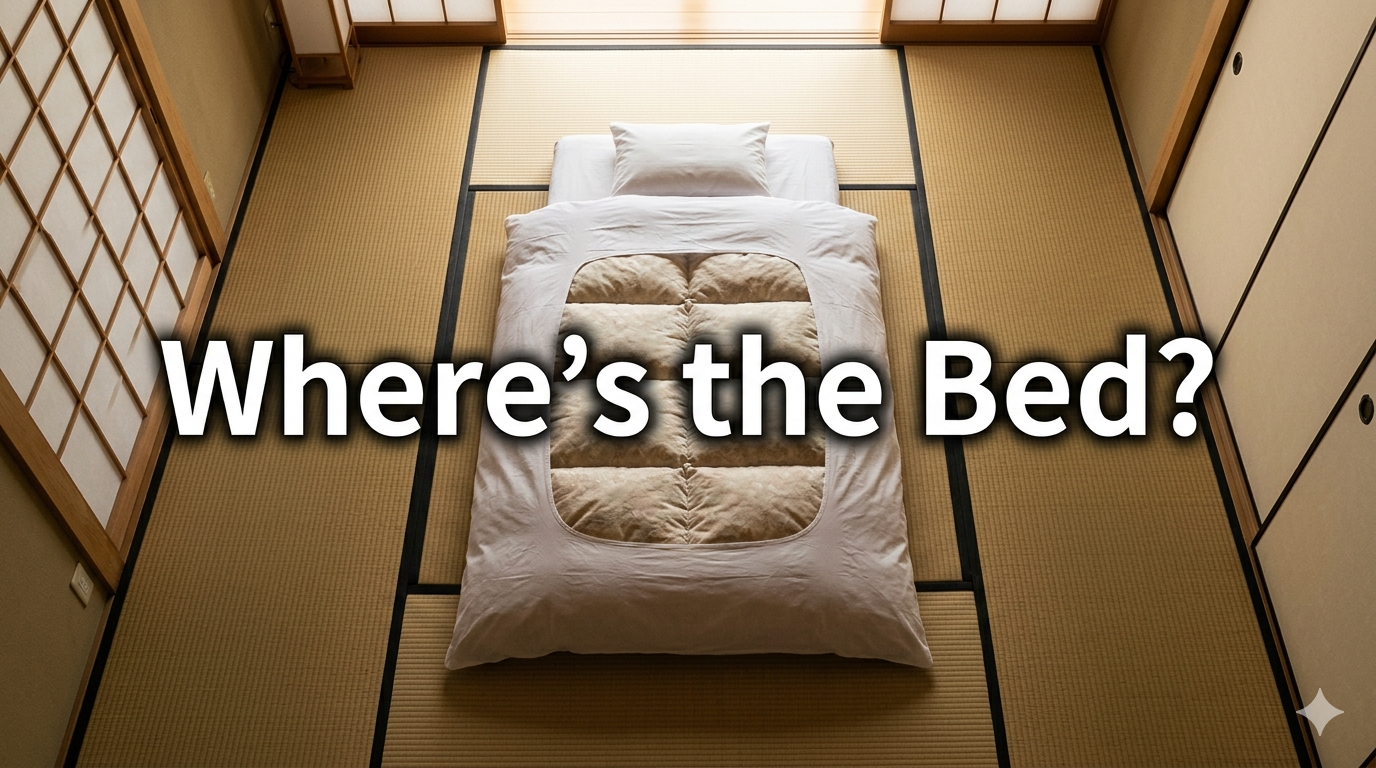
A personal guide for first-timers visiting Japan — and for anyone curious why Japanese people still happily sleep on the floor (and why you might want to, too).
- 🛌 Let Me Tell You About My First Night Back in Japan
- 📊 How Many Japanese People Still Sleep on a Futon?
- 🏯 Why Does Japan Have a Futon Culture in the First Place?
- 📜 A Brief (and Surprisingly Dramatic) History of the Futon
- 🌿 Futon and Tatami: A Love Story That Can’t Be Separated
- 🏨 Your First Ryokan Stay: A Survival Guide
- ❓ Should You Leave the Futon Out in the Morning at a Ryokan?
- 🌸 The Cultural Weight of Sleeping on the Floor
- ✅ Summary: What to Know Before You Unfurl Your First Futon
🛌 Let Me Tell You About My First Night Back in Japan
I spent three and a half years living in Georgia — the country, not the American state (though the peach confusion never gets old). When I finally came home to Japan, I expected to miss the wine. I expected to miss the hospitality. What I did not expect was that the thing I would miss most, the one thing that made me go “oh yes, this is home”, was… my futon.
That’s right. A thin cotton mattress rolled out on a tatami floor. Not a king-sized memory foam cloud. Not a hotel pillow-top. A futon.
If you’re reading this before your first trip to Japan — especially if you’re planning to stay at a ryokan (traditional Japanese inn) — I want you to be excited, not confused. Because a lot of first-time visitors walk into their tatami room, look around for the bed, and wonder if they forgot to book the furniture.
Spoiler: the bed arrives later. And it’s magnificent.
📊 How Many Japanese People Still Sleep on a Futon?
You might assume that in the age of IKEA and memory foam, the futon has become a nostalgic relic. But you’d be wrong. According to a 2016 survey by DIMSDRIVE with over 4,000 respondents, roughly 47.3% of Japanese households use a futon as their primary sleeping surface, compared to 51.9% who use a bed. That’s basically a 50/50 split — remarkable in a country where Western influence has been pouring in for over 150 years.
More interestingly, the futon is especially popular among families with children. According to data from Muji’s lifestyle research arm, households with kids show futon usage rates above 50%. There’s a lovely logic to it: when everyone sleeps on the floor together, nobody falls off.
Among people in their 30s and 40s, futon use is particularly high — often driven by limited living space and the practical desire to keep rooms flexible. In Japanese apartments, a bedroom that can also be a living room is not a compromise; it’s brilliant design.
In a 2022 LINE Research survey of over 5,000 Japanese people, futon and bed usage remained almost evenly split across all age groups — proof that the futon is far from disappearing.
🏯 Why Does Japan Have a Futon Culture in the First Place?
To understand the futon, you have to understand the tatami. These woven rush-grass mats — soft underfoot, with a faintly grassy scent that is, frankly, one of the most calming smells on earth — have been the standard Japanese floor covering for over a thousand years. And when you sleep on tatami, a Western-style bed frame makes no sense whatsoever. So the futon was born: a foldable, stackable, store-it-in-the-closet solution to the age-old question of “where do I put my bed during the day?”
Japan’s living spaces have always been on the compact side. Even today, in cities like Tokyo and Osaka, apartments are cozy. The futon’s genius is that it gives you a bedroom at night and a living room in the morning. No dedicated bedroom required. No permanent furniture hogging your square meters. Just a futon in the oshiire (closet) and a world of possibility.
There’s also the climate factor. Japan has hot, humid summers and cold winters. Traditional wooden Japanese homes needed good airflow — and a bed frame raised off the ground would actually trap moisture underneath. Futons, aired out and dried in the sun regularly, work with the climate, not against it.
📜 A Brief (and Surprisingly Dramatic) History of the Futon
Here’s where things get interesting. The story of the Japanese futon is not just about a mattress — it’s about Buddhism, cotton farming, feudal economics, and the postwar consumer boom.
In the Beginning: Mats and Ingenuity
In ancient Japan, people slept on mushiro (woven straw mats) or goza (rush mats) spread directly on the floor. Cozy? Relative. But it worked. The idea of a dedicated, padded sleeping surface came gradually, as cotton cultivation began to spread through Japan after the 1500s following successful harvests of cotton plants.
The Buddhist Connection: Where the Word “Futon” Comes From
Here’s a fascinating detail that most people — including many Japanese people — don’t know: the word “futon” actually has Buddhist origins. The original term, written as 蒲団 (futon), referred to a round cushion used during zazen (seated meditation) in Zen Buddhist practice. It was stuffed with the soft fibers of the gama (cattail) plant — not for sleeping, but for sitting still for hours in meditation.
Over time, as padded bedding developed in Japan, the name of this meditation cushion was borrowed and applied to the sleeping mat we know today. So every time you curl up on a futon, you’re technically lying on a renamed Zen meditation tool. Quite the spiritual upgrade.
For more on the linguistic and cultural history, the Wikipedia entry on Futon is a solid starting point.
The Edo Era: Futons Were Insanely Expensive
Here is the most jaw-dropping part of futon history: during the Edo period (1603–1868), owning a futon was a luxury reserved for the seriously wealthy. Historical records suggest that three futons cost around 100 ryō — the currency of the era.
Now, converting old Japanese currency to modern yen is notoriously tricky. But if we estimate 1 ryō at roughly ¥120,000 in today’s terms, then 100 ryō comes out to about ¥12,000,000 (roughly $80,000 USD) for just three futons. That’s approximately ¥4,000,000 — around $27,000 — per futon.
Per. Futon.
Ordinary townspeople in the Edo period slept under old kimono or whatever fabric they had. A real, cotton-filled futon was the equivalent of a luxury car. It wasn’t until after World War II and Japan’s postwar economic recovery that the futon became a standard household item accessible to everyone.
| Era | Who Had Futons? | What Others Used |
|---|---|---|
| Ancient Japan | Almost nobody | Woven straw mats (mushiro/goza) |
| After 1500s | Nobility & wealthy merchants | Cotton not yet widely available |
| Edo Period | The ultra-wealthy only | Old kimono as bedding |
| Post-WWII | Everyone! | Now a standard household item |
🌿 Futon and Tatami: A Love Story That Can’t Be Separated
Ask any Japanese person what they think of when they imagine sleeping on a futon, and they’ll almost certainly mention tatami in the same breath. These two are inseparable — the peanut butter and jelly of Japanese domestic life.
Tatami mats are traditionally made from igusa (rush grass) woven over a core of rice straw. They’re firm but springy underfoot, and they have a natural ability to absorb moisture and release it — absorbing up to half a liter of humidity each, according to data from traditional tatami craftsmen. They’re also remarkably hygienic: the tight weave discourages dust, and a well-maintained tatami floor stays surprisingly clean.
But the real magic of tatami is the scent. Fresh tatami smells like a gentle cross between green tea and cut grass. It’s a smell that is deeply embedded in the Japanese sensory memory — when you walk into a tatami room, something in your nervous system just… relaxes. There’s actually a word for this calming quality: the Japanese often say tatami brings a sense of ochitsuki (落ち着き) — a sense of calm and settling.
For more on tatami construction, the Kashiwaya Ryokan’s guide to Japanese-style rooms is worth a read.
Why Futon on Tatami Is Actually Great for Your Back
Western mattresses — especially the ultra-plush pillow-top variety — are designed with a certain logic: sink in, feel cushioned, sleep like a cloud. The problem is that the human pelvis is the heaviest part of the body, accounting for approximately 44% of total body weight. When you sink into a soft mattress, your hips drop lower than your shoulders and feet, creating a subtle but consistent curve in your lower spine. Over time, that adds up.
A futon, by contrast, is firmer. Your body stays level. Your spine stays aligned. Your hips don’t sink into a crater. This is why many people who experience chronic back pain actually report relief after switching to a firmer sleeping surface. I can personally vouch for this — after years on European beds of varying squishy quality, sleeping on my futon again felt like my spine finally remembered its natural shape.
The tatami beneath the futon helps too: it has a subtle give that absorbs minor pressure points without letting you sink through. It’s a system that has been refined over centuries, and it works.
🏨 Your First Ryokan Stay: A Survival Guide
Let’s talk about the experience that brings many foreign travelers face-to-face with their first futon: the Japanese ryokan. Traditional inns that have been operating in essentially the same format for centuries, ryokans are one of the most distinctive hospitality experiences in the world.
According to the Japan Ryokan Association, a futon set consists of a shikibuton (the mattress laid on the tatami) and a kakebuton (the quilt or duvet placed on top). Both are folded and stored in the oshiire closet during the day.
Here’s what typically happens during a ryokan stay, and why it surprises so many visitors:
You check in, and you’re shown to your room. The floor is tatami. There’s a low lacquered table, a zabuton (floor cushion) to sit on, perhaps a tokonoma alcove with a flower arrangement. It looks like a beautifully curated living room. There is no bed. You might double-check the closet (there’s nothing in there but your yukata robe and some extra towels).
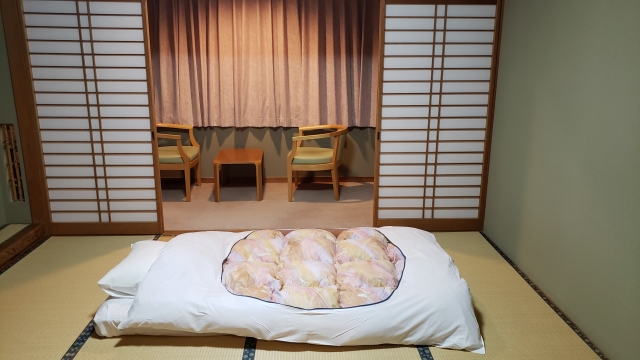
Then you go to the communal onsen, have a spectacular kaiseki dinner, wander around in your yukata feeling like a feudal lord. You return to your room — and the futon has appeared. The staff have quietly entered while you were at dinner and laid it out, complete with pillow and covers, in the center of the tatami space. The room has transformed from a daytime living room into a nighttime bedroom.
As the Selected Onsen Ryokan guide puts it: in the morning, if you have breakfast in your room, the staff will come and put the futon away for you — so you can leave it out after waking up without worrying about it.
This concept — a room that transforms between day and night — is one of the most fundamentally different ideas in Japanese spatial design. In Western homes, a bedroom is a bedroom. It has a bed in it. The bed stays. In traditional Japanese homes and ryokans, the same room can be a place to eat, to socialize, to practice calligraphy, and to sleep — just depending on what time of day it is.
For many visitors, this is not just a different sleeping arrangement. It’s a different philosophy of how space should be used.
❓ Should You Leave the Futon Out in the Morning at a Ryokan?
Great question, and one that causes genuine anxiety for first-time ryokan guests. The short answer: yes, it’s completely fine to leave the futon as-is in the morning.
If you have breakfast served in your room, the staff member (nakai) who brings your meal will fold and store the futon for you while you’re at the table — or after you finish. If you head out to breakfast in a dining room, the futon will typically be put away during that time. Either way, you don’t need to attempt to fold and store it yourself (though points for trying — it’s harder than it looks).
The staff are professionals. Futon-folding and room transformation is part of their art. Let them do it.
What you might want to do — especially if you’re staying multiple nights — is fold the covers loosely back from the mattress when you wake up, to let it air a little. This is what Japanese households do too: airing the futon is an important ritual, as moisture can build up from body heat overnight. On a sunny day, you’ll often see futons draped over apartment balcony railings across Japan, catching the breeze. It’s one of those charming, deeply practical Japanese habits.
Practical tip: If you’d prefer a Western-style bed, many modern ryokans now offer “wa-yo-shitsu” (Japanese-Western hybrid rooms) that combine tatami aesthetics with a raised bed. Just request this when booking — the Japan Guide’s ryokan room overview has a helpful breakdown of room types.
🌸 The Cultural Weight of Sleeping on the Floor
There’s one more dimension to the futon that goes beyond back support and storage efficiency. Sleeping on the floor — at the same level as everyone else in the household — carries a kind of quiet egalitarianism. When a family lays out futons side by side on a tatami floor, there’s no hierarchy of who gets the bigger mattress or the better pillow. Everyone is on the ground together.
There’s also something psychologically grounding (pun very much intended) about sleeping close to the earth. Many people who try tatami futon sleeping for the first time — myself included — report a sense of security, of being held by the floor rather than floating above it on a mattress. It’s subtle. It might even sound ridiculous if you’ve never tried it. But it’s real.
For centuries, ryokans have preserved the pairing of tatami and futon as a defining feature of Japanese hospitality. As CoCoRo’s cultural guide explains, by maintaining this style of accommodation, the hospitality industry has played a significant role in keeping futon culture alive — both for Japanese guests and international visitors discovering it for the first time.
✅ Summary: What to Know Before You Unfurl Your First Futon
Let’s wrap it up neatly, the way a good nakai wraps up a futon:
- Nearly half of Japanese homes still use futons — they’re not a museum piece, they’re a daily reality for millions of people.
- The futon-tatami combination is a system, built over centuries, that manages humidity, supports the spine, and maximizes living space.
- The word “futon” comes from a Buddhist meditation cushion — and the scent of tatami beneath it is genuinely calming.
- At a ryokan, your futon will be laid out by staff in the evening — you don’t need to do anything except enjoy the transformation of the space.
- In the morning, you can leave the futon as-is — staff will take care of folding and storing it for you.
- Sleeping on a futon may actually be better for your back than the cloud-like Western mattress you’re used to — especially if your mattress is too soft.
After years of bouncing between Georgian single beds, European hotel mattresses, and the occasional overnight train, I can say with full conviction: nothing beats the moment when you lay down on a freshly aired futon, pull the kakebuton up around your chin, and feel the faint scent of tatami rise up from below.
Japan figured something out a very long time ago. And the rest of the world is still sleeping on it.
Have you tried sleeping on a futon in Japan?
Did you love it — or spend the first night wondering where the bed was?
Tell me your experience


Share your thoughts