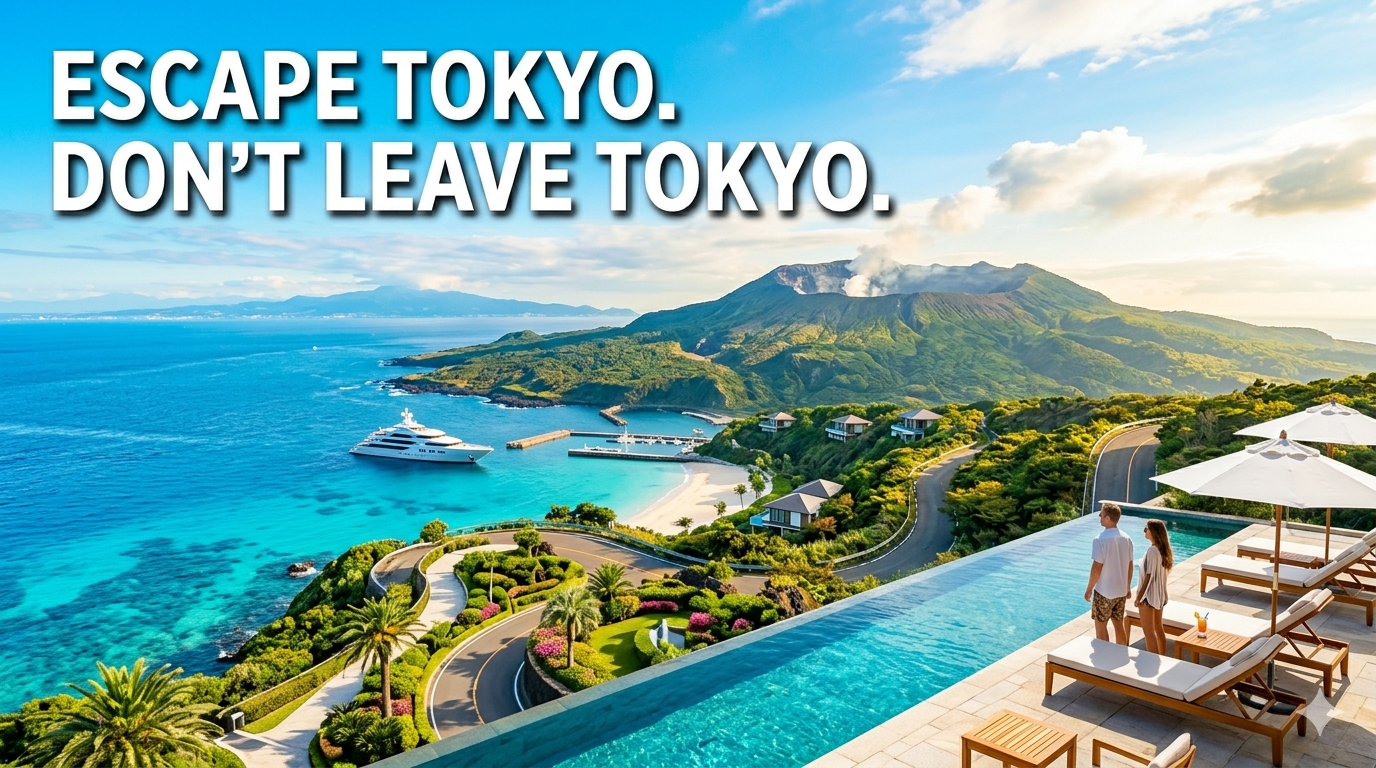
Let me guess. When someone says “Tokyo,” you picture neon signs, bullet trains, the Shibuya scramble crossing, and enough people to fill a small country. What you probably don’t picture is a volcanic island with black sand beaches, an outdoor hot spring facing the Pacific, and a stretch of terrain so otherworldly that Japan’s official maps actually label it a desert.
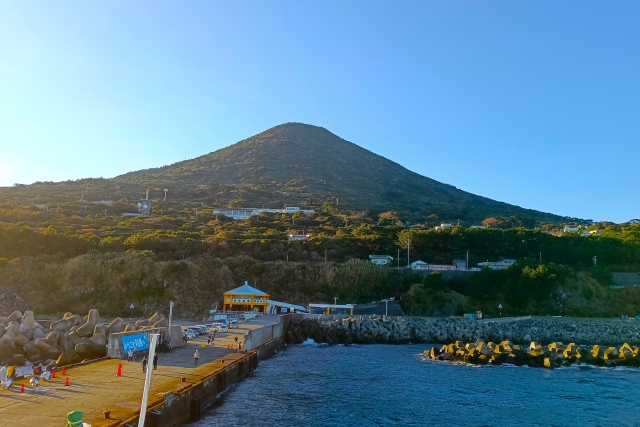
But here’s the thing — Izu Oshima (伊豆大島) is 100% Tokyo. It belongs to Tokyo Metropolis. It has a Tokyo zip code. And it is, without a doubt, one of the most surprising and rewarding day trips (or weekend escapes) you can take from the capital.
I’ve been here multiple times, and I still find it hard to believe this place exists just a short boat ride from one of the world’s busiest cities. So let me tell you everything you need to know to make it happen.
- 🌋 Wait — Tokyo Has an Island?
- 🚢 How to Get to Izu Oshima: Ferries, Schedules & Fares
- 🚴 Cycling the Sunset Palm Line: No Traffic Lights, No Stress
- ♨️ Onsen With an Ocean View (And No Awkward Nakedness)
- 🌿 Hammock Time: The Art of Doing Absolutely Nothing
- 🌑 Japan’s Only Desert: Welcome to Another Planet
- 🌺 Best Time to Visit Izu Oshima
- 🏝️ Practical Tips for First-Timers
- ✈️ Ready to Reset?
- 📌 Quick Reference
🌋 Wait — Tokyo Has an Island?
Yes. Actually, Tokyo has several islands. But Izu Oshima is the closest, the largest, and arguably the most spectacular. Located about 120 km south of central Tokyo in the Pacific Ocean, Oshima is a volcanic island with an active stratovolcano — Mount Mihara (三原山) — sitting right in the middle of it.
The island covers about 91 square kilometres and is home to roughly 7,000 people, a thriving camellia (tsubaki) flower industry, some of the best hot springs in the Kanto region, and — I promise I’ll explain this later — the only patch of land in Japan officially designated as a “desert” on a government map.
The feeling you get when the jet ferry pulls away from Takeshiba Pier in central Tokyo and you watch the skyline shrink behind you is genuinely magical. Within two hours, you’ve traded skyscrapers for lava fields. That contrast is exactly what makes Oshima so special.
🚢 How to Get to Izu Oshima: Ferries, Schedules & Fares
Getting to Oshima is half the fun — seriously. The main operator is Tokai Kisen (東海汽船), a company with over 120 years of history running ships to the Izu Islands. They offer two main types of vessels:
Option 1: High-Speed Jet Ferry (高速ジェット船) — The Recommended Choice
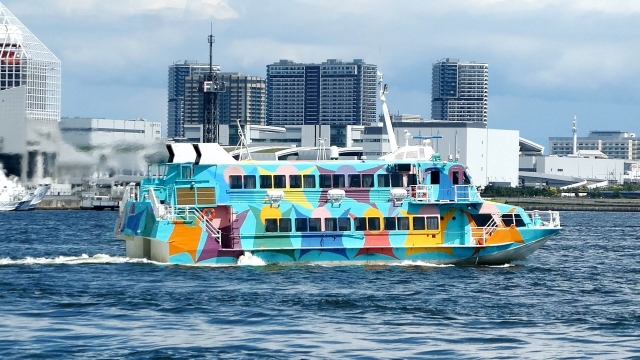
This is what you want for a day trip or a quick weekend visit. The jet ferry — officially called a “jetfoil” — is genuinely futuristic. It uses jet engines to take in seawater and blast it backward with enough force to lift the entire hull out of the water. You’re essentially flying, just very low, and very wet on the outside.
| Route | Travel Time | Approximate Fare (One Way) |
|---|---|---|
| Tokyo (Takeshiba) → Oshima | ~1 hour 45 min | ~¥9,800–¥10,800 |
| Atami → Oshima | ~45 min | ~¥6,500 |
Departures from Tokyo: Typically 2 departures per day from Takeshiba Pier (竹芝桟橋), near Hamamatsucho Station. More sailings are added during peak seasons (spring, Golden Week, summer). The first morning departure usually leaves around 8:10 AM.
Seasonal routes: During certain seasons, ferries also depart from Kurihama (Kanagawa), Tateyama, Atami, and Ito — which can be very convenient if you’re coming from outside central Tokyo.
⚠️ Important: The jet ferry does not run every single day of the year, and weather cancellations happen. Always check the official Tokai Kisen website before booking, especially in winter.
👉 Official Tokai Kisen website (EN): https://www.tokaikisen.co.jp/en/
👉 Timetable & Fares page: https://www.tokaikisen.co.jp/en/time_price/
Option 2: Large Passenger Ship (大型客船) — The Slow & Romantic Option
If you’re in no rush and want to wake up on the island, the large overnight ferry is a great choice. Ships like the Salvia Maru (さるびあ丸) depart Tokyo late at night and arrive at Oshima in the early morning — giving you maximum island time the next day.
| Route | Travel Time | Approximate Fare (Cheapest Class) |
|---|---|---|
| Tokyo (Takeshiba) → Oshima (overnight) | ~6–8 hours | ~¥6,000–¥7,000 |
This is the budget option, and honestly one of the cosiest ways to travel in Japan. Grab a tatami mat spot, stare up at the ceiling, fall asleep to the sound of the ocean. Very therapeutic. Definitely not for anyone prone to seasickness.
How to Get to Takeshiba Pier
Takeshiba Pier is extremely easy to reach from central Tokyo:
- Yurikamome Line: Takeshiba Station (竹芝駅) — the pier is right next to the station exit
- Toei Oedo Line / JR Yamanote Line: Hamamatsucho Station (浜松町駅), then about a 7-minute walk
The terminal building itself has ticket counters, waiting areas, vending machines, and toilets. You can buy tickets on the day if there’s availability, but during busy seasons book in advance online through the Tokai Kisen website.
A Note on Ports at Oshima
Oshima has two main ports: Motomachi Port (元町港) on the west coast, and Okata Port (岡田港) in the north. Which port the ferry uses each day is decided based on weather and sea conditions — and the decision is announced on the Tokai Kisen website, sometimes the morning of departure. Don’t worry too much about this: bus services from both ports connect to the main sights.
🚴 Cycling the Sunset Palm Line: No Traffic Lights, No Stress
One of the most liberating things you can do on Oshima is rent a bicycle and ride the Sunset Palm Line (サンセットパームライン) — a coastal road that hugs the western shoreline heading north from Motomachi. This is the kind of cycling that makes you feel like you’re in a movie.
The road is relatively flat along the coast, the sea breeze is constant, and here’s the kicker: there are almost no traffic lights on the island. For anyone who’s ever cycled in Tokyo and spent half their time waiting at intersections, Oshima’s roads feel almost irresponsibly free.
On clear days, you can see the Izu Peninsula and even Mount Fuji shimmering across the water. The combination of ocean views, sea air, and the gentle creak of a bicycle is — without exaggeration — one of the most peaceful things I’ve experienced in Japan.
Bike rental info: Available near Motomachi Port, typically around ¥600/hour or ¥1,500–¥2,000/day. Rental cars are also available if cycling isn’t your thing — pick-up is at Motomachi Port, and with prior arrangement, also at Okata Port or the airport.
💡 Tip: If you’re doing a day trip, plan your cycling in the morning before it gets warm, and leave the afternoon for onsen. You’re welcome.
♨️ Onsen With an Ocean View (And No Awkward Nakedness)
Let’s talk about the hot springs, because Oshima’s onsen scene is genuinely special — and particularly foreigner-friendly, thanks to one key detail: swimsuits are required.
Motomachi Hama-no-Yu (元町浜の湯)
This is the island’s most famous onsen, and for good reason. It’s an open-air, mixed-gender outdoor bath right on the coast, just a 4-minute walk from Motomachi Port. The water is clear and colourless, fed by volcanic springs that started flowing after Mount Mihara’s 1986 eruption. The minerals are said to relieve fatigue and improve skin — which sounds like marketing copy until you actually step out of the water and notice how silky your skin feels.
The view is the real star, though. You’re soaking in a hot bath while looking out at the Pacific Ocean, with Mount Mihara rising behind you. On a clear day, you can see the Izu Peninsula — and occasionally Mount Fuji itself. The most popular time is late afternoon, when the sun turns the ocean gold and starts to sink below the horizon. Go then if you can.
- Entry fee: ¥300 for adults, ¥150 for children (very affordable)
- Hours: 1:00 PM–7:00 PM (11:00 AM–7:00 PM in July and August) — hours may vary, check before visiting
- Swimsuit: Mandatory (both men and women)
- Note: Bring your own shampoo; soap is provided but shampoo is not
👉 GO TOKYO official listing: https://www.gotokyo.org/en/spot/981/index.html
There’s also a Gojinka Spa (御神火温泉) in Motomachi — a more modern indoor facility with various baths, a sauna, steam room, and even a jacuzzi. Entry is ¥700 at the door (or ¥500 if you buy a ticket at the office near the port). It closes at 9:00 PM.
And if you’re staying overnight, the Oshima Onsen Hotel (大島温泉ホテル) — run by Tokai Kisen — offers day-trip access to their outdoor baths with views of Mount Mihara, and is the island’s most atmospheric place to stay.
🌿 Hammock Time: The Art of Doing Absolutely Nothing
I want to make a case for something that might seem radical in today’s “optimize your itinerary” travel culture: doing nothing on purpose.
Oshima has a quiet, almost meditative quality that’s hard to put into words. The rhythm of the island is slower. People wave at you. The sound of cicadas or ocean waves fills the spaces between conversations. Some accommodations have hammocks, and if you find yourself horizontal, swaying gently, listening to the Pacific, with no Wi-Fi notifications demanding your attention — that is not wasted time. That is the entire point.
This is what the Japanese sometimes call shima jikan (島時間) — island time. The clocks don’t stop, but somehow they feel less urgent. If you’ve been grinding through Tokyo’s schedule — meetings, trains, crowds, decisions — Oshima will remind you what your nervous system actually feels like when it’s not on high alert.
Pack a book. Bring a light jacket for the sea breeze. Find a bench overlooking the ocean. Be aggressively unhurried. You can go back to being efficient on Monday.
🌑 Japan’s Only Desert: Welcome to Another Planet
Now for the wildcard — the thing that makes even people who’ve lived in Japan for years do a double take.
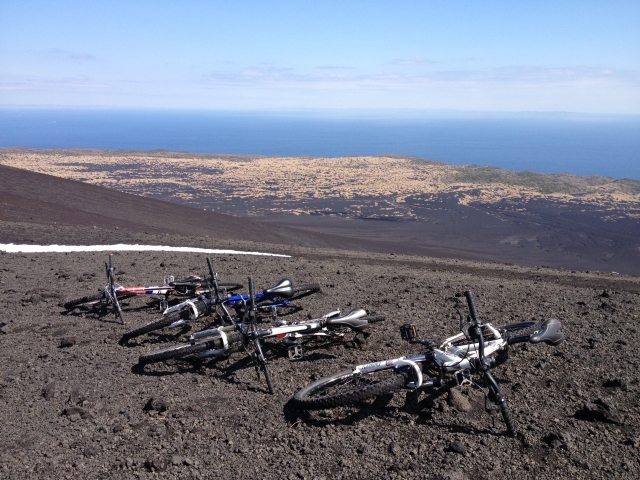
On the eastern flank of Mount Mihara, there is an area called Urasabaku (裏砂漠). “Sabaku” means desert. And yes, it is officially listed as a desert on maps produced by Japan’s Geospatial Information Authority (国土地理院) — making it the only location in Japan designated as a desert on official government maps.
It’s not sandy like the Sahara. Instead, it’s a vast expanse of black volcanic rock and volcanic scoria — hardened lava from the 1986 eruption — stretching across the landscape in total silence. No vegetation. No colour. Just black terrain under a wide sky. The contrast with lush green forest just minutes away is genuinely surreal.
Standing in the middle of it, you’d be forgiven for thinking you were on the moon. Or Mars. Or the set of some sci-fi film that never made it out of post-production. The photos come out incredible, especially on overcast days when the grey sky meets the black rock and everything looks like a monochrome painting.
How to get there: The Urasabaku area is accessible from the Mount Mihara trail system. You can hike up from the base, or take a bus to the Mount Mihara trail entrance. A full circuit of the caldera rim takes about 45–60 minutes once you’re at the top. The views into the active crater are sobering — in the best possible way.
💡 Fun fact: Mount Mihara last had a significant eruption in 1986, when lava overflowed the summit caldera and flowed down the northwestern slopes, forcing the evacuation of over 10,000 residents. Tokai Kisen — the same company running your ferry today — helped coordinate that evacuation. The lava hardened into the terrain you can now walk on. Geology is wild.
🌺 Best Time to Visit Izu Oshima
Oshima is a year-round destination, but certain seasons offer distinct experiences:
Winter & Early Spring (January – March): Camellia Season
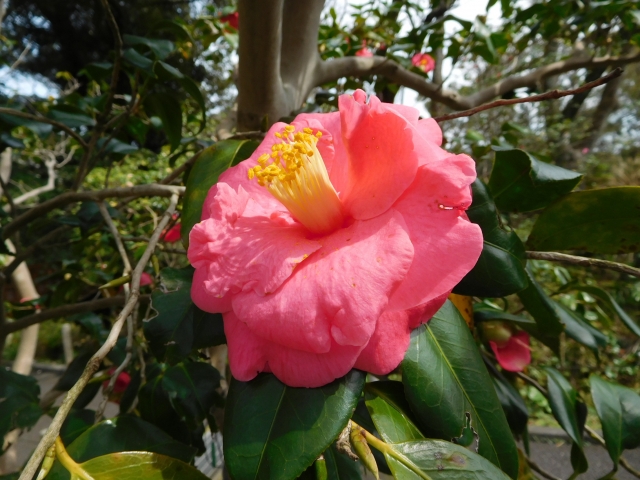
This is Oshima’s signature season. The island is famous for its camellia flowers (椿, tsubaki), and during this period the hillsides and roadsides blaze with red and pink blossoms. Oshima Park (大島公園) has around 450 varieties of camellia — more than almost anywhere else in the world. An annual Camellia Festival (椿まつり) is held from late January through late March. It’s surprisingly moving, and the island isn’t crowded. Cold but beautiful.
Spring & Autumn (April–May, September–November): Cycling Weather
These are arguably the best months for general sightseeing and cycling. Temperatures are comfortable, the sky is often clear (great for Mount Fuji views), and the crowds are manageable. Spring also brings azaleas around the Mount Mihara trails.
Summer (June–August): Beach & Festival Season
The beaches at the northern and western coasts open for swimming and snorkelling. The black sand beaches are striking — volcanic basalt gives the sand its dark colour, which holds heat longer than white sand, so be careful on sunny days. Summer is the busiest season; book ferries and accommodation well in advance.
🏝️ Practical Tips for First-Timers
Getting Around the Island
- Rental bikes: Best for the coast and shorter routes. ~¥600/hour or ~¥1,500–2,000/day near Motomachi Port.
- Rental cars: Best for reaching Mount Mihara and the southern parts of the island. Available at Motomachi Port; arrange in advance if picking up at Okata Port.
- Buses: Oshima Bus services connect the main ports and tourist spots, with schedules timed to ferry arrivals. Useful but limited in frequency.
- Taxis: Available; a ride between Motomachi and Okata is approximately ¥2,400.
Food to Try
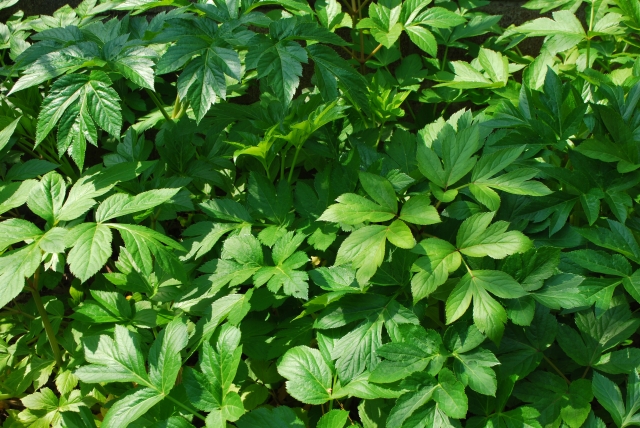
Ashitaba (明日葉) is the island’s signature ingredient — a bitter, fast-growing plant used in everything from tempura to soba to tea. You’ll see it everywhere. It’s an acquired taste, but try it at least once. The island is also known for its fresh seafood, including kinmedai (splendid alfonsino) and handmade べっこう寿司 (bettō-zushi), a local sushi style using a sweet soy-based sauce.
Accommodation
For overnight stays, Oshima has options from family-run pensions (民宿, minshuku) to the mid-range Oshima Onsen Hotel. Budget accommodation fills up fast on summer weekends — book early. The Oshima Onsen Hotel staff will even meet you at the port if you arrive on the afternoon jetfoil, which is a very charming touch.
Money & ATMs
There’s a post office ATM next to Motomachi Port with international card support, open weekdays 9:00–18:00 and weekends 9:00–14:00. Bring some cash — many smaller shops and restaurants on the island are cash-only.
Flying Instead
ANA operates flights from Haneda Airport to Oshima Airport in about 35 minutes. It’s faster than the ferry, but more expensive and less atmospheric. The ferry journey is genuinely part of the experience — don’t skip it if you can help it.
✈️ Ready to Reset?
Izu Oshima isn’t a place that asks much of you. You don’t need a detailed itinerary, a specific gear list, or a reason beyond “I need to be somewhere that doesn’t feel like an email inbox.” The island does the work. You just show up, let the ferry take you there, and try to remember what it feels like to exist without an agenda.
If you’ve been in Tokyo for a while and something feels slightly frayed — that specific urban exhaustion that comes from too much concrete and too little sky — Oshima is the fix. It’s close enough to be impulsive, different enough to feel like a real journey, and calm enough to actually work.
The volcano is optional. The hammock is mandatory.
📌 Quick Reference
| What | Details |
|---|---|
| Ferry operator | Tokai Kisen (東海汽船) |
| Departure point (Tokyo) | Takeshiba Pier (竹芝桟橋), near Hamamatsucho |
| Journey time (jet ferry) | ~1 hour 45 min from Tokyo; ~45 min from Atami |
| Jet ferry fare (one way) | ~¥9,800–¥10,800 from Tokyo; ~¥6,500 from Atami |
| Large ship fare (cheapest class) | ~¥6,000–¥7,000 from Tokyo (overnight) |
| Tokai Kisen English site | tokaikisen.co.jp/en |
| Hama-no-Yu onsen | ¥300 adult; swimsuit required; 1 PM–7 PM (summer 11 AM) |
| Bike rental | ~¥600/hour or ¥1,500–2,000/day near Motomachi Port |
| Best season | Jan–Mar (camellias); Apr–May & Sep–Nov (cycling/hiking) |
Ferry schedules and fares change seasonally. Always confirm the latest timetable and prices on the official Tokai Kisen website before booking.


Share your thoughts